










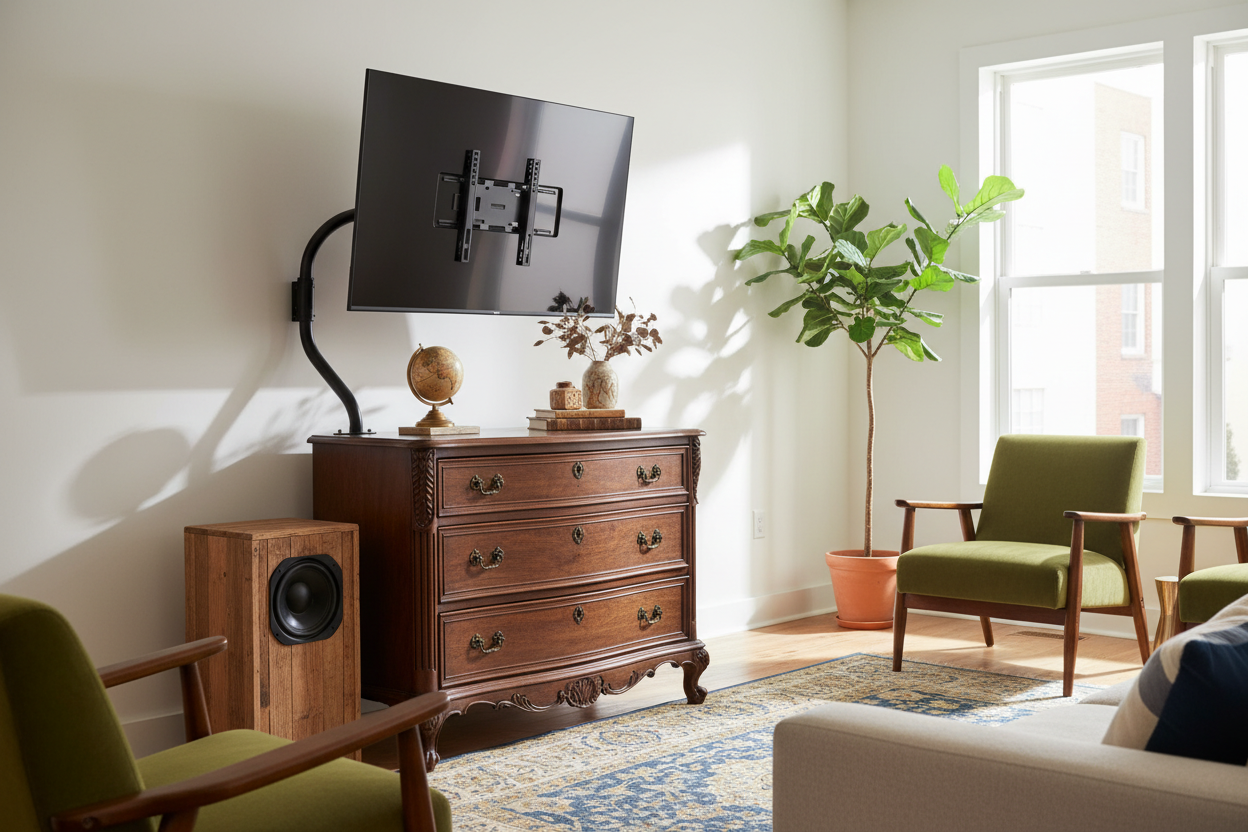
I spent three months scouring estate sales for the perfect mid-century sideboard, only to realize my 65-inch TV looked like a tech-bro intruder sitting on top of it. Those factory-issued plastic 'chicken feet' legs are a crime against interior design. They are wide, they are ugly, and they take up every square inch of surface space I wanted for my lamp and ceramics.
I did not want to drill into my drywall—I am a renter and my landlord has a 'no holes' policy that borders on obsessive. Instead, I decided to experiment with a furniture tv mount. By attaching a specialized bracket directly to the back of the wood, I got the floating look I wanted without sacrificing my security deposit or the integrity of my vintage find.
Quick Takeaways
- Solid wood is non-negotiable; particle board will crumble under the weight of a heavy screen.
- Use a universal pillar mount that clamps or bolts to the back frame of the piece.
- Always pre-drill your holes to prevent 70-year-old wood from splitting.
- Hide your cables behind the vertical mount for a clean, professional finish.
The 'Beautiful Credenza, Ugly TV Base' Dilemma
We have all been there: you find a gorgeous vintage piece, but the modern screen ruins the vibe. When I was styling a retro 1960s TV stand, I realized that the scale of today’s TVs is the biggest hurdle. A 55-inch screen on a delicate credenza looks top-heavy and clumsy.
Standard TV legs are usually spaced so wide they barely fit on the top surface. This forces the screen forward, leaving no room for decor. A mount that attaches to the furniture itself solves this by lifting the screen a few inches up, creating a 'floating' effect that lets the furniture breathe.
Can Any TV Mount Attach to Furniture? (The Weight Test)
Before you get the drill out, you need to be honest about what your furniture is made of. If you are working with a heavy rustic furniture TV stand made of solid oak or pine, you are in the clear. These pieces have the structural 'meat' to hold a heavy bracket.
If your piece is from a big-box flat-pack store, stop now. To tv mount to furniture safely, you need a frame that will not shear. Particle board and MDF are essentially compressed sawdust and glue; they have zero lateral strength. If you try to bolt a 40-pound TV to a 1/2-inch MDF backer, it will snap like a cracker the moment you let go.
Checking Your Furniture's Back Panel
Most dressers have a thin, flimsy piece of plywood or cardboard tacked onto the back. You cannot mount to this. You need to locate the vertical 'stiles' or the horizontal 'rails'—the thick wooden skeleton of the piece. Use a flashlight to see where the side panels meet the back. This is where you will want to tv mount attach to furniture.
How to Actually Make a TV Mount Attach to Furniture Safely
I chose a universal pillar-style mount. These look like a single vertical pole with a VESA plate on top. Instead of mounting to the wall, the base of the pole is designed to be bolted through the back of a cabinet. I measured twice and cried once, drilling two clean holes through the back frame of my dresser.
The trick is using 'fender washers' on the inside. These are wide, flat metal rings that distribute the pressure of the bolt over a larger surface area. Without them, the bolt head might eventually pull through the wood. Once I tightened the nuts, the mount was rock solid. I even did a careful shake test to ensure there was no wobbling.
For cable management, I used zip ties to run the power and HDMI cords down the back of the metal pillar. From the front, the TV looks like it is hovering magically four inches above the dresser top. I finally have room for my favorite books and a small tray for remotes without everything feeling cluttered.
When to Give Up and Buy a Real Media Console
Sometimes, the antique is just too precious or too fragile. If your dresser has thin, spindly legs or the wood is showing signs of rot, do not risk it. A falling 65-inch TV is a safety hazard and an expensive mistake. In those cases, it is smarter to pivot to a modern TV stand with cabinets that mimics the vintage look but offers the steel-reinforced support you need.
There is no shame in admitting a DIY project is beyond the scope of the material. If you are worried about ruining a family heirloom, browse through some purpose-built TV stands instead. You can find plenty of options that respect the mid-century aesthetic without requiring you to drill holes into a piece of history.
FAQ
Will this ruin the value of my antique?
Technically, any modification can lower the value for serious collectors. However, if you are drilling into the back frame (which is rarely seen), the impact is minimal compared to the utility you gain.
Can I use a regular wall mount on furniture?
Generally, no. Wall mounts are designed to pull against wall studs. Furniture mounts are designed for clamping or through-bolting. A wall mount attached to a thin dresser back will likely fail.
How much weight can a furniture mount hold?
Most are rated for 60 to 80 pounds, but the real limit is your furniture's stability. If the dresser is shallow, a heavy TV might make the whole thing tip forward. Always use an anti-tip kit to anchor the furniture to the wall for safety.


Dejar un comentario
Este sitio está protegido por hCaptcha y se aplican la Política de privacidad de hCaptcha y los Términos del servicio.