










I remember staring at my living room wall for three hours, holding a stud finder that kept beeping at nothing, while my 65-inch OLED sat precariously on a stack of coffee table books. I wanted that floating look, but my landlord treats a single nail hole like a felony. That's when I finally caved and looked for a contemporary tv stand with mount. I was terrified it would look like something pulled out of a corporate board room, but the reality of modern furniture design actually surprised me.
The fear, of course, is that your living room will end up looking like a Marriott conference room or a hospital waiting area. We've all seen those clunky metal carts that scream 'corporate presentation.' But after testing a few units in my own 12x15 apartment, I realized the tech has actually caught up to the aesthetic. You can get the height, the clean lines, and the safety without turning your home into an office.
- No holes in the wall: Perfect for renters or anyone with crumbling plaster walls.
- Adjustable height: You can finally stop straining your neck by propping the TV too low.
- Built-in cable management: No more 'spaghetti' wires hanging down behind the console.
- Small footprint: These take up significantly less visual space than a chunky 24-inch deep credenza.
The 'Conference Room' Stigma (And Why It's Over)
For years, modern tv stands with mount were basically industrial equipment. They were heavy, grey, and had those giant locking casters that belong in a warehouse. If you wanted your TV off the table, you either drilled into the wall or you accepted the 'Best Buy floor display' look. That's just not the case anymore. Design-forward brands have realized that we want the 'floating' look without the structural commitment of a 50-pound wall bracket.
Today’s silhouettes are incredibly slim. Designers are using powder-coated steels and integrated wood panels to soften the look. Instead of a thick, ugly pole, you get a streamlined spine that often sits flush against the wall. It mimics the look of a wall-mounted screen without the risk. I’ve seen versions with glass shelving and even fabric-wrapped back panels that blend right into a Scandi-style room. The 'office' vibe only happens if you settle for the cheapest, most basic metal stand you can find on a clearance rack. If you choose a piece with intentional lines, it looks like a curated design choice rather than a temporary fix.
Why I Bypassed the Drywall Drill
I once tried to mount a heavy bracket in an old pre-war apartment. Two hours and four 'oops' holes later, I realized the studs weren't where they were supposed to be, and I was looking at a lost security deposit. Switching to a hybrid unit from a collection of modern TV stands changed my entire layout strategy. I could move the TV six inches to the left without needing a patch kit and a bucket of paint. It’s the ultimate zero-damage alternative for those of us who like to rearrange our furniture every six months.
Beyond the safety of my walls, there's the height factor. Most standard consoles are about 18 to 22 inches high. If you have a 65-inch or 75-inch screen, that puts the center of the image way below eye level, especially if you're sitting on a modern sofa with a standard 17-inch seat height. A stand with an integrated mount lets you hover that screen at the sweet spot—usually about 42 inches from the floor to the center of the screen—without needing a massive piece of furniture to prop it up. It makes the room feel airier because you can see more of the floor, which is a classic trick for making small apartments feel like they have more square footage than they actually do.
Material Matters: Avoiding the Plastic Trap
If you buy a unit that’s all high-gloss plastic and cheap chrome, it’s going to look like a tech lab. To keep things cozy, look for matte finishes. A stylish black TV stand is a solid choice because the dark metal of the mounting pole disappears against a dark wood or charcoal finish. It’s a classic trick: if you can’t hide the hardware, make it blend into the shadow of the unit itself. This creates a moody, monochromatic look that feels expensive rather than utilitarian.
Be careful with white finishes, though. If the paint is too shiny or the edges are rough, it looks like cheap office furniture from the 90s. I’ve written before about why your modern white TV stand looks cheap, and it usually comes down to the texture of the materials. Stick to eggshell or matte whites, or better yet, a light oak that brings some organic warmth to the metal components. You want the piece to feel like furniture first and a tech accessory second. Avoid anything with visible silver bolts on the front—that's a dead giveaway of a low-quality build.
Hiding the Wires Like a Professional
The biggest mistake I see is people buying a mounting stand and then letting the power cords dangle behind the pole. It ruins the 'floating' illusion instantly. You need a unit with a hollow spine or at least high-quality clips along the back. I’m a fan of the mid century modern TV stand style because it often combines that warm wood aesthetic with discrete internal channels for your HDMI and power cables. If the wires are tucked inside the mounting column, the whole setup looks like a custom architectural install.
When I set up my current rig, I used Velcro ties instead of plastic zip ties. It makes it much easier when you inevitably decide to swap out a gaming console or add a soundbar. If your stand doesn't have a wide enough spine to hold four or five thick cables, look for 'flat' HDMI cables—they tuck away much more easily than the standard round ones. Also, remember to leave a little bit of slack at the top so you can still tilt or swivel the TV without yanking the ports out of the back of your screen.
How to Style the 'Floating' Gap
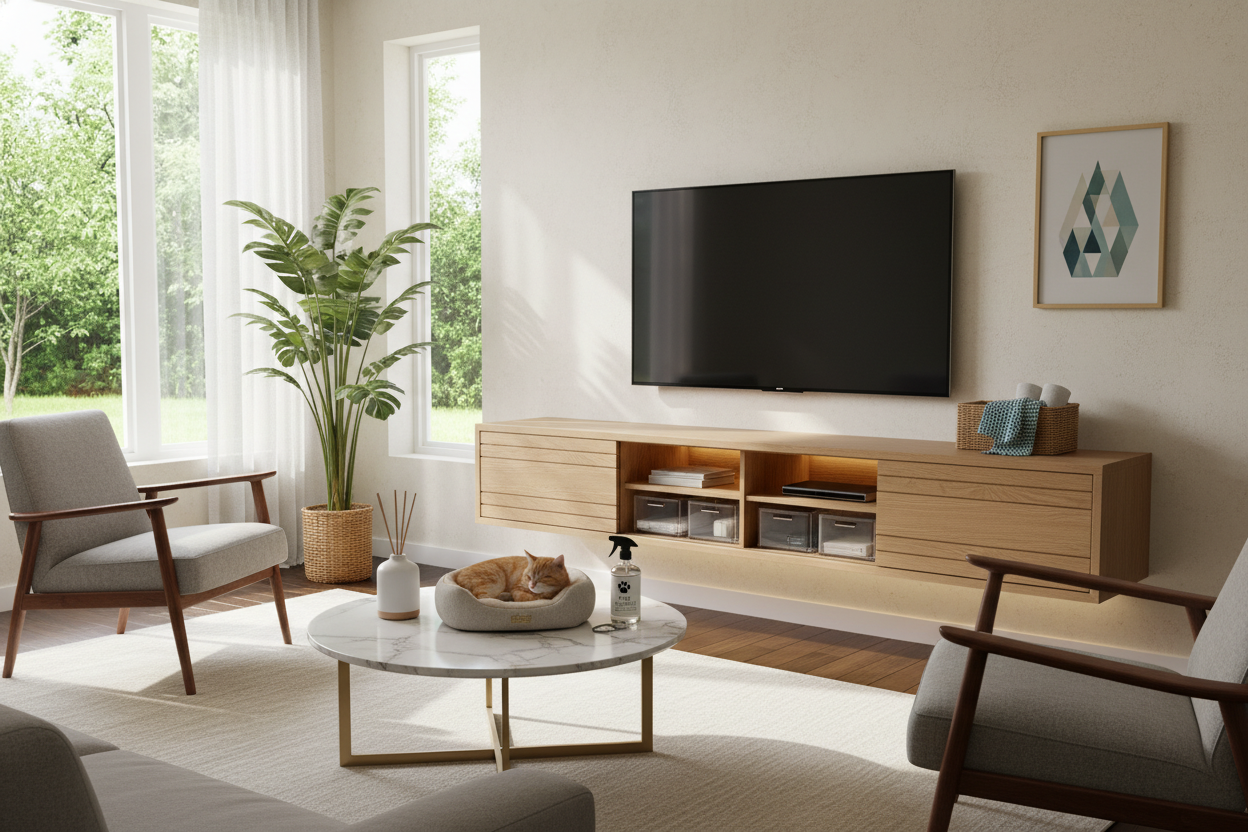
Once your TV is hovering, you’re left with a gap between the bottom of the screen and the top of the console. This is the danger zone where things can look a bit 'stark' if you don't handle it right. Don't leave it empty, but don't clutter it either. I like to place a low-profile soundbar directly under the screen, which helps ground the floating element and hides the very top of the mounting bracket. It bridges the physical gap between the tech and the furniture.
On the surface of the stand itself, go for horizontal items. Think a stack of oversized art books, a long wooden tray, or a few ceramic bowls. Avoid tall vases or lamps that will overlap with the screen and create visual noise—there is nothing more annoying than a lampshade blocking the bottom corner of your favorite movie. You want the eye to move across the console, not get stuck on a silhouette that's fighting with your screen. Keep the decor about 2-3 inches shorter than the bottom of the TV for the cleanest look. This keeps the 'floating' effect intact while making the unit feel lived-in and intentional.
FAQ
Are these stands stable for heavy TVs?
Yes, provided you check the weight rating before buying. Most modern units are built with a heavy steel base or are designed to be weighted down by the weight of the console and the items inside it. I've never had one even wobble, even with a 75-inch beast attached, as long as it's assembled correctly on a level floor.
Will it fit any TV brand?
Almost all of them use standard VESA patterns, which are the four bolt holes on the back of your TV. Just check your TV's manual or measure the distance between those holes. If they match the stand's specs, you're good to go. Most stands come with a variety of bolt sizes to accommodate different brands.
Can I adjust the height later?
Usually, yes. Most mounts have several 'hooks' or bolt positions on the bracket. It’s a two-person job to lift the screen off and move it, but it only takes about five minutes. This is great if you buy a new sofa that sits higher or lower than your old one.


Dejar un comentario
Este sitio está protegido por hCaptcha y se aplican la Política de privacidad de hCaptcha y los Términos del servicio.