










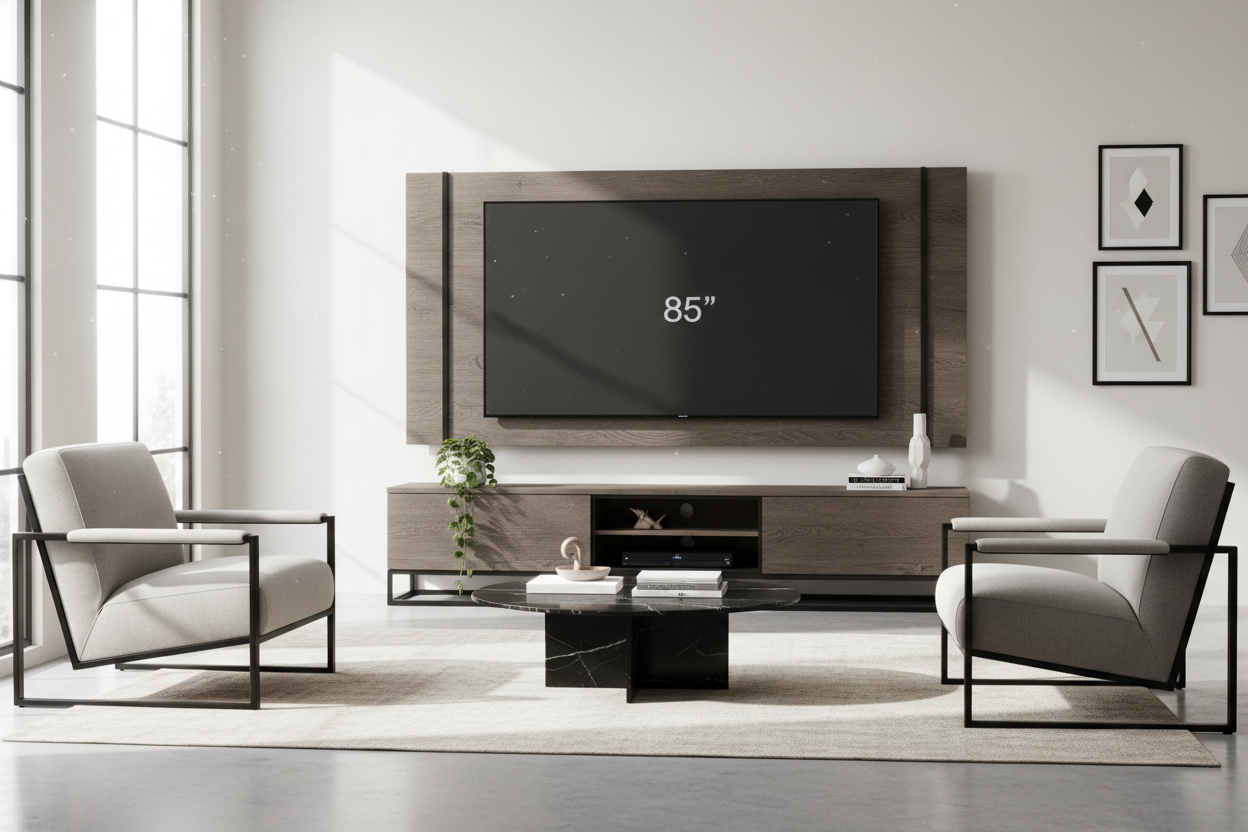
I spent three weeks staring at a massive 85-inch TV sitting on the floor because every console I found looked like it belonged in a college dorm. When you go big on the screen, the furniture has to keep up or the whole room feels off-balance. I’ve seen enough sagging particle board in my life to be skeptical, but I finally bit the bullet on the sabala entertainment center for tvs up to 85 to see if it could actually handle the weight.
- Build Time: 2 hours (with help).
- Weight Capacity: Rock solid with no visible bowing.
- Storage: Deep enough for bulky AV receivers.
- Finish: High-quality laminate that resists scratches better than real softwoods.
The Giant Screen Dilemma (And Why I Chose Sabala)
Buying a huge TV is the easy part. Finding a place to put it without making your living room look like a Best Buy showroom is where the nightmare begins. Most standard stands stop at 65 or 70 inches. If you put an 85-inch screen on a 70-inch stand, the overhang makes the TV look like it’s about to tip over, and it visually shrinks your room. I needed something with a wide footprint that didn't cost as much as the TV itself.
The sabala entertainment center caught my eye because it actually scales with the tech. It’s not just a stretched-out version of a smaller unit; it has the structural reinforcements needed for these modern behemoths. I’ve owned ‘luxury’ units that wobbled if you walked too fast. This one promised a level of stability that my 90-pound Sony X90L desperately needed. It’s about creating a focal point that feels intentional, not like an afterthought.
I chose the Sabala because the proportions felt right. It’s low enough to keep the screen at eye level—crucial for avoiding neck strain—but substantial enough to anchor the wall. If you’re tired of your tech dominating the room in a bad way, this specific unit is designed to bridge that gap between ‘tech-heavy’ and ‘homey.’
Unboxing and the Dreaded Assembly Process
Let’s be real: shipping a piece of furniture this large is a logistical feat. The sabala tv stand arrived in a box that weighed nearly 130 pounds. Do not, under any circumstances, try to drag this up a flight of stairs by yourself. I made that mistake and my lower back is still filing a formal protest. You need a second person just to get the parts out of the box without snapping a dowel.
The instructions were surprisingly decent. I’ve dealt with manuals that looked like abstract art, but these were logical. Each piece was labeled with a sticker that actually stayed on, and the hardware was sorted into individual bags. It took my partner and me about two hours from opening the box to sliding it against the wall. A pro tip: use your own screwdriver. The little ones they include are fine for tiny hands, but a full-sized grip will save your palms from blisters.
One thing that surprised me was the lack of ‘mystery screws’ at the end. Usually, there’s a handful of hardware left over that makes you wonder if the whole thing will collapse in your sleep. Here, everything had a home. The back panels, which are usually the flimsiest part of flat-pack furniture, actually screwed in rather than using those annoying tiny nails that always bend. It felt like a win before I even put the TV on it.
Build Quality: Will It Sag in the Middle?
The biggest fear with any long-span furniture is the middle-bow. You set up your beautiful living room, and three months later, the center of the stand is dipping like a hammock. I’ve seen it happen to $800 units. To test the sabala tv stand, I didn’t just put the TV on it; I loaded the cabinets with my heavy vinyl collection and a vintage amplifier that weighs more than a small child.
Structural integrity comes down to the center support legs. The Sabala uses a multi-leg system that distributes the weight across the floor rather than just the corners. After a month of holding up my 85-inch screen, I put a level across the top. It’s still dead straight. The high-density engineered wood used here is denser than the cheap stuff you find at big-box retailers, which helps prevent that creeping fatigue over time.
The doors also stay aligned. On cheaper stands, the weight of the TV can slightly warp the frame, causing the cabinet doors to stick or hang crooked. These have remained perfectly flush. If you’re worried about your expensive electronics ending up on the floor, this build quality offers some much-needed peace of mind. It feels like a tank disguised as a mid-century modern credenza.
How It Looks In a Real Living Room
Visual scale is everything. You might worry Is a TV Stand Up to 88 Inches Too Big for a Normal Room?, but when you’re dealing with a screen this size, you actually need the extra width to create a sense of balance. The Sabala is wide enough that you can actually place a couple of small decorative items or speakers on either side of the TV without it feeling cluttered. It frames the screen rather than just holding it up.
The finish is a matte wood grain that doesn’t reflect the glare from the TV, which is a detail most people overlook until they’re trying to watch a dark movie. Compared to a standard stylish black TV stand entertainment center, the Sabala has a bit more warmth and texture. It doesn't look like plastic. In my living room, which has a mix of walnut and oak, it blended in without looking like a mismatch.
It’s a large piece of furniture, no doubt about it. But because it sits relatively low to the ground and has clean lines, it doesn't swallow the room. It actually made my living room feel larger because it replaced a taller, bulkier unit that was half the width. It draws the eye horizontally, which is an old interior design trick to make a space feel more expansive. It’s the difference between a room that looks messy and one that looks curated.
Storage and Cable Management Reality Check
If you’re a gamer or a home theater nerd, you know the struggle of the ‘cable nest.’ Most stands have one tiny hole in the back that you’re supposed to cram six HDMI cables, three power bricks, and an ethernet cord through. The sabala tv stand for tvs up to 85 actually has thoughtful cutouts. I managed to hide a PS5, an Xbox, and a mesh router inside the cabinets without any wires peeking out from the sides.
Airflow is the other big concern. Electronics get hot. I was worried the closed cabinets would turn my consoles into expensive ovens. However, the internal shelving is adjustable, and there’s enough clearance behind the shelves for air to circulate. I’ve run the PS5 for four-hour sessions with the doors closed, and while it gets warm, it’s nowhere near the ‘emergency shutdown’ levels I’ve experienced with shallower cabinets.
The drawers are surprisingly deep, too. I’m using one for controllers and the other for those random charging cables that everyone seems to accumulate. It’s nice to have a place to hide the clutter. The magnetic catches on the doors are strong enough to keep them shut but don’t require a massive tug to open. It’s these small functional details that make it feel like a piece of furniture you can actually live with daily.
The Verdict: Should You Buy It?
If you’ve invested in a massive screen, don't undercut the experience with a flimsy stand. The Sabala is a workhorse. It’s sturdy, it looks significantly more expensive than its price tag suggests, and it actually solves the cable management problems that plague most modern setups. It’s perfect for the person who wants a clean, ‘grown-up’ living room without spending three grand at a high-end boutique.
The only downside is the assembly weight and the time commitment. If you’re not handy or you live alone on the fourth floor of a walk-up, you might want to pay for assembly. But once it’s up, it’s not going anywhere. If you’re still on the fence or realized you might need something for a slightly different layout, you can browse the full entertainment center collection to find your match. For my 85-inch beast, though? This was the right call.
FAQ
Will an 85-inch TV actually fit?
Yes. The stand is designed with a width that ensures the feet of most 85-inch TVs sit securely with several inches to spare on either side. Just double-check your TV's specific stand width, as some ‘legs’ are wider than others.
Is the back finished?
The back is finished in a matching color, but it’s clearly the ‘back side’ with visible screws and cable holes. It’s designed to sit against a wall, not in the middle of a room as a divider.
How do you clean the surface?
A damp microfiber cloth is all you need. Avoid harsh chemical sprays or furniture wax, as the laminate finish doesn't absorb oils like natural wood and can become streaky.


Dejar un comentario
Este sitio está protegido por hCaptcha y se aplican la Política de privacidad de hCaptcha y los Términos del servicio.