










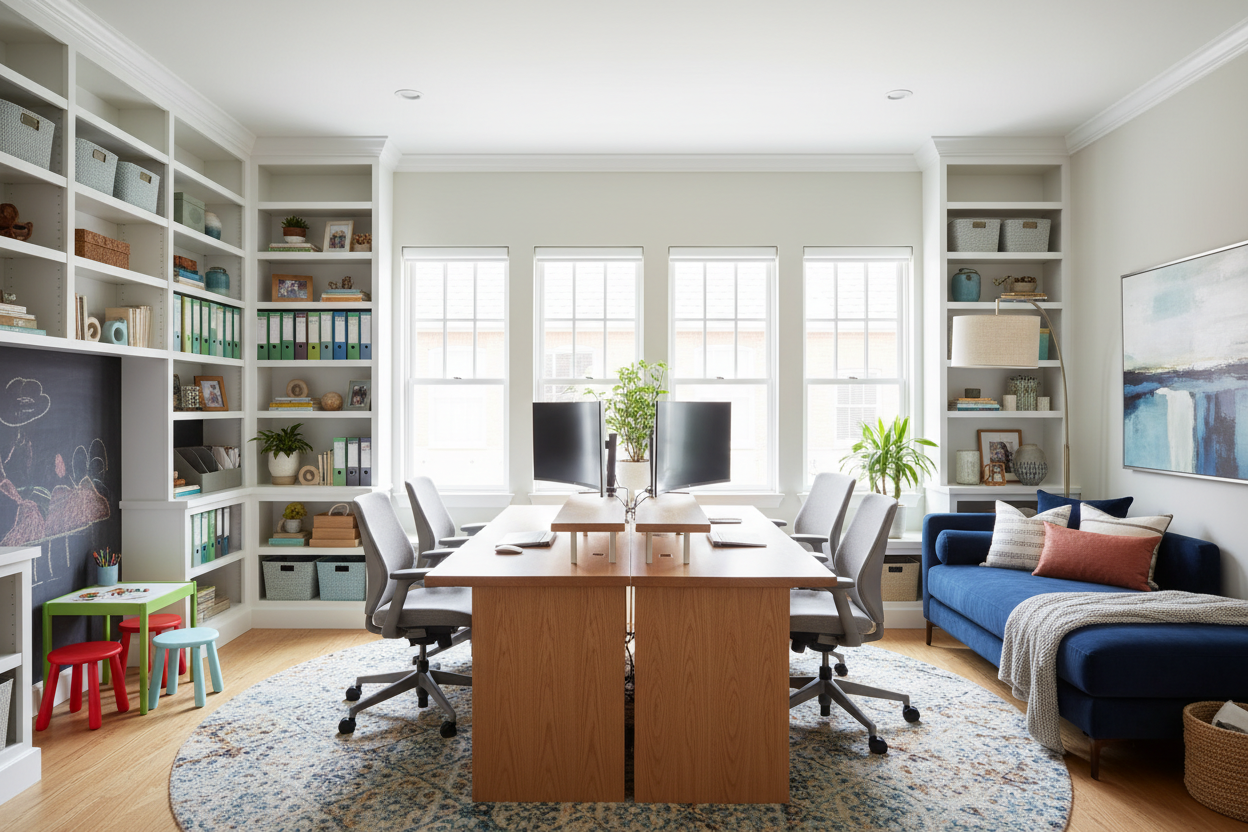
The era of the secluded, silence-only study is rapidly evolving. Today, the challenge isn't just finding a place to work; it is creating a multi-functional hub where remote work deadlines coexist with homework sessions and creative projects. Implementing successful family home office ideas requires a shift in perspective—moving away from a single-user mindset to a collaborative, zoned approach.
Quick Decision Guide: Key Features to Look For
If you are planning a shared workspace, prioritize these four elements to ensure longevity and productivity:
- Zoning Capability: Look for layouts or furniture that create visual boundaries between 'focus zones' (adult work) and 'creative zones' (kids' activities).
- Surface Durability: Opt for High-Pressure Laminate (HPL) or linoleum desk surfaces over softwoods; they resist scratches and marker stains significantly better.
- Acoustic Management: Incorporate soft furnishings, rugs, or acoustic wall panels to dampen sound transfer in a shared room.
- Scalable Storage: Choose modular shelving that offers closed cabinetry for sensitive documents and open bins for school supplies.
Mastering the Layout: The Art of Zoning
The biggest failure point in family office ideas is treating the room as one homogeneous space. In interior design, we utilize 'spatial zoning' to dictate behavior. For a family office, you need distinct territories.
The Command Position vs. The Nook
For the primary adult workstation, position the desk in the 'command position'—facing the door but not directly in line with it. This reduces subconscious anxiety and improves focus. Conversely, home office ideas for families often benefit from placing children's workstations against a perpendicular wall or in a built-in nook. This orientation difference minimizes eye contact during deep work sessions, reducing distractions for both parties.
Material Matters: Durability Meets Aesthetics
When selecting furniture for a high-traffic shared space, the finish is just as important as the silhouette.
Desktops and Surfaces
While a solid walnut desk is stunning, it is a liability in a room shared with children. Softwoods and open-grain veneers trap dust and are susceptible to indentations from aggressive writing. I often steer clients toward Fenix NTM (a matte nanotech material) or high-quality linoleum toppings. These materials are self-healing against micro-scratches, offer a soft tactile feel, and are incredibly easy to clean without looking industrial.
Performance Upholstery
For seating, specifically lounge chairs or reading corners within the office, avoid standard cotton blends. Look for 'performance velvets' or fabrics treated with Crypton technology. These allow you to maintain a luxury aesthetic without fearing the inevitable juice spill or ink smudge.
Ergonomics for Varying Heights
One of the most overlooked aspects of family office ideas is the ergonomic disparity between users. A standard 29-inch desk height is suitable for an adult but creates poor posture for a child.
Invest in height-adjustable desks (sit-stand mechanisms). For younger children, use a 'grow-with-me' chair that includes a footring. This ensures their feet are supported, which stabilizes their core and actually improves their attention span during homework. Visual balance is maintained by keeping the chair finishes consistent, even if the scales differ.
Lighting and Ambiance
Lighting defines the mood. Avoid relying solely on a central overhead fixture, which creates harsh shadows and eye strain. Instead, layer your lighting:
- Task Lighting: Articulating desk lamps with adjustable color temperatures (cool for focus, warm for reading).
- Ambient Lighting: Floor lamps with linen shades to soften the room's edges.
- Accent Lighting: LED strips in bookshelves to highlight decor and reduce the visual weight of heavy cabinetry.
Lessons from My Own Projects: The "Veneer" Regret
I learned the hard way about material selection early in my career while designing a workspace for a client with two elementary-aged children. We selected a beautiful, open-pore white oak veneer for a custom wrap-around desk, aiming for a 'Scandi-minimalist' look.
It was a visual triumph—for about three weeks. I visited a month later and noticed faint, dark grooves in the wood grain. The kids had been pressing hard with ballpoint pens on single sheets of paper, and the pressure transferred through the paper, permanently indenting the soft veneer. Worse, marker ink had wicked into the open grain and was impossible to remove without sanding the finish off.
Since then, my personal take on family home office ideas always involves a "haptic test." If I can press a fingernail into the wood and leave a mark, it doesn't belong in a kid's zone. Now, I almost exclusively use desktop linoleum for shared surfaces. It absorbs the pressure of writing, feels warmer to the touch than wood, and simply wipes clean. It’s a practical compromise that saves the furniture and the parents' sanity.
Creating a Space That Lasts
Designing a shared office is about anticipating the chaos of daily life and meeting it with robust, elegant solutions. By prioritizing zoning, durable materials, and proper lighting, you create a space that supports both your career and your family's growth.
Frequently Asked Questions
How do I soundproof a shared family office?
While total soundproofing requires structural work, you can dampen sound significantly by adding mass. Heavy velvet curtains, thick wool rugs with high-density pads, and acoustic felt pinboards above desks will absorb high-frequency noises like typing and chatter.
What is the minimum size for a shared family office?
To comfortably fit one adult desk and a dedicated homework station, you ideally need a room of at least 100 square feet. If space is tighter, consider a 'cloffice' (closet-office) conversion for the adult to free up floor space for the children.
How do I hide the clutter of cables and school supplies?
Cable management spines that run from the desk to the floor are essential for safety. For supplies, utilize rolling pedestals (file cabinets on wheels) that can be tucked under desks when not in use, keeping the visual plane clear.

Dejar un comentario
Este sitio está protegido por hCaptcha y se aplican la Política de privacidad de hCaptcha y los Términos del servicio.