










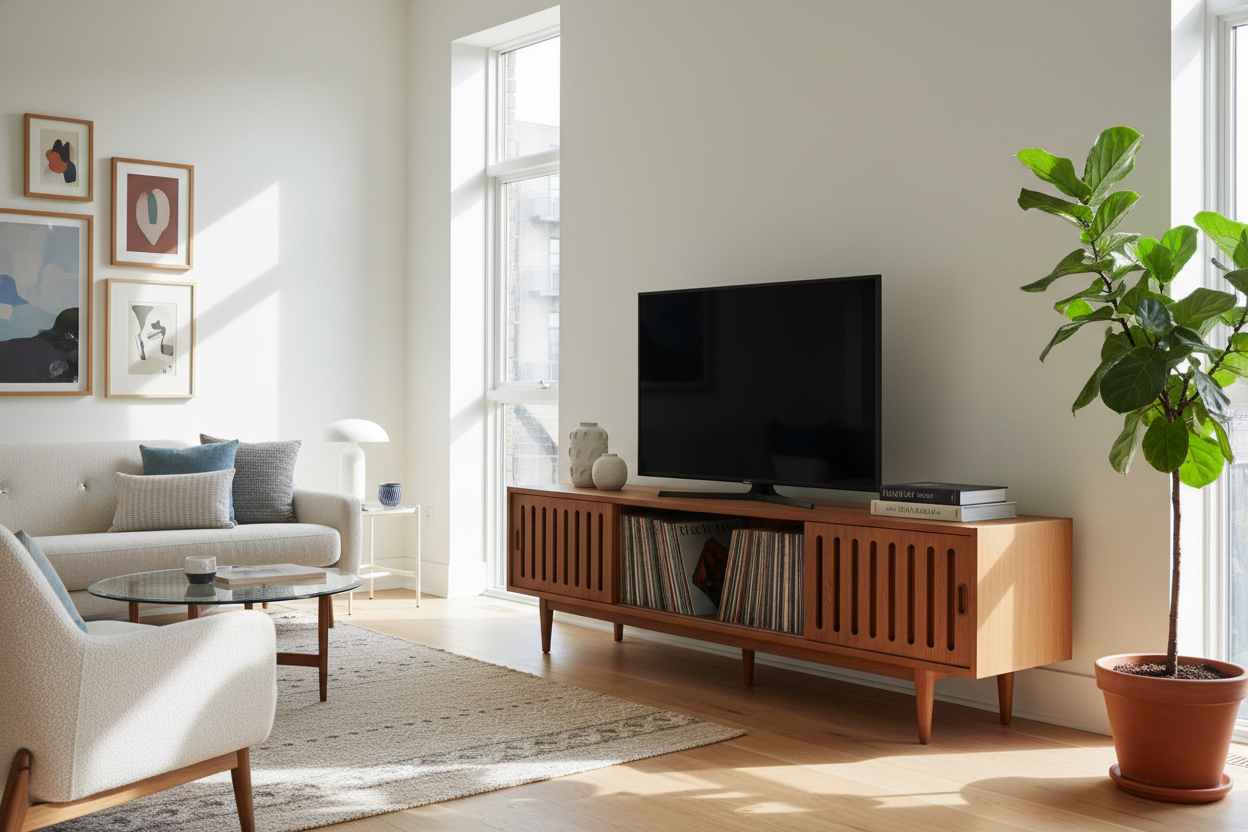
I spent months scouring thrift stores for the perfect 1970s ceramics and linen pillows, only for my partner to bring home a 75-inch black void of a television. It felt like a giant plastic billboard had moved into our sanctuary, sucking all the warmth out of the room. I tried to ignore it, but you can only hide so much tech behind a strategically placed fiddle-leaf fig before the whole thing looks desperate.
The solution wasn't getting rid of the TV (a battle I lost early on), but finding a danish media console that could actually hold its own against the hardware. It turns out, the right piece of wood can act like an anchor, grounding all that cold glass and plastic into something that feels like a real home.
- Wood tones like teak or walnut provide the necessary warmth to offset a cold, black screen.
- Slatted doors are the ultimate hack for hiding ugly routers while keeping your remotes functional.
- Tapered legs are essential for making a large unit feel light rather than bulky.
- Always buy a console at least 6 to 10 inches wider than your TV to keep the proportions balanced.
The Battle of the 75-Inch Screen
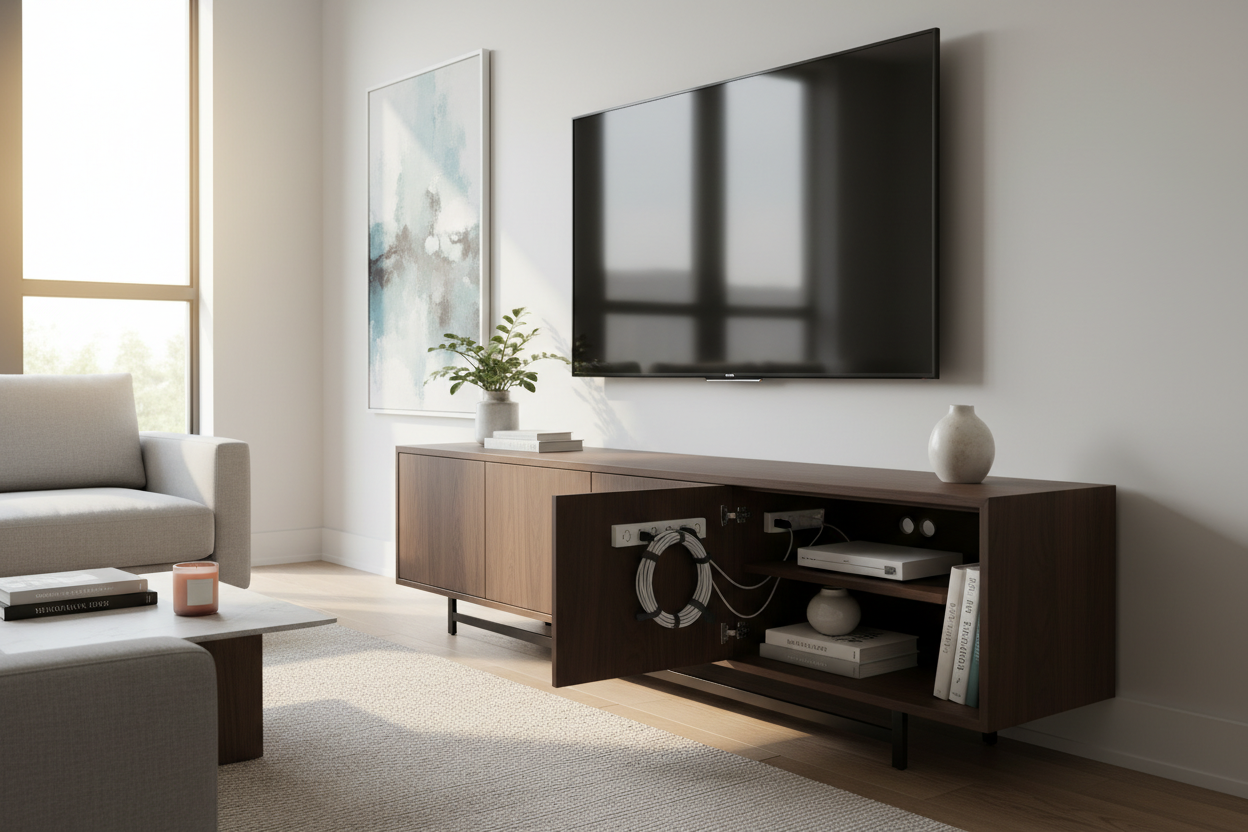
Our living room used to be my favorite place to unwind, but once the giant screen arrived, the vibe shifted. It wasn't just the TV itself; it was the 'tech tail'—the tangled mess of HDMI cables, the glowing blue light of the router, and the bulky gaming consoles that looked like they belonged in a college dorm. I tried to hide it all in a wicker basket, but it just looked like a fire hazard.
The frustration of trying to blend modern tech with a curated, design-forward space is real. You want the convenience of a home theater, but you don't want your house to look like a sports bar. I realized I needed a piece of furniture that was as much of a statement as the TV itself, something with enough architectural weight to balance out that massive screen.
Why High-Gloss Modern Consoles Only Made It Worse
In my first attempt to fix the problem, I went too modern. I thought clean, white lines would make the tech disappear. I even tested an adjustable modern TV console cabinet because I liked the idea of flexibility. While the clean lines were a step in the right direction, the high-gloss finish just made the whole setup look like a Best Buy showroom. It was sterile.
The problem with ultra-modern, shiny furniture is that it reflects the light from the TV. It doubles down on the 'appliance' feel of the room. You don't want your living room to feel like a lab; you want it to feel like a place where you can actually put your feet up. I learned the hard way that if you want to neutralize a big piece of tech, you need natural materials, not more plastic and lacquer.
Enter the Danish Media Console (and Its Magic Slatted Doors)
The moment I swapped the glossy stand for a walnut danish tv stand, the room changed. Scandinavian design has this incredible ability to feel both vintage and futuristic at the same time. The warmth of the wood grain immediately softened the harshness of the screen. It felt like the TV finally had a place to sit, rather than just hovering ominously over the floor.
But the real 'secret sauce' of a danish media cabinet is the slatted doors. If you have a mess of black boxes—cable boxes, PlayStations, mesh routers—slats are your best friend. They provide airflow so your gear doesn't melt, and more importantly, infrared signals from your remote can pass right through them. You get a clean, minimalist look without having to get up and open a cabinet door every time you want to change the volume.
Tapered Legs Give Your Living Room Room to Breathe
One of the biggest mistakes I see people make is buying a media center that sits flush against the floor. It’s a heavy, blocky look that makes a small room feel tiny. Danish design almost always utilizes tapered legs, which lift the bulk of the furniture off the ground. Seeing that extra bit of floor underneath the unit creates an illusion of space, making even a massive 80-inch danish entertainment center feel airy.
If you are dealing with a truly cramped apartment, you might even consider a wall mounted media console to keep the floor completely clear. But for most of us, those iconic mid-century legs provide just enough 'lift' to keep the room from feeling weighed down by the tech. It’s an architectural trick that works every single time.
Proportions Matter When Buying a Danish Entertainment Center
I’ve seen it a thousand times: a massive TV sitting on a stand that is the exact same width as the screen. I call this the 'lollipop effect,' and it looks terrible. It makes the TV look top-heavy and the furniture look like an afterthought. To get that high-end, intentional look, your console needs to be significantly wider than the TV.
When I was shopping, I realized I needed to upgrade to a larger media cabinet for TV to properly anchor the 75-inch beast. You want at least three to five inches of 'breathing room' on either side of the screen. This allows the furniture to frame the TV, rather than just holding it up. It turns the TV into a part of the decor rather than a giant intruder.
How to Style Around the Tech Chaos
Once the danish media console is in place, the work isn't quite done. You have to style it so the TV doesn't become the only focal point. I like to balance the heavy black rectangle with something organic on the side—usually a trailing Pothos or a tall, architectural vase. It breaks up the hard horizontal lines of the screen.
Don't be afraid to put a small, warm-toned lamp on one end of the console. The soft glow at night makes the screen feel less like a glowing abyss and more like a cozy part of the room. I also stack a few oversized art books on the bottom shelf if there is an open cubby. It’s all about layering textures so the 'clinical' feel of the tech is buried under layers of personality. My living room finally feels like mine again, even with the giant screen.
How wide should my console be compared to my TV?
Your console should be at least 6 inches wider than your TV (3 inches on each side). If you have the space, 10 to 12 inches wider looks even better and more intentional.
Do slatted doors really work with remotes?
Yes, most modern IR remotes work through slats without any issues. If you have an older device, you might have to point it more precisely, but for Apple TV or Roku, it's seamless.
What wood finish is best for a Danish look?
Teak is the classic mid-century choice, but it can be pricey. Walnut is a fantastic, darker alternative that feels very high-end and hides scratches better than lighter woods.


Dejar un comentario
Este sitio está protegido por hCaptcha y se aplican la Política de privacidad de hCaptcha y los Términos del servicio.