










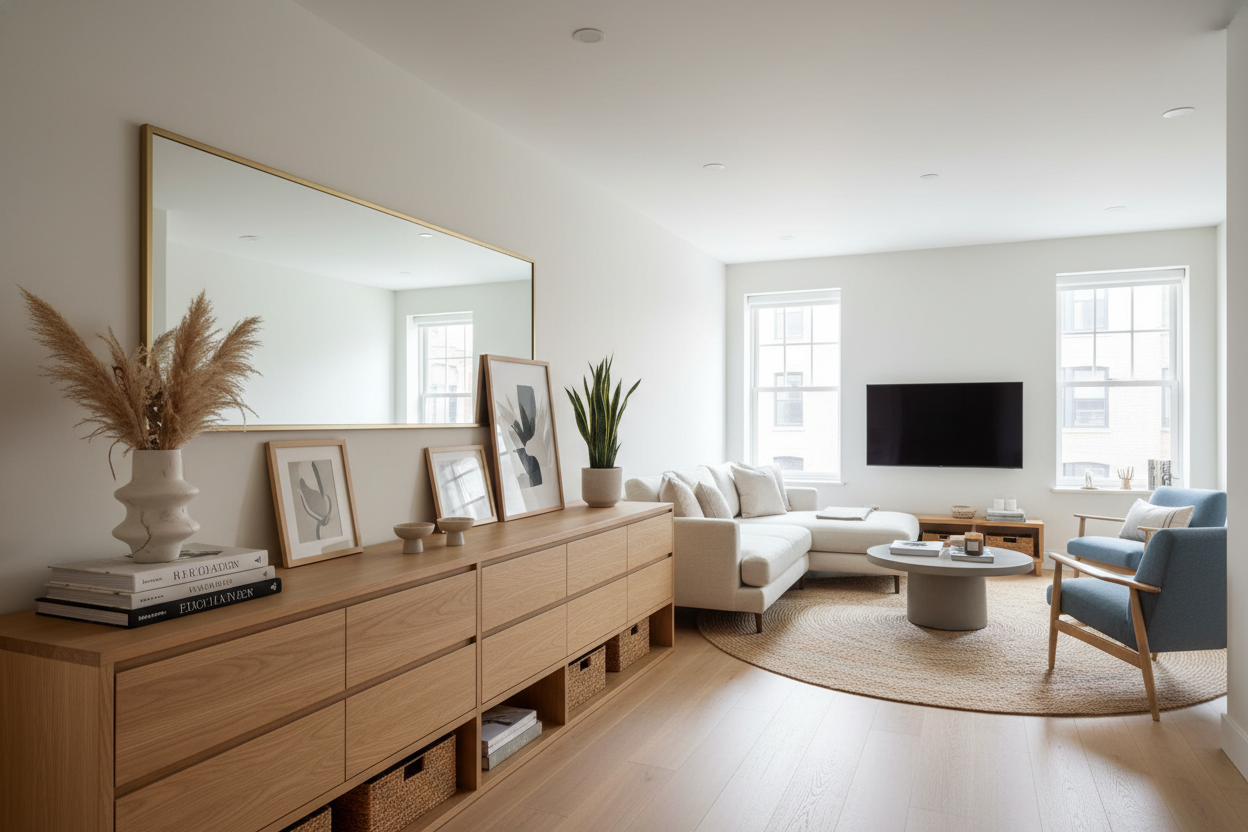
I used to live in what I affectionately called 'The Tunnel.' It was a living room so narrow that if two people walked past each other, one usually ended up bruised by a coffee table corner. My first instinct was to go vertical. I bought those towering, six-foot-tall bookcases everyone gets in their twenties, thinking I was being smart by 'using the height.' I was wrong. Those tall shelves made the walls feel like they were leaning in to tell me a secret I didn't want to hear.
The fix didn't come from a renovation or a miracle floor plan. It came from a 2 AM realization that horizontal lines are the only way to cheat the eye. I ditched the towers and replaced them with a long low cabinet with drawers that stretched nearly the entire length of the main wall. Suddenly, the room stopped looking like a hallway and started looking like a curated lounge.
Quick Takeaways
- Horizontal lines draw the eye across, visually widening narrow rooms.
- Drawers are superior for hiding 'daily life' clutter like chargers and mail.
- Solid wood is non-negotiable if you plan to put a TV or heavy books on top.
- A low profile keeps sightlines open, making the ceiling feel higher.
Why Tall Bookcases Were Ruining My Room's Flow
Tall furniture in a narrow room is a trap. When you have high shelves filled with a chaotic mix of books, candles, and random tchotchkes, you're creating a massive amount of visual noise right at eye level. In my old setup, every time I sat on the sofa, I felt dwarfed by the looming shadows of my own stuff. It felt claustrophobic, not cozy.
The flow was nonexistent. Because the bookcases were so deep and high, they dictated where every other piece of furniture had to go. There was no room for error. I realized that by forcing the eye upward, I was highlighting exactly how cramped the floor space actually was. I needed a reset that stayed below the 30-inch mark.
The Visual Magic of a Long Low Cabinet With Drawers
When you swap verticality for a long, horizontal piece, something happens to the proportions of the room. It’s a classic design trick: horizontal lines lead the eye along the perimeter, which tricks the brain into thinking the walls are further apart than they are. By keeping the top of the cabinet low, you leave the upper two-thirds of the wall open, which instantly makes the ceiling feel like it’s gained a few inches.
But it's not just about the 'look.' The functionality of a cabinet with doors and drawers is where the real sanity-saving happens. Drawers are the ultimate black hole for the things that usually clutter up a coffee table—remote controls, half-finished notebooks, and that pile of mail you're avoiding. Doors are great for hiding the 'ugly' stuff like routers or bulky gaming consoles that don't need to be on display.
Pairing It With a Small Low Cabinet With Doors
If you have a particularly long wall, you don't have to find one single 12-foot piece of furniture. I actually found that pairing my main unit with a small low cabinet with doors on the end created a nice asymmetrical look. I use the drawer section for the small, fiddly items I reach for daily, and the cabinet section for the heavy hitters like my board game collection and a stack of vinyl records.
This 'modular' approach also makes moving much easier. I’ve lived in three apartments in five years, and a massive 80-inch sideboard is a nightmare to get up a flight of stairs. Two smaller units side-by-side? That’s a Sunday afternoon job that won't break your back or your friendships.
Why You Should Probably Invest in a Low Wood Storage Cabinet
I learned the hard way that cheap particleboard and long spans do not mix. My first attempt at this look was a budget piece made of 'engineered wood' (which is just fancy talk for sawdust and glue). Within six months, the middle was sagging like a tired hammock under the weight of my 55-inch TV. It looked terrible and made the drawers stick.
If you want a piece that actually lasts, a low wood storage cabinet is the only way to go. Look for kiln-dried hardwoods like oak, walnut, or acacia. A solid wood modern sideboard might cost more upfront, but it won't bow, and it won't end up in a landfill in two years. Plus, real wood has a weight and texture that anchors a room in a way that laminate never can.
How to Style the Top So It Doesn't Become a 'Catch-All' Dump
The danger of a long, flat surface is that it’s an invitation for junk. Within a week, my new cabinet was covered in keys, loose change, and empty sparkling water cans. To prevent this, you have to style it with intention. I follow the 'Rule of Three': one large statement piece (like a piece of art leaning against the wall), one medium light source (a low-profile lamp), and one small organic element (a plant or a bowl).
By using oversized art that sits *on* the cabinet rather than hanging high on the wall, you keep the focus low and maintain that feeling of width. If you have a TV, offset it to one side rather than centering it perfectly. This leaves room for a 'vignette' on the other side, which makes the whole setup feel like a deliberate design choice rather than just a media stand.
Other Awkward Spaces Begging for This Exact Furniture Formula
Once I saw what a long, low profile did for my living room, I started seeing 'bowling alley' problems everywhere. This setup is a lifesaver in a bedroom, especially if you have large windows with high sills. Instead of a traditional tall dresser that blocks the light, a linear design drawer storage cabinet can sit right under the window, giving you all the storage without sacrificing the view.
I've also seen this work beautifully in dining rooms that are too narrow for a traditional chunky buffet. A slim, low cabinet provides a surface for serving food during parties but stays out of the way when you're trying to pull out a chair. It’s the Swiss Army knife of furniture shapes. If a room feels 'off,' try lowering the center of gravity. It works every time.
FAQ
How long should my cabinet be compared to the wall?
Ideally, you want the piece to take up about 60% to 75% of the wall's length. If it’s too short, it looks like a lonely island. If it’s wall-to-wall, it can feel built-in (which is cool, but harder to pull off with freestanding furniture).
Can I put a TV on a low cabinet if I don't want to mount it?
Absolutely, just check the height. You want the middle of the TV screen to be at eye level when you're sitting down. A cabinet that is 24 to 30 inches tall is usually the sweet spot for most sofas.
What's the best way to hide cords in a low cabinet?
Look for pieces with pre-drilled 'cord escapes' in the back. If it doesn't have them, a 2-inch hole saw bit and a power drill can fix that in five minutes. Just make sure you're drilling through the back panel, not a structural support!

Dejar un comentario
Este sitio está protegido por hCaptcha y se aplican la Política de privacidad de hCaptcha y los Términos del servicio.