










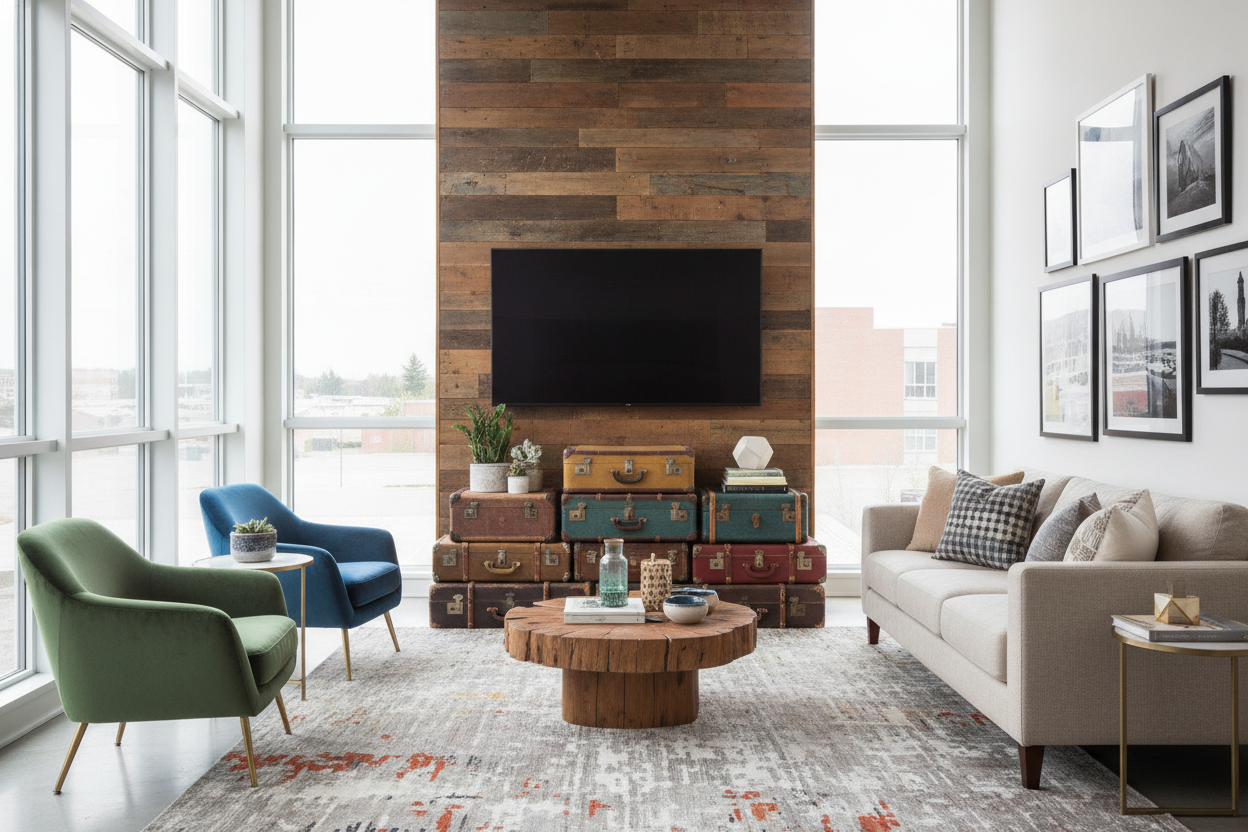
I sat on my floor last Tuesday, staring at my 65-inch TV, and realized my living room felt like the waiting room of a high-end dental office. The console was a $40 particle board slab that sagged slightly in the middle, and it did nothing but highlight the giant black mirror on the wall. It was a quirky tv stand or bust, because I couldn't look at that generic setup for one more night.
- Weight capacity is the only rule you can't break; check the specs before you buy.
- Cord management can be faked with adhesive clips and a power strip hidden in a basket.
- Asymmetry helps distract the eye from the 'big black rectangle' problem.
- Vintage sideboards often make better media consoles than actual media consoles.
The Moment I Realized My Living Room Looked Like an Electronics Store
We've all been there. You spend months picking out the perfect rug and a sofa that doesn't eat your lower back, and then you plop the TV on a basic black box. When I moved into my current place, it was so easy to just browse through standard TV stands because they were available and cheap. But 'safe' furniture is usually just code for 'forgettable.'
My living room had no soul. The TV was the undisputed, boring focal point. It didn't look like a home; it looked like a showroom for mid-tier electronics. I realized that if I wanted my space to feel like me, I had to stop treating the TV area like a utility zone and start treating it like a gallery wall.
Finding Unique TV Stands for Flat Screens That Still Hide Cords
The biggest hurdle with unique tv stands for flat screens is the cord situation. Modern tech comes with a proprietary mess of HDMI cables and power bricks that 'quirky' vintage furniture wasn't designed to handle. I once tried using an old metal locker, and the sound of the vibrating metal every time the bass kicked in was a nightmare.
If you're going for a non-traditional look, you have to get creative with a drill and some hole saws. I eventually looked at an adjustable wide TV stand to understand how modern pieces manage airflow and cable routing. Now, I use a vintage teak sideboard, but I've tucked all the messy bits into a cord management box hidden behind a stack of oversized art books. It keeps the 'unusual' vibe without the visual clutter.
Where to Actually Find Unusual Entertainment Centers
Thrift stores and Facebook Marketplace are the gold mines here. Look for 'credenzas' or 'buffets' instead of searching for unusual entertainment centers. Those keywords usually lead to overpriced 'industrial' pieces that look like they belong in a themed restaurant. You want something with character—maybe a mid-century piece with tambour doors or an old apothecary chest.
A word of warning: check the height. A dining sideboard is often 30-34 inches tall, which might put your TV at an uncomfortably high viewing angle. If you can't find the perfect funky vintage piece, you can always look for minimalist entertainment centers and customize them. Swap the legs for something brass, or paint the drawer fronts a weird, moody green. It’s the easiest way to get a custom look without the custom price tag.
Don't Forget the Awkward Angles: Unusual Corner TV Stands
Corner placements are the absolute worst for interior design. Most unusual corner tv stands look like they were designed in 1998 to hold a massive tube TV. If you're stuck in a small apartment with a weird layout, don't settle for a triangular piece of junk. I’ve seen people use circular pedestal tables or even heavy-duty easels to reclaim that corner space.
Before you commit to a funky corner find, make sure it’s structurally sound. I always tell my friends to read up on solid wood corner TV stands to understand the weight limits. A 55-inch flat screen isn't light, and the last thing you want is your 'unusual' find collapsing under the weight of your Netflix binge-watching station.
Styling Your Weird, Wonderful New Setup
Once you have the stand, the work isn't done. The goal is to make the TV disappear—or at least stop screaming for attention. I use the 'rule of three' with my styling: one tall plant to break the horizontal line of the screen, a stack of books for texture, and one weird object (mine is a brass crab) to keep things interesting.
Try hanging a piece of art slightly off-center above the TV. It feels counter-intuitive, but it breaks the symmetry that makes a room feel stiff. Use warm lighting—think a small lamp with a pleated shade sitting right on the console—to soften the glow of the screen. Suddenly, that giant black rectangle feels like part of a curated collection rather than a tech eyesore.
Frequently Asked Questions
Can I use a regular dresser as a TV stand?
Yes, but check the height. If the dresser is over 30 inches tall, you’ll be craning your neck. Also, make sure the top isn't bowing under the weight of the TV stand legs.
How do I hide cables on a stand with open legs?
Use clear adhesive cable clips to run the wires down the back of the legs. If the legs are thin, wrap the cords in a decorative sleeve that matches your wall color.
Are vintage TV stands safe for heavy screens?
Not always. Older furniture was built for different weight distributions. If the top feels thin or the legs look wobbly, reinforce it with a center support leg or a plywood brace inside the cabinet.


Dejar un comentario
Este sitio está protegido por hCaptcha y se aplican la Política de privacidad de hCaptcha y los Términos del servicio.