










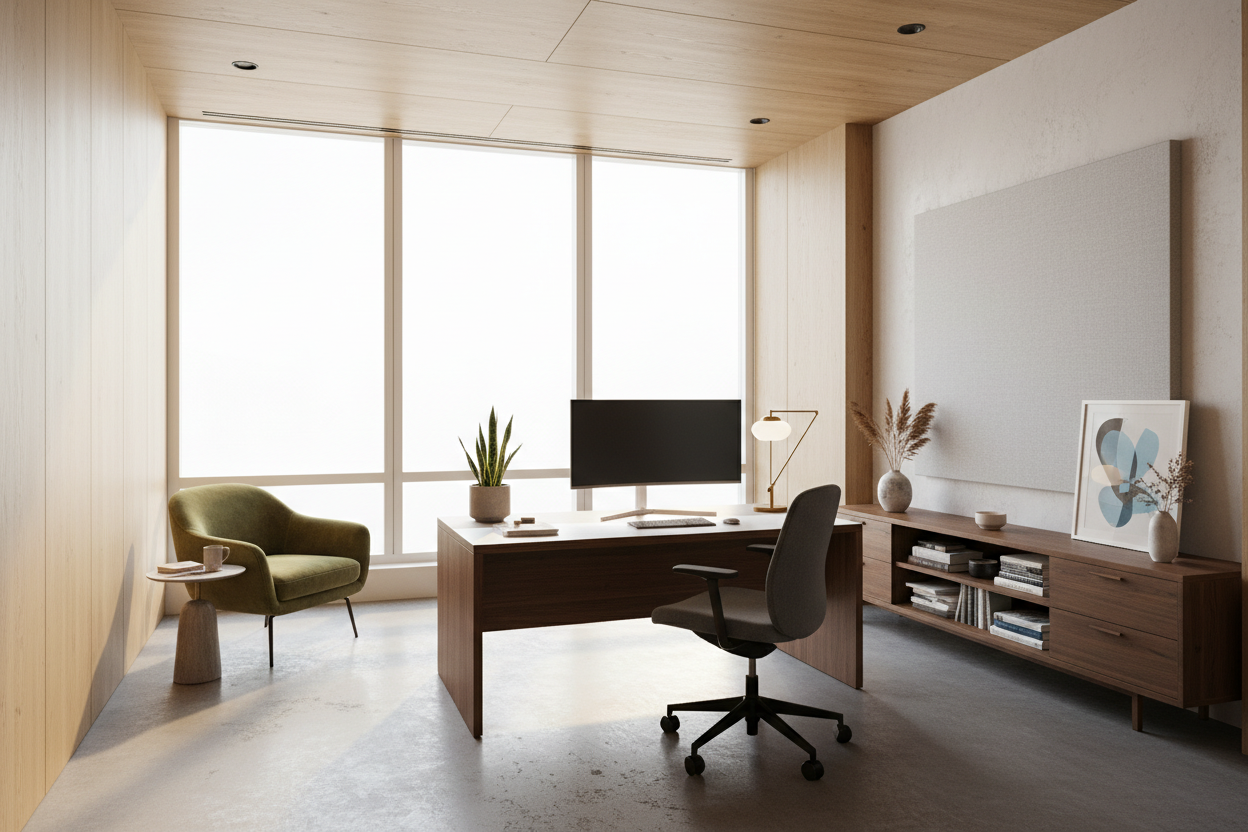
Most corporate environments suffer from what I call "beige fatigue." It is the stifling feeling of walking into a workspace that lacks identity, texture, or purpose. When clients come to me asking how to decorate an office, they are rarely just looking for aesthetic improvements; they are searching for a way to reclaim their productivity and mental clarity. Whether you are dealing with a sprawling executive suite or a compact cubicle, the principles of high-end design remain the same: function must dictate form, and every object should earn its place.
Key Features to Look For: A Quick Design Checklist
Before buying a single accessory, review these core elements to ensure your design supports your workflow rather than hindering it. This checklist is essential when decorating your office at work.
- Lighting Quality: Aim for a mix of ambient and task lighting (ideally 3000K to 4000K color temperature) to reduce eye strain.
- Ergonomics First: Prioritize chairs with lumbar support and adjustable armrests over purely sculptural pieces.
- Acoustic Control: Incorporate soft materials like rugs, curtains, or acoustic panels to dampen echo and noise.
- Storage Solutions: utilize vertical shelving to keep the desk surface clear for active work.
- Biophilic Elements: Introduce low-maintenance greenery to improve air quality and reduce stress.
Assessing Your Canvas: Layout and Flow
When decorating a new office, the first step is not shopping, but space planning. You must understand the "traffic flow" of your day. If you are decorating a small office at work, the placement of your desk relative to the door and window is critical. Ideally, position your desk in the "command position"—facing the door but not directly in line with it. This taps into primal psychology, increasing your sense of security and focus.
For those wondering how should i decorate my office when space is tight, focus on verticality. Use floating shelves or tall, narrow bookcases to draw the eye upward, making the room feel more expansive. Avoid placing heavy furniture in traffic paths; physical obstruction leads to mental obstruction.
Materiality and Furniture Selection
The difference between a space that feels "cheap" and one that feels "curated" often comes down to materials. When brainstorming ideas for decorating your office at work, pay close attention to the tactility of surfaces.
Wood and Veneers
In high-end design, we look for commercial-grade durability. If you can't invest in solid walnut or oak, look for high-pressure laminates (HPL) with a textured grain. Avoid thermofoil finishes that peel over time. A substantial desk anchors the room and sets the tone for all other decoration work.
Textiles and Seating
If you are decorating my office at work implies you have control over the chair, invest heavily here. Look for fabrics with a high "double rub" count (a measure of abrasion resistance). A wool blend or a high-quality mesh offers breathability that leather sometimes lacks during long sessions.
Lighting: The Invisible Decor
One of the most overlooked ways to decorate your office is through light layering. Overhead fluorescent lighting is harsh and creates unflattering shadows. To soften the space, introduce a desk lamp with an adjustable arm for task work and a floor lamp with a linen shade for ambient glow. This allows you to control the mood. When considering how to decorate your office space at work, remember that warm light (2700K) is relaxing, while cool light (4000K) promotes alertness. A smart bulb allows you to toggle between these depending on your deadline.
Styling and Personalization
The query "decorating my work office" often leads to clutter. The goal is curated personality, not chaos. Use the "Rule of Three" when arranging accessories on shelves or desks. Group items of varying heights and textures—for example, a tall plant, a medium-sized framed print, and a small ceramic bowl.
When decorating your office, choose art that has depth. Abstract pieces often work best in professional settings as they are not distracting. If you are decorating your office at work and cannot paint the walls, use large-scale art or a high-quality peel-and-stick wallpaper to create a focal point without permanent damage.
My Personal Take on how to decorate an office
Lessons from My Own Projects: The "Aesthetic Chair" Trap
Early in my career, while decorating my office, I fell in love with a mid-century modern replica chair. It was a stunning cognac velvet bucket seat that looked incredible in photos. I bought it immediately, ignoring the fact that it had fixed height and zero lumbar support.
Two months later, I was visiting a chiropractor. The velvet, while beautiful, trapped heat, and the lack of adjustment meant my wrists were at a terrible angle for typing. I learned a hard lesson that I now pass to every client: Never sacrifice ergonomics for aesthetics in a chair you sit in for more than an hour. Now, when I look for work office space decorating ideas, I always start with a high-performance task chair—usually a mesh back for airflow—and add warmth through a throw blanket or a lumbar pillow, rather than the chair structure itself. Real luxury is being pain-free at 5:00 PM.
Conclusion
Ultimately, your workspace should be a reflection of your professional aspirations grounded in physical comfort. By selecting durable materials, prioritizing lighting, and curating rather than cluttering, you create an environment that respects your time and energy. Start with the lighting, upgrade the chair, and the rest will follow.
Frequently Asked Questions
How do I decorate a small office at work without making it look cluttered?
Focus on "closed" storage. Open shelving can look messy in small spaces. Use cabinets or baskets to hide paperwork and cables. Keep the desk surface 80% clear, reserving space only for the computer, a lamp, and one personal item.
What are the best plants for an office with no windows?
If you are decorating a new office with limited natural light, opt for ZZ plants or Snake plants (Sansevieria). They are incredibly architectural, require very little water, and thrive in low-light or fluorescent-lit environments.
Is it worth painting the walls if I am renting the office space?
If the lease allows it, painting is the highest ROI decoration work you can do. A coat of "Greige" (grey-beige) or a deep navy on a single accent wall can instantly elevate the perceived value of the furniture in the room. If painting isn't an option, large canvas art is the next best alternative.


Dejar un comentario
Este sitio está protegido por hCaptcha y se aplican la Política de privacidad de hCaptcha y los Términos del servicio.