










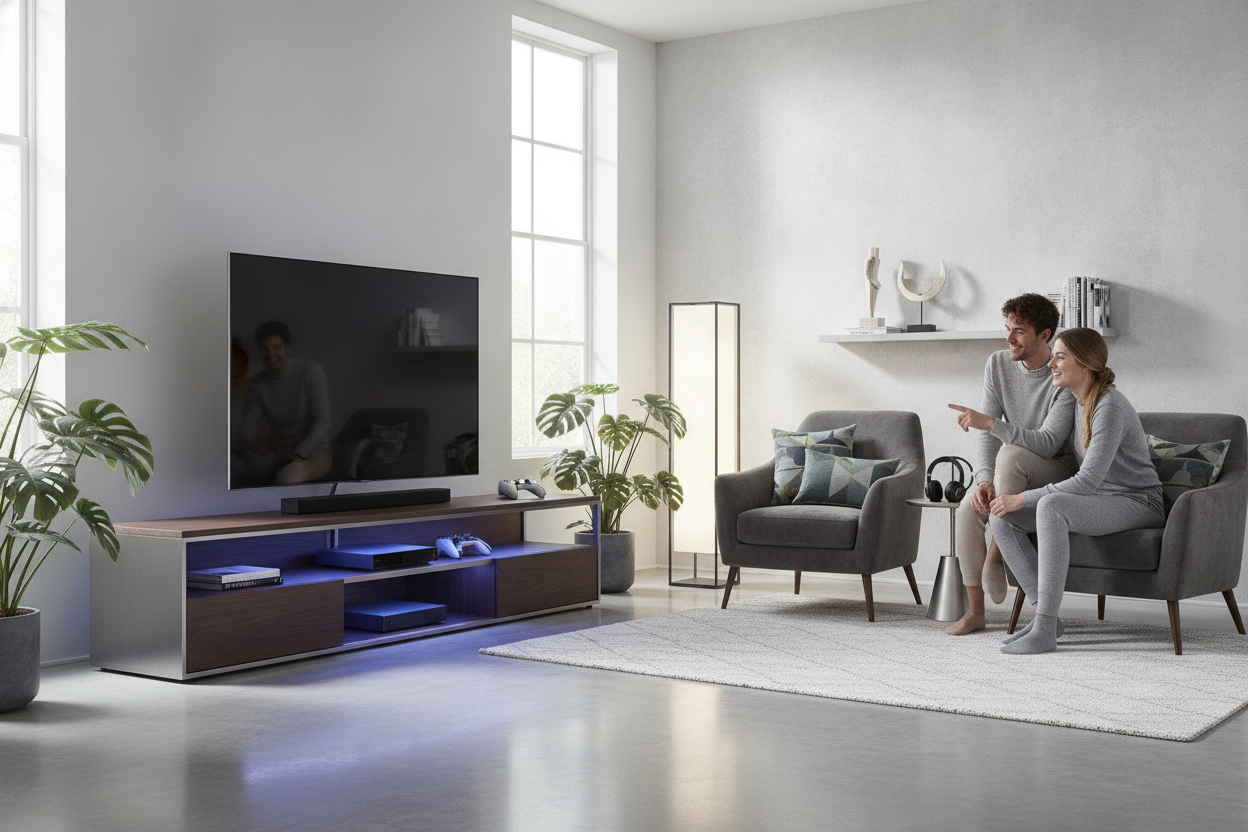
My partner and I have very different ideas of what makes a living room 'comfortable.' I want linen curtains, 2700K warm bulbs, and enough potted plants to start a nursery. He wants a setup that looks like a high-end command center. When he first suggested a gaming tv stand with lights, I pictured a neon-soaked basement filled with empty energy drink cans. I almost said no on the spot.
But after staring at our cluttered media console for three weeks, I realized we needed a change. We decided to find a middle ground where his tech-heavy needs met my minimalist preferences. It turns out, you can actually own an led gaming tv stand without your home looking like a suburban arcade. You just have to be incredibly intentional about how you style it.
- Choose a single, warm color temperature instead of the 'rainbow' cycle.
- Opt for a floating design to keep the floor space clear and modern.
- Mix hard tech surfaces with organic textures like clay and greenery.
- Aggressively hide every single cable to avoid the 'spaghetti' look.
The Great Compromise: Ambient Lighting vs. 'Gamer Aesthetic'
The struggle of the 'gamer' versus 'decorator' household is real. He wanted immersion; I wanted a room that didn't vibrate with blue light while I was trying to read. We had to move away from the idea that gaming furniture must be aggressive. Most of the stuff marketed to gamers is chunky, plastic, and loud.
We looked for a unit with clean lines and integrated LEDs that weren't the main event. The goal was to treat the lights as architectural accents rather than a light show. Once we stopped thinking about it as a 'gaming' piece and started thinking about it as a 'media unit with bias lighting,' the design started to click. It’s about creating a mood, not a spectacle.
The Secret is Controlling the Color Temperature
The biggest mistake people make with an led gaming tv stand is leaving it on the factory-default 'color jump' setting. Nothing kills a sophisticated vibe faster than a console that flashes from lime green to hot pink while you're watching a movie. It’s distracting and, frankly, looks cheap.
I found that sticking to a static, warm amber or a very desaturated 'soft white' makes the unit look like a custom built-in. If we're feeling moody, a deep navy blue can work, but we never touch the saturated reds or purples. I noticed that our black TV stand with LED lights actually looks better with these warmer tones because the dark finish absorbs the excess glare, leaving just a soft, sophisticated halo behind the cabinet.
Why Floating the Console Elevates the Entire Room
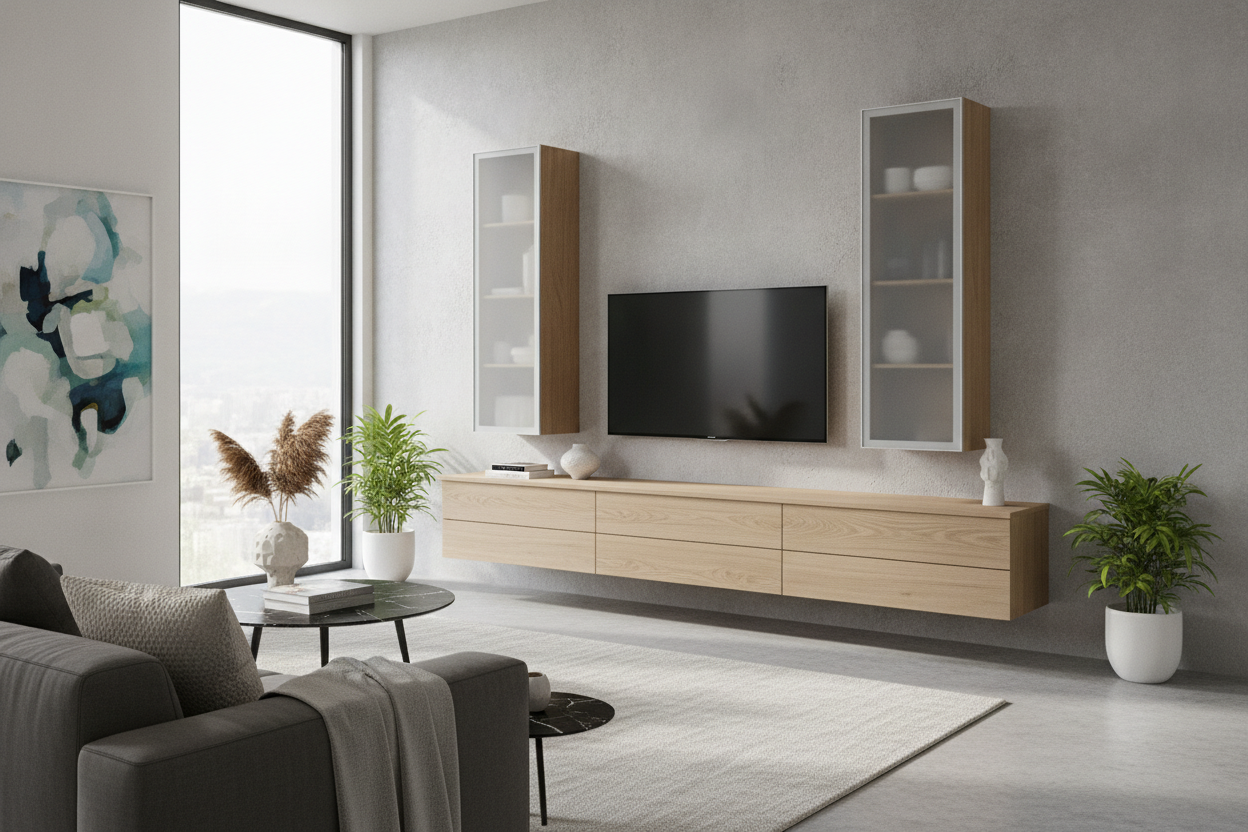
If you put a glowing box directly on a rug, it looks heavy. It feels like it’s taking up more space than it actually is. By choosing a wall-mounted unit, you create a gap between the furniture and the floor that makes the whole room feel airier. This is especially true for smaller apartments where every inch of visible floor counts.
A floating high gloss TV stand uses its under-lighting to create a weightless illusion. Instead of a bulky piece of furniture, you have a sleek, glowing shelf. It turns the LED strip from a 'gaming feature' into an architectural detail that highlights your flooring. Just make sure you mount it at the correct eye level—nothing ruins the chic look like a TV hanging way too high on the wall.
Balancing the Tech With Organic Textures
High-gloss finishes and LED strips are very 'hard' design elements. To keep the room from feeling like a sterile lab, you have to counter that tech with something soft and alive. I spent hours browsing modern TV stands before realizing the stand itself was only half the battle; it’s what you put on and around it that matters.
I styled our setup with a matte terracotta vase and a trailing pothos plant that hangs over the edge of the console. The organic shape of the leaves breaks up the straight lines of the LEDs. I also added a woven seagrass basket nearby to store extra controllers. That mix of natural fiber and glowing tech creates a balanced, 'grown-up' look that doesn't scream 'I spend 14 hours a day on Discord.'
Hiding the Wires (Because Lights Highlight Everything)
Here is the cold, hard truth: LEDs are spotlights for your failures. If you have a single stray HDMI cable or a dusty power strip behind your stand, that light is going to illuminate it for everyone to see. Cable management isn't optional here; it’s the entire job.
When floating TV stand with LED lights became our main choice, I had to get serious about wire channels. We used paintable cord covers to match our walls and zip-tied everything behind the unit. It took three hours and a lot of frustration, but seeing that clean glow without a single 'black snake' of a wire hanging down made it worth it. If you aren't willing to hide the cords, don't buy the lights.
Is a gaming TV stand with lights too bright for a bedroom?
Not if you get one with a dimmer. Most modern LED stands come with a remote or an app where you can drop the brightness to 10%. At that level, it’s just a nice nightlight that won't keep you awake.
Will the LED strips peel off over time?
The cheap ones do. I always recommend reinforced adhesive or even small clear clips to keep the strips in place. Heat from the TV and consoles can loosen the glue, so check them every few months.
Does the light actually help with eye strain?
Surprisingly, yes. It’s called bias lighting. By illuminating the wall behind the screen, it reduces the contrast between the bright TV and the dark room, which makes those long Netflix marathons much easier on your eyes.

Dejar un comentario
Este sitio está protegido por hCaptcha y se aplican la Política de privacidad de hCaptcha y los Términos del servicio.