










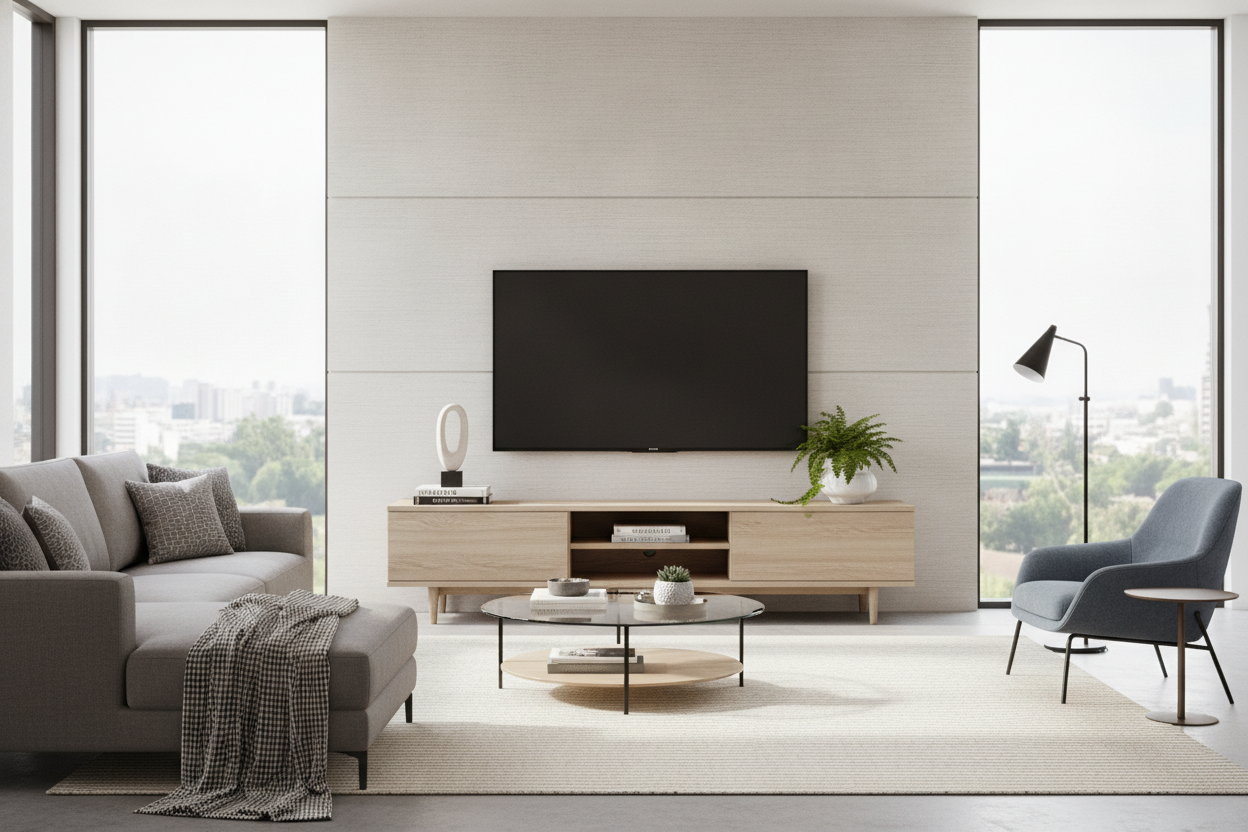
I spent my Sunday afternoon with a metal tape measure and a growing sense of existential dread. My living room features a builder-grade bump-out that measures exactly 60 inches wide—a five-foot span of drywall that seems designed specifically to taunt me. In the world of physics, trying to slide a 60-inch console into a 60-inch gap is a recipe for scuffed baseboards and a lot of swearing. That is how I ended up on a deep-dive for a tv stand 59 inch wide.
- The 1-Inch Rule: Always leave at least half an inch of clearance on either side to avoid 'wall-wedging.'
- Proportions Matter: A 59-inch stand is the 'Goldilocks' size for 55-inch and 65-inch screens.
- Cable Management: Look for units with recessed backs so your plugs don't add 2 inches of depth.
- Dual Purpose: In small apartments, your TV stand often has to double as a heater or a sideboard.
The 'Just Under Five Feet' Dilemma
Most furniture manufacturers love round numbers. They build for 48 inches, 60 inches, or 72 inches. But when you are dealing with a standard apartment layout where a door frame or a hallway entrance sits exactly five feet away from a corner, a 60-inch unit is an absolute non-starter. I learned this the hard way when I tried to squeeze a 'standard' sideboard into my last place and ended up having to remove the baseboard trim just to make it flush. It looked terrible.
Scrolling through endless categories of standard-sized Tv Stands makes you realize how rare odd-number dimensions actually are. Most sites will filter by '50 to 60 inches,' which is about as helpful as a screen door on a submarine when you have a hard limit of 59.5 inches. You end up clicking through dozens of products only to find they are all 58 or 60. That missing 59 inch tv stand becomes a white whale. It’s the specific dimension that says 'I fit this space perfectly' rather than 'I’m floating awkwardly in the middle of it.'
Why You Need That One Inch of Clearance
Let’s talk about the 'wedging' effect. If you have a 60-inch alcove and you buy a 60-inch stand, you have zero margin for error. Walls are rarely perfectly plumb. Your floor might have a slight crown. If that wall is even an eighth of an inch out of alignment, your furniture won't slide in. And even if it does, you’ve just created a permanent home for dust bunnies and spiders that you can never, ever reach with a vacuum attachment.
Having a 59 tv stand in a 60-inch space gives you that half-inch of 'breathing room' on either side. This isn't just about aesthetics; it's about survival for your baseboards. Every time you need to pull the stand out to reset the router or add a new HDMI cable, you risk gouging the paint if the fit is too tight. Plus, most power cables and bulky wall warts need a little room to breathe. Cramming them against a wall is a great way to fray your cords or, worse, create a fire hazard. That one inch of clearance is the difference between a functional media center and a permanent installation you’ll eventually have to crowbar out of the wall.
What Screen Size Actually Looks Good on It?
Proportion is the silent killer of good interior design. If your TV is wider than your stand, it looks like a lollipop—top-heavy and precarious. If the stand is way wider than the TV, the screen looks like a postage stamp. A 59-inch width is actually a design sweet spot. A standard 55-inch TV is roughly 48 inches wide. On a 59-inch stand, you get about 5.5 inches of 'landing zone' on either side. It’s the perfect amount of space for a small plant or a couple of decorative books without looking cluttered.
If you're pushing it to a 65-inch screen, which usually measures about 57 inches wide, you’re playing a dangerous game, but a 59-inch base still wins. You’ll have an inch of overhang on the stand, which keeps the visual weight grounded. Anything smaller than 59 inches and a 65-inch TV starts to look like it’s about to tip over. I personally run a 55-inch OLED on my 59-inch unit, and the symmetry is genuinely satisfying. It feels intentional, not like I just grabbed whatever was on sale at the big box store.
The Models That Made the Shortlist
When you finally find a tv stand 59 inch wide, you usually have to choose between 'cheap particle board' and 'ridiculously expensive custom build.' However, there are a few gems that hit the mark. I’m a big fan of closed storage because I have a messy collection of physical media and a router that looks like a robotic spider. I look for soft-close hinges and ventilated back panels—don't buy anything that traps heat, or you'll fry your PlayStation in six months.
For those of us living in drafty, older buildings where the insulation is basically just 'hope and prayers,' the 59 W White Fireplace Heater Tv Stand With Open Shelves Timer is a massive win. It’s one of those rare pieces that solves two problems at once. You get the specific 59-inch footprint you need, but it also pumps out enough BTUs to keep your toes warm during a Netflix binge. I’ve seen people try to use standalone space heaters next to their TV stands, and it always looks like a cluttered mess of wires. Combining them into one unit is just smart space management.
How to Style a Snug Fit
If your 59-inch stand is sitting in a tight alcove, the goal is to make the space feel deliberate. Don't try to cram floor lamps into the tiny gaps on the sides; it just highlights how tight the fit is. Instead, draw the eye upward. I use battery-operated wall sconces about 18 inches above the top of the TV. It creates a vertical line that makes the ceiling feel higher and takes the focus off the fact that the console is hugging the walls.
Floating shelves are another great trick. If you place a shelf about two feet above the TV that is slightly wider than the stand itself, it 'caps' the look and makes the whole setup feel like a built-in library. I also suggest using a cord-hiding kit that matches your wall color. In a tight space, a single black cord hanging down the side of a white wall sticks out like a sore thumb. Keep it clean, keep it vertical, and nobody will notice you only had an inch to spare.
FAQ
Will a 65-inch TV fit on a 59-inch stand?
Yes, physically. A 65-inch TV is usually 57-58 inches wide. It will fit, but you’ll only have about half an inch of clearance on each side. Just make sure the TV's legs or pedestal base are narrower than 59 inches, or you're in trouble.
Is a 59-inch stand hard to assemble?
It depends on the material. Most 59-inch units are mid-sized, so they usually take about 45 to 90 minutes. I highly recommend having a second person to help flip it over—I’ve snapped more than one cam-lock trying to be a hero and do it solo.
Why not just buy a 58-inch stand?
You can, but those extra two inches of surface area are surprisingly useful. If you have a soundbar, that extra width often determines whether the bar sits flush or hangs off the edge. Always maximize your available space, but respect the clearance.


Dejar un comentario
Este sitio está protegido por hCaptcha y se aplican la Política de privacidad de hCaptcha y los Términos del servicio.