










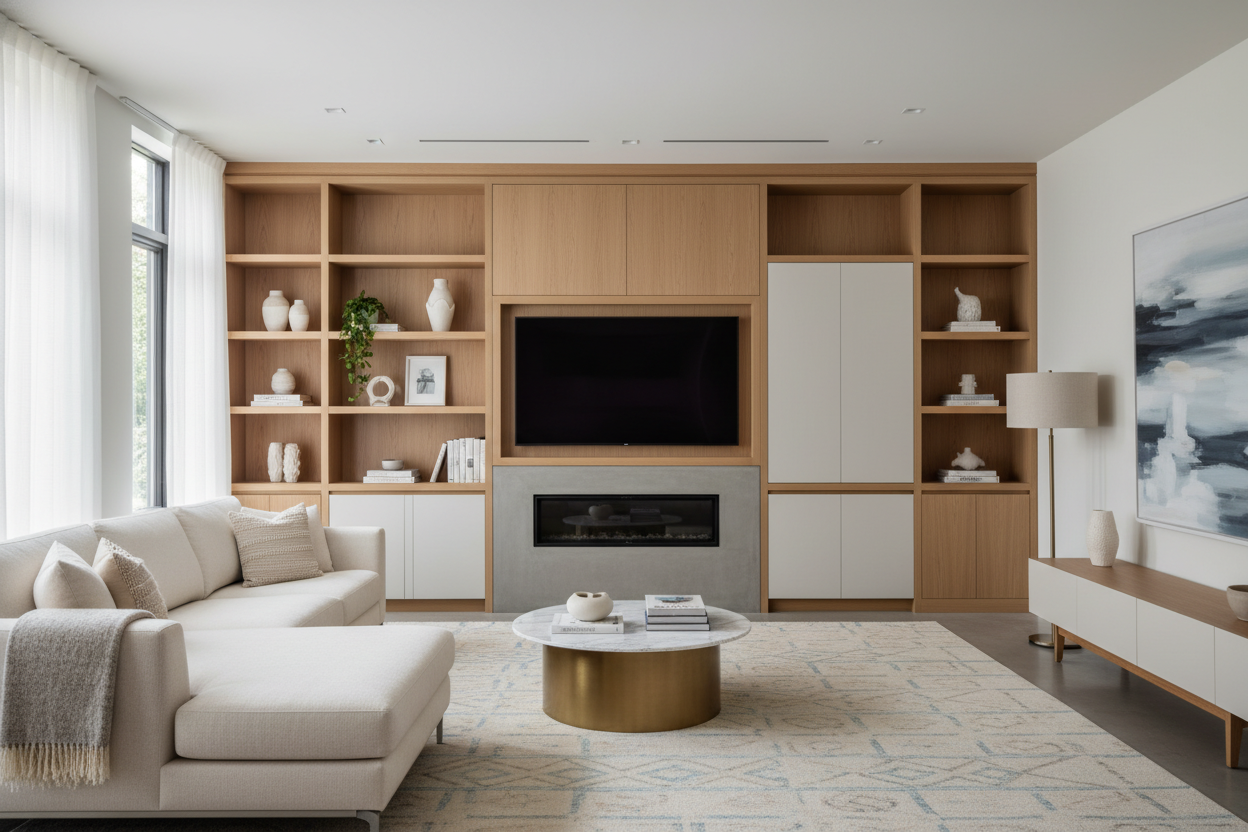
I spent three months staring at a fourteen-foot drywall expanse in my living room, wondering why the place felt so hollow. I had a nice sofa and a rug that cost more than my first car, but the room still felt like a high-end waiting room. It was the classic 'builder-grade special'—a featureless white box with zero architectural soul.
The breaking point came when I tried to scale things down. I bought a sleek, minimalist full wall entertainment center thinking it would keep things airy. Instead, it looked like a postage stamp stuck to a billboard. That is when I realized that in a room with no character, you have to build the character yourself.
Quick Takeaways
- Stop fear-buying small furniture; tiny pieces make a large room feel colder and more disorganized.
- A massive unit acts as 'fake architecture,' giving a flat wall depth and purpose.
- Measure your baseboards before buying—they are the number one reason units do not sit flush.
- Cable management is not optional; if you can see a single 'spaghetti wire,' the built-in illusion is ruined.
The 'Floating TV on a Giant Blank Wall' Dilemma
We have all seen it. A 55-inch TV sits lonely on a basic black TV stand entertainment center, surrounded by ten feet of nothingness. It makes the ceiling feel too high and the walls feel too bare. In my case, the TV looked like it was hovering in a void, and every time I sat down, I felt the urge to go buy more 'stuff' to fill the gaps.
That is the trap of the white box. You try to fix it with gallery walls or floor lamps, but the visual weight is never right. A small console cannot anchor a large room. It just looks like you ran out of money halfway through decorating. I needed something that didn't just hold the TV, but actually owned the wall.
Why a Whole Wall Entertainment Center Was the Only Fix
It sounds counter-intuitive, but adding a massive piece of furniture actually made my living room feel bigger. By choosing a whole wall entertainment center, I effectively pushed the wall forward. It gave the room a focal point that wasn't just a glowing screen; it became a library, a display case, and a storage hub all at once.
When I finally committed to a massive entertainment center, the room instantly felt grounded. The vertical lines of the shelving drew the eye upward, making the 8-foot ceilings feel significantly more grand. It stopped being a room with a TV in it and started being a 'media room.' That shift in identity is what happens when you prioritize scale over safety.
Faking the 'In Wall Entertainment Center' Look on a Budget
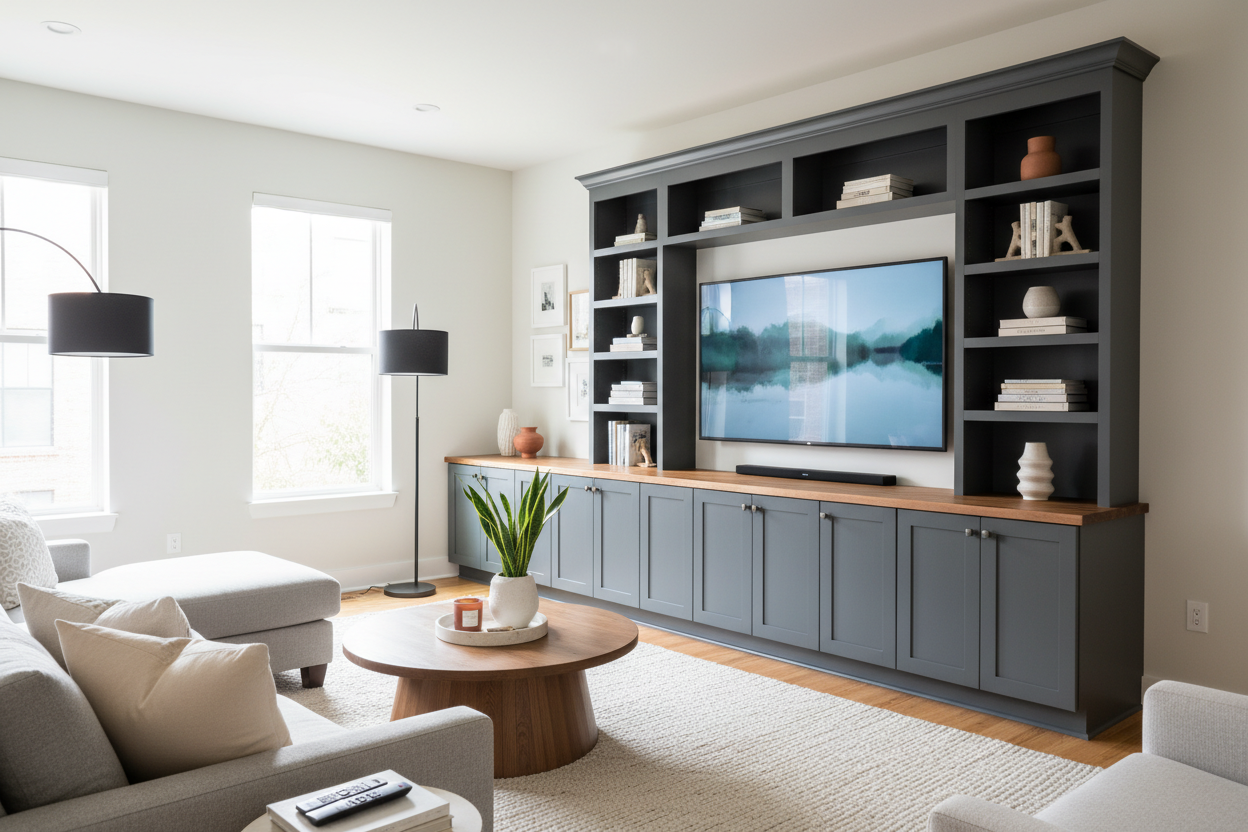
You do not need to hire a carpenter for five grand to get that custom look. The secret to a convincing in wall entertainment center is all in the gaps. If you buy a modular unit, use shims to level it perfectly. If there is a two-inch gap between the top of the unit and your ceiling, fill it with a piece of matching crown molding. It is a $40 fix that makes the unit look like it was built with the house.
I also swapped the standard hardware for heavy brass pulls. Cheap plastic or thin metal handles are a dead giveaway for mass-produced furniture. Today's modern entertainment center wall unit designs are much sleeker than the chunky oak monstrosities of the 90s, focusing on clean lines and matte finishes that blend into the drywall rather than fighting against it.
What I Actually Hide Inside All Those Cabinets
Let's be honest: half the reason I wanted this was to hide my shame. My 'tech life' is a disaster of tangled HDMI cables, three different gaming consoles, and a WiFi router that looks like a robotic spider. A full-wall unit is basically a giant mask for your clutter. I dedicated two entire lower cabinets just to board games and spare throw blankets that used to live in a pile on the floor.
The key is closed storage on the bottom and open shelving on top. I put the ugly stuff—the router, the power strips, the dusty Wii Fit board—behind solid doors. The top shelves are for the 'curated' version of me: art books I pretend to read, a few ceramic vases, and plants that I desperately try to keep alive. It is functional theater.
3 Things to Measure Before You Go Wall-to-Wall
Before you click 'buy' on a nine-foot-wide unit, grab a tape measure and a roll of painter's tape. First, check your baseboards. Most units assume your walls are perfectly flat, but your baseboards will kick the bottom of the unit out by half an inch, leaving a gap at the top. You may need to notch the back of the unit or remove the baseboard entirely.
Second, check your outlets. There is nothing worse than realizing your main power source is directly behind a solid structural support beam of the new unit. Third, consider your layout. If you have a fireplace or a weird window, a standard wall-to-wall might not work. In those cases, I usually recommend an off-center wall mounted entertainment unit to balance the room without blocking the architecture you actually like.
Personal Experience: The Depth Mistake
I have a confession: I didn't measure the depth of my first unit relative to my front door. It fit the wall perfectly, but it stuck out so far that the door hit the side of the cabinet every time I came home with groceries. I ended up having to add a rubber bumper to a $1,200 cabinet. Learn from me: check the 'swing' of your doors and the walking paths. You want a presence, not an obstacle course.
FAQ
Do I need to anchor this to the wall?
Yes. Always. Especially if you have kids, pets, or live in an earthquake zone. A unit this size is a giant lever; if you pull on a top shelf, the whole thing can come down. Use heavy-duty toggle bolts into the studs.
Will a big unit make my small room feel cramped?
Usually, the opposite happens. One large, organized piece of furniture creates less visual 'noise' than five small pieces scattered around. It streamlines the space.
How do I handle the cords?
If the unit doesn't have pre-drilled holes, buy a 2-inch hole saw bit for your drill. Cut your own holes behind where the devices sit. Use Velcro ties—never zip ties—to bundle the cables so you can actually swap them out later without a knife.


Dejar un comentario
Este sitio está protegido por hCaptcha y se aplican la Política de privacidad de hCaptcha y los Términos del servicio.