










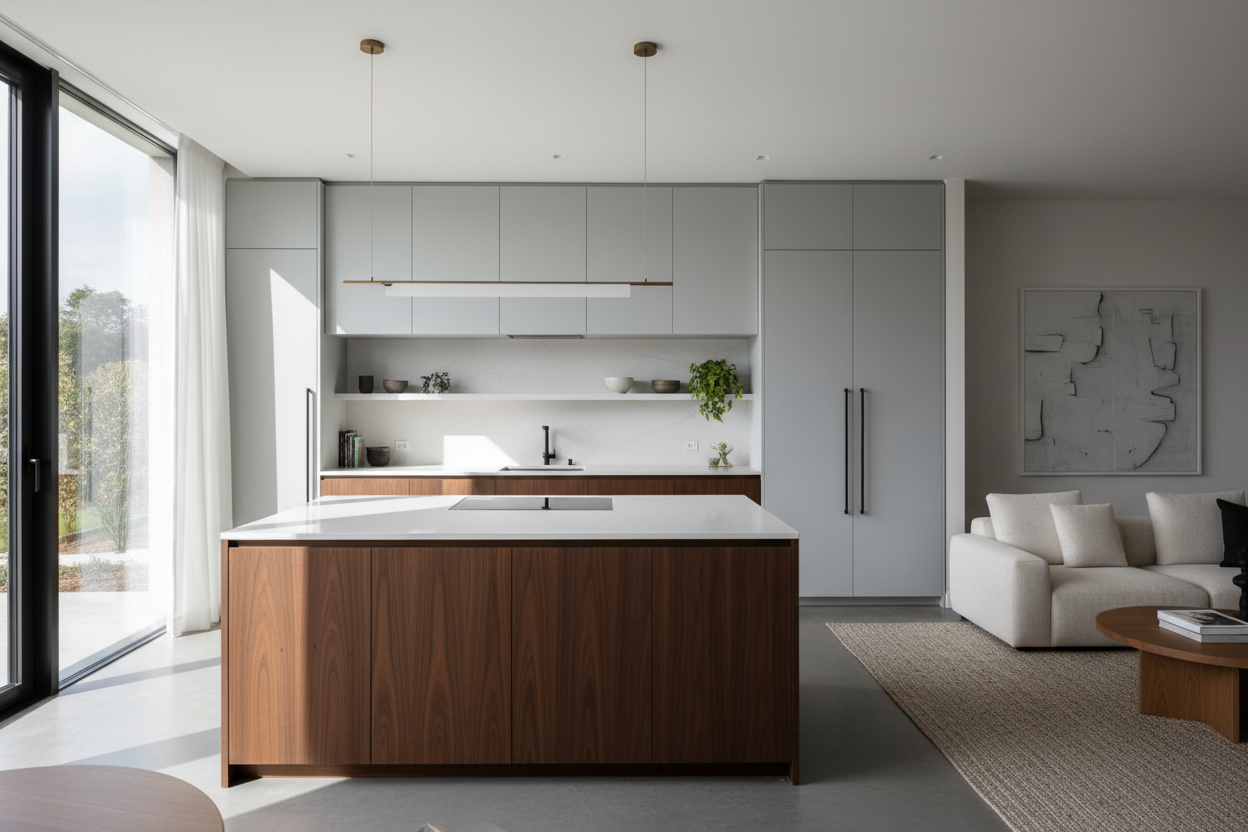
I remember sitting in a windowless design office, staring at a $120,000 quote for a client's new kitchen. The client was beaming, convinced that every single cabinet was being hand-carved by a master craftsman in a dusty workshop. In reality? I was just clicking 'add to cart' on a series of pre-manufactured boxes from a massive factory. The only thing 'custom' about it was the specific way we stacked them and the 40% markup we tacked on for the privilege.
People get blinded by the allure of custom kitchens, thinking it is the only way to achieve a high-end look. I spent years selling that dream before I realized the massive flaw: you are often paying for the ego of the showroom, not the quality of the wood. Most of the time, you are overspending on the 'guts' of the kitchen—the parts you never see—and leaving yourself broke when it comes to the details that actually matter.
- Most luxury cabinets are just standard 24-inch deep boxes with expensive filler panels.
- The 'Semi-Custom' route saves you 50% without sacrificing the look.
- Fixed islands are the fastest way to ruin a flexible floor plan.
- Save your carpenter budget for the three 'visual anchors': hoods, corners, and ceiling trim.
The Dirty Little Secret of High-End Showrooms
Here is the truth that gets me kicked out of industry parties: 'Bespoke' is often just a marketing term for 'we chose the colors for you.' When you walk into a high-end showroom, you aren't looking at unique engineering. You are looking at 3/4-inch plywood boxes—the same ones used in mid-range builds—dressed up with fancy paint and heavy brass hardware.
I have seen homeowners drop $80k on cabinetry where the actual boxes were standard sizes (12, 15, 18, 24 inches). The 'custom' part was just a 3-inch piece of scrap wood used to fill a gap at the end of the run. You are essentially paying a $30,000 premium for a few pieces of matching trim. It is a racket that relies on the fact that most people are too intimidated by the renovation process to ask what is actually inside the box.
Why the 'Semi-Custom' Sweet Spot is Your Best Friend
If I were doing my own kitchen today, I would never go fully custom. I would go semi-custom. This means buying high-quality, mass-produced modular boxes (think IKEA or even solid-wood RTA options) and spending the 'custom' money only on the parts you touch and see: the door fronts, the end panels, and the hardware. This high-low mixing strategy is exactly the same concept as our guide to custom setups for home offices.
By using a standard 30-inch base cabinet that costs $200 and pairing it with a $150 custom-painted shaker door from a third-party maker, you get a kitchen that looks like it cost six figures for about $15,000. You get the soft-close Blum hinges (the industry gold standard) and the heavy-duty drawer slides without the showroom overhead. It is about being smart with where the 'real' wood goes. Put the money into 1-inch thick solid maple doors, not the box that holds your Tupperware.
Stop Letting Cabinets Dictate Your Dining Space
The biggest mistake I see in modern 'luxury' design is the obsession with filling every square inch with fixed cabinetry. We have become allergic to empty floor space. I have designed kitchens where we built massive, 10-foot islands that effectively killed any chance of having a normal dining table. It feels grand for a week, then you realize you are trapped in a maze of granite and painted MDF.
Leaving a wall blank or opting for a smaller footprint of cabinets gives you room for a freestanding hutch or a breakfast nook. This flexibility is vital, especially when choosing chairs and tables for small kitchens where every inch of 'swing space' for a chair matters. A kitchen that is 100% built-in is a kitchen that can never evolve. Give yourself the breathing room to bring in a vintage table or a mobile prep cart later on.
The Only 3 Places You Actually Need a Carpenter
You do not need a master carpenter to screw boxes to a wall. You need them for the 'finesse' points. If you want to save money, hire a general installer for the main run and save your specialist for these three spots. First: the range hood. A custom-plastered or wood-wrapped hood is the focal point of the room. Second: the ceiling-height trim. If your cabinets stop 6 inches from the ceiling, they look cheap. A carpenter can bridge that gap with seamless crown molding.
Third: the awkward corners. Standard 'lazy susans' are usually junk. A carpenter can build a custom 'dead corner' solution or a specialty pull-out that actually utilizes that 45-degree nightmare space. I once spent $2,000 on a custom corner pantry for a client, and she told me it was the only part of the $100k kitchen that actually felt worth the money. Focus on the geometry, not the volume.
Questions to Ask Before Signing That Massive Quote
Before you hand over a deposit, you need to interrogate the quote. Ask your designer: 'Are these boxes built in standard 3-inch increments?' If the answer is yes, you are buying a modular kitchen at a custom price. Ask about the drawer boxes—they should be dovetailed solid wood, not stapled particle board. If they are charging you $1,000 for a cabinet box that isn't even 5/8-inch thick, walk away.
Also, ask for a 'parts and labor' breakdown. Many showrooms hide their massive margins by bundling everything together. If they refuse to show you the cost per cabinet, it is because they don't want you to know you are paying $900 for a box that costs $150 to manufacture. Be the 'annoying' client. It is the only way to ensure your budget goes into the materials, not the salesperson's commission.
Is plywood better than MDF for kitchen cabinets?
For the cabinet boxes, yes—plywood holds screws better and handles occasional moisture better. However, for painted door fronts, MDF is often superior because it does not shrink or expand with humidity, meaning your paint won't crack at the joints.
How much should a custom kitchen actually cost?
For a standard 10x12 kitchen, a truly bespoke, handmade-from-scratch kitchen will start at $50,000 for cabinetry alone. If you are being quoted $20,000 for 'custom,' you are likely getting semi-custom cabinets with a fancy label.
Can I use IKEA boxes with high-end doors?
Absolutely. Companies like Semihandmade or Reform exist specifically for this. You get the world-class engineering of IKEA's internal hardware with a high-end architectural look on the outside. It is the smartest way to renovate.

Dejar un comentario
Este sitio está protegido por hCaptcha y se aplican la Política de privacidad de hCaptcha y los Términos del servicio.