










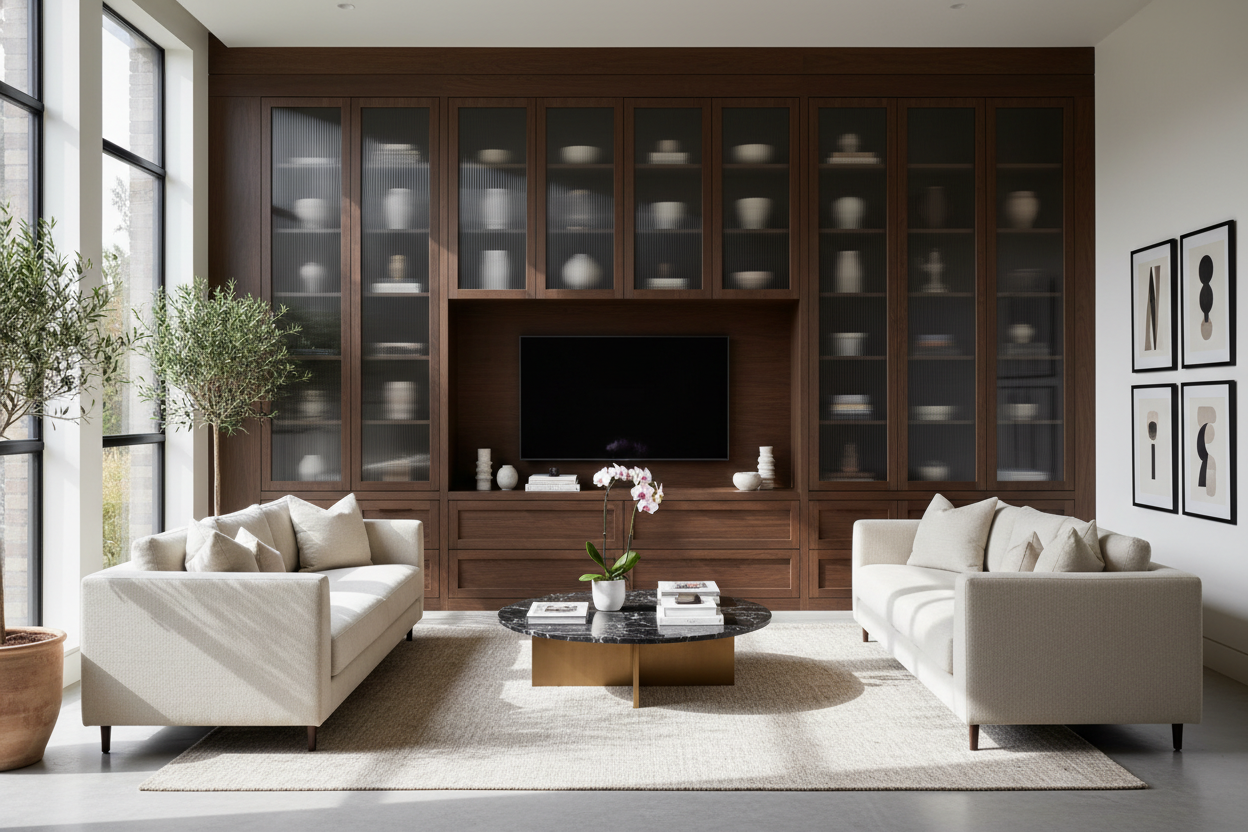
I spent three months staring at the massive, blank wall in my living room, paralyzed by indecision. I wanted those floor-to-ceiling custom built-ins that make a house look like it has its life together, but the local carpenter quoted me $12,000 for the privilege. My budget was closer to $1,200. I almost settled for a couple of wobbly IKEA bookcases until I realized I could just buy a massive 8 foot tall cabinet and get 90% of the look for about 10% of the price.
- Vertical storage is the only way to win in a small footprint; stop buying low-slung credenzas.
- Always measure your 'tilt-up' clearance—an 8ft cabinet needs more than 8ft of ceiling to stand up.
- Mixing closed doors on the bottom with glass on top hides the mess while showing off the 'aesthetic' stuff.
- Anchoring to the wall isn't a suggestion; it's a survival requirement for furniture this tall.
The Built-In Dream (And The Reality Check)
We’ve all been there: scrolling through architectural digests and convincing ourselves that we need custom millwork to feel at home. But the reality of hiring a contractor involves weeks of sawdust, permit headaches, and a bill that rivals a mid-sized sedan. I realized that a freestanding 8 foot cabinet could provide that same sense of permanence without the permanent debt. I didn't need the wall to be built around the shelves; I just needed the shelves to be big enough to command the room.
The shift from 'furniture' to 'architecture' happens the moment you cross that 90-inch threshold. Most standard cabinets stop at 72 inches, leaving a weird, dusty gap at the top that serves no purpose. By opting for an 8 foot tall storage cabinet, I reclaimed that dead air. It stopped looking like a piece of furniture I'd pushed against a wall and started looking like part of the house itself.
Why Going Vertical Is the Ultimate Cheat Code
There’s a specific visual trickery that happens when you use an 8 ft tall cabinet. It draws the eye upward, which actually makes my standard nine-foot ceilings feel significantly higher. It’s the same reason people hang curtain rods near the ceiling. When the furniture reaches for the sky, the room feels grander, even if the floor plan is tight. I managed to fit my entire board game collection, three sets of linens, and a printer inside one 8 ft tall storage cabinet without sacrificing a single extra square inch of floor space.
The beauty of a massive vertical unit is the organization. I used an 8 door storage cabinet layout to keep the chaos categorized. The bottom doors hide the ugly plastic bins of cables and old tax returns, while the middle sections hold the things I actually use. It’s about compartmentalizing your life so you don't have to look at your junk every time you sit down for coffee.
Measuring Your Space (Please Don't Skip This)
Here is where I almost ruined my life: the tilt. If you buy an 8ft tall cabinet and you have exactly 8ft ceilings, you are never getting that thing upright. Geometry is a cruel mistress. You need at least a few inches of 'arc clearance' to transition the unit from laying on the floor to standing against the wall. I learned this the hard way with a heavy 8 foot cabinet with doors that nearly took out my ceiling fan.
Check your doorways, too. An 8ft storage cabinet is a beast to navigate through tight hallways or around kitchen islands. I recommend taping out the footprint on the floor and the height on the wall with blue painter's tape before you hit 'buy.' If you're looking at an 8 foot long cabinet that also stands 8 feet tall, you're basically moving a small shed into your house. Plan your path from the front door to the final destination like you're moving a piano.
Hiding the Ugly Stuff vs. Showing Off Decor
The secret to a 8 foot cabinet that doesn't look like a locker room is the door configuration. I’m a huge fan of the 'mullet' approach: business on the bottom, party on the top. I went with solid wood doors on the lower half to hide my shameful collection of mismatched Tupperware and old magazines. For the top, I chose glass. If you want something that feels a bit more sophisticated and moody, a black cabinet with glass doors is the way to go. It grounds the room and makes your white ceramic vases or old hardcover books pop.
An 8 foot tall storage cabinet with doors gives you the best of both worlds. You get the 'display' vibe of a bookshelf but the 'hide-the-mess' utility of a closet. Just make sure the shelves are thick—at least 3/4 of an inch. Anything thinner will start to bow under the weight of books over time, and nothing ruins the 'custom' look faster than sagging shelves.
How to Make a Freestanding Unit Look Custom
To really sell the lie that this 8ft tall cabinet was built for the room, you have to anchor it flush. Most houses have baseboards that prevent furniture from sitting against the wall. I actually cut a small notch out of the back of my 8 foot tall cabinets to accommodate the baseboard, allowing the unit to sit perfectly flat against the drywall. It’s a 10-minute DIY fix that makes a $500 cabinet look like a $5,000 installation.
Finally, don't overstuff it. Knowing how to style an 8 foot tall cabinet without crowding a room is the difference between a curated home and a cluttered one. Leave some negative space. Group items in odd numbers. And for the love of all things holy, use wall anchors. An 8 ft tall cabinet is a giant lever, and if a kid tries to climb it, you want that thing bolted into at least two studs with heavy-duty L-brackets.
FAQ
Can I assemble an 8ft cabinet by myself?
Technically, maybe. Realistically, no. You need at least two people to stand it up and hold it steady while you're leveling it. These units are heavy and unwieldy; don't risk your drywall or your toes trying to be a hero.
What if my floors are uneven?
Most 8 foot tall storage cabinets will lean forward if your floors slope even a tiny bit. Use plastic furniture shims tucked under the front base until the unit is perfectly plumb against the wall before you anchor it. Never rely on the wall anchors to 'pull' the cabinet straight.
Is MDF okay for a cabinet this tall?
MDF is fine for the frame, but I insist on solid wood or high-quality plywood for the actual shelves. MDF shelves will sag under the weight of books or heavy decor much faster than real wood, especially in a unit this wide.

Dejar un comentario
Este sitio está protegido por hCaptcha y se aplican la Política de privacidad de hCaptcha y los Términos del servicio.