










I spent three years in a rental where the first thing you saw when you walked in was a 55-inch black rectangle staring you down like a monolith from a sci-fi movie. I tried everything to hide it. I bought those weird sliding barn doors (total regret), I tried a gallery wall that just looked cluttered, and I eventually realized that most tv shelf ideas fail because they treat the TV like a piece of fine art rather than an appliance.
- Asymmetry prevents your living room from looking like a retail showroom.
- Always choose a base piece that is wider than your screen to avoid a top-heavy look.
- Mix organic shapes like plants and ceramics to soften the hard lines of the tech.
- Scale your shelves to the size of the TV, not just the available wall space.
The 'Tech Shrine' Problem in Most Living Rooms
We’ve all seen it: the TV is perfectly centered, with one lonely shelf floating exactly six inches below it. It creates this 'shrine' effect where the screen is the only thing your eyes can focus on. It’s stiff, it’s boring, and it makes your living room feel like a waiting room. In my first apartment, I spent $200 on a reclaimed wood shelf just to put it perfectly centered under the screen, and I hated it within a week. It didn't look like a home; it looked like a corporate lobby.
The problem is that symmetry demands attention. When everything is balanced around the TV, you’re basically telling your guests to sit down and start the movie before they’ve even said hello. To fix this, you have to break the 'altar' mentality. The goal is to make the TV a guest in the room, not the host. This means integrating it into a larger composition of storage and decor rather than letting it stand alone on its own dedicated pedestal.
Asymmetry is Your Best Friend (Yes, Really)
The secret to great tv shelves ideas is embracing the off-center. If you shift your TV to one side of a long console and use the extra space for a stack of coffee table books or a tall lamp, the screen suddenly becomes just another element on the wall. I started using staggered shelving—one long shelf high up, a shorter one lower down—to create a visual path that leads the eye around the room. It’s a classic interior design trick that works every time for tv shelf ideas for living room setups.
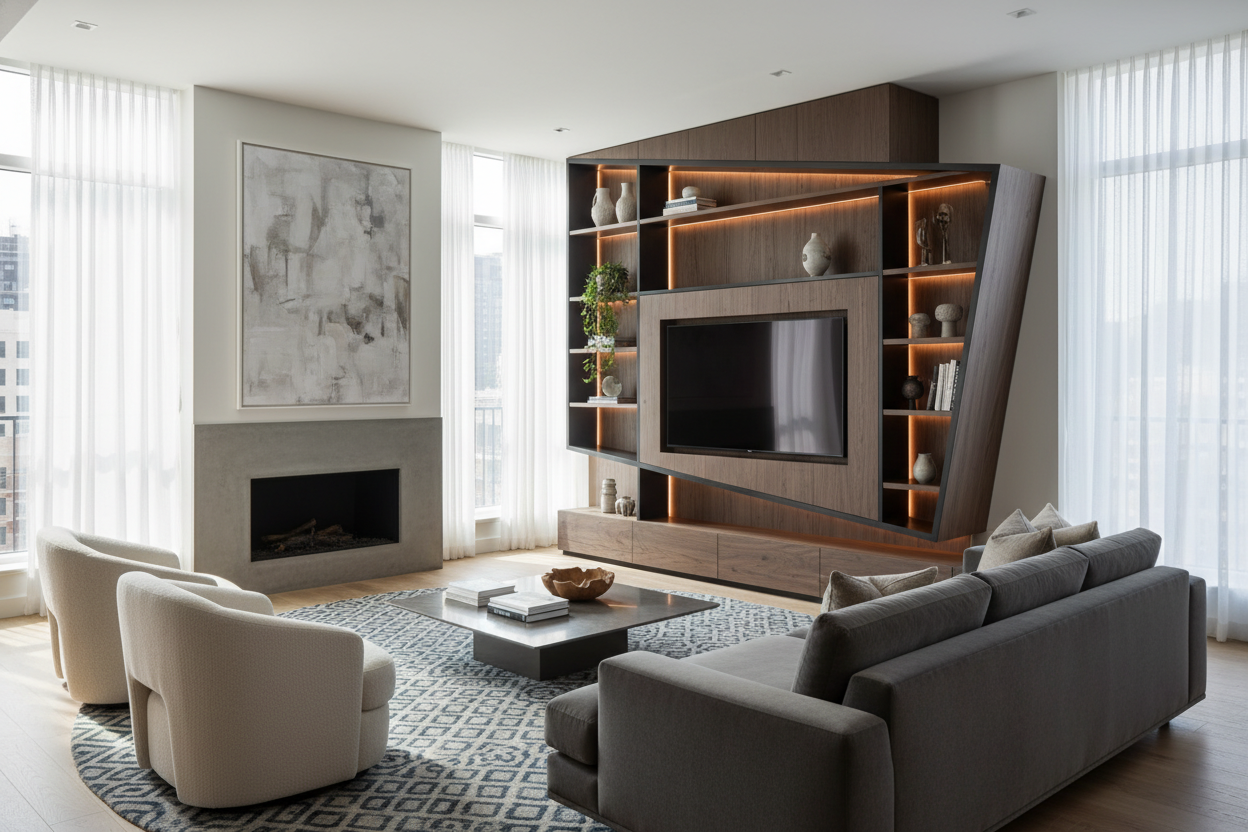
When you place shelves asymmetrically, you create 'negative space' that feels intentional rather than empty. For example, try mounting a long shelf that starts three feet to the left of the TV and extends past it. This draws the eye horizontally across the wall. It breaks up that vertical 'stack' of tech and makes the whole wall feel like a curated installation. I’ve found that using a mix of open shelving and closed cabinetry on one side helps hide the ugly stuff (looking at you, PlayStation) while letting the pretty stuff shine.
Grounding the Space With a Solid Base
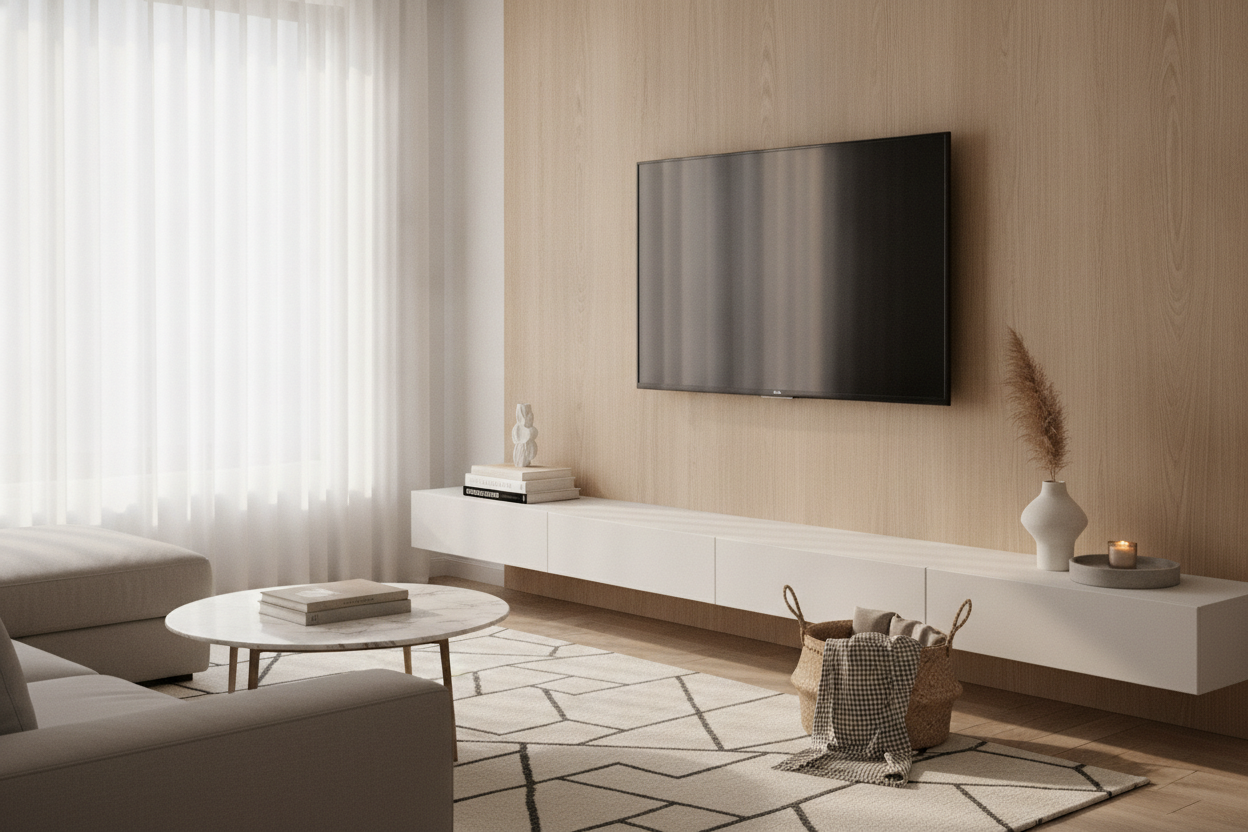
Floating shelves are trendy, but they often lack the visual 'weight' needed to balance a massive 65-inch screen. If you have a giant TV floating over thin air, the whole wall feels top-heavy and anxious. I found that pairing wall ledges with a substantial wide TV stand creates a necessary foundation. It anchors the space and gives the eye a place to land.
I once tried to go 'ultra-minimalist' with just two thin floating shelves and no furniture underneath. It was a disaster. It looked like my TV was about to fall off the wall and take the drywall with it. A solid base piece doesn't just hold your components; it balances the dark mass of the screen. Look for something that is at least 10 to 12 inches wider than the TV on both sides. This extra 'runway' allows you to place a lamp or a plant next to the screen, which further helps in camouflaging that big black box.
Stop Buying Wall Ledges That Are Too Narrow
Scale is where most people mess up. If you have a massive TV, a tiny 24-inch shelf looks like a postage stamp. It’s like wearing a hat that’s three sizes too small. You need adjustable shelf storage that can actually span the width of your setup. I generally recommend shelves that are either exactly the width of the console below or significantly offset to create a deliberate shape.
If you use shelves that are too short, they look like an afterthought. I prefer using long, continuous lines. If you can't find a shelf long enough, butt two of them together to create the illusion of a custom built-in. This gives you a much more high-end look without the custom-carpentry price tag. Remember, the goal is to make the TV feel like it's 'tucked into' the shelving, not just sitting in front of it.
What Actually Goes on These Shelves?
Once the shelves are up, do not just line up your Blu-rays or leave your router out in the open. I use 'the rule of three': one organic item (like a trailing Pothos plant), one structural item (a stack of heavy books), and one personal item (a ceramic bowl or a vintage find). I learned this the hard way when I tried to figure out a corner shelf for a TV in my last studio. Corners are notorious for becoming 'dust bunny graveyards' if you don't style them with intent.
By using a mix of heights—a tall vase on one end, a medium-sized book in the middle, and a small decorative object on the other—you create a vignette that feels lived-in. Avoid anything too reflective or glass-heavy right next to the screen, though. There is nothing more annoying than a glare from a picture frame hitting you right in the eyes during the climax of a movie. Stick to matte textures, wood tones, and greenery to keep the vibe relaxed and cozy.
How high should I mount my TV shelves?
Keep the bottom shelf about 8 to 12 inches above the top of the TV. If it’s any higher, it looks like it’s floating away from the rest of the room. If it’s too low, the area feels cramped and you'll have trouble cleaning the top of the TV.
Can I use floating shelves for heavy speakers?
Only if you are drilling directly into the studs. Most 'floating' shelf hardware is only rated for about 15-20 lbs. A decent bookshelf speaker can easily exceed that, especially with the vibration. If you have heavy audio gear, use shelves with visible, heavy-duty brackets.
How do I hide the messy cables?
Use paintable cable raceways to run wires down the wall, or do what I do: strategically place a tall, opaque vase or a stack of books on the shelf directly in front of where the wires drop. It’s the easiest 'low-tech' fix there is.

Dejar un comentario
Este sitio está protegido por hCaptcha y se aplican la Política de privacidad de hCaptcha y los Términos del servicio.