










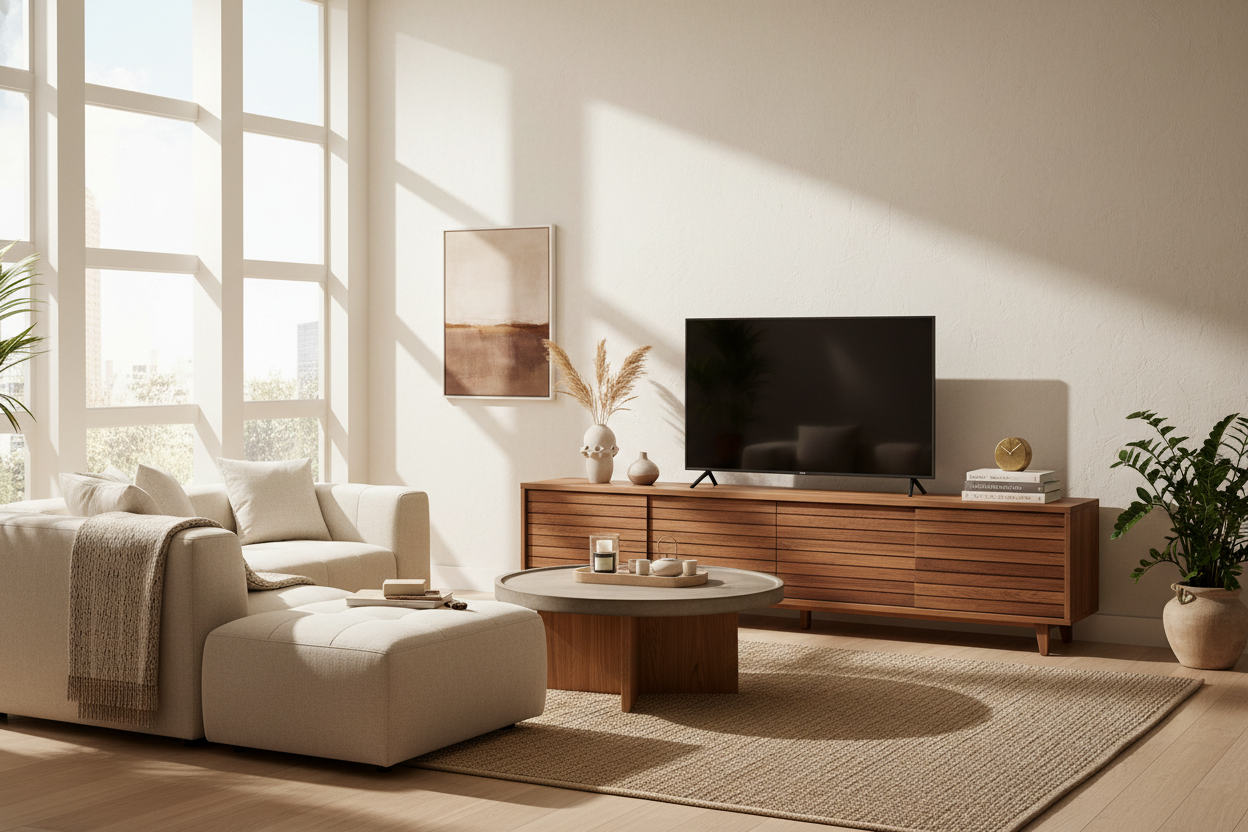
I sat on my sofa last Tuesday and realized my living room had the cozy ambiance of a Best Buy showroom. Between the massive OLED screen, the soundbar, and the gaming consoles, the whole wall was just a void of black glass and plastic. I needed something to kill the clinical vibe, and a wooden tv stand 50 inch wide turned out to be the exact antidote to ground the tech chaos.
- Natural wood grain provides the organic contrast needed to soften high-tech electronics.
- Avoid 'paper veneers' that bubble; prioritize solid wood or high-grade plywood for longevity.
- A 50-inch stand provides the perfect 'overhang' for a standard 50-inch TV (which is actually about 44 inches wide).
- Mixing timber with matte black hardware prevents the room from looking like a rustic cabin.
My Living Room Felt Like an Electronics Store
We’ve all been there. You spend months picking out the perfect screen, only to realize that once it's in your house, it looks like a giant obsidian monolith. My previous media console was a white lacquer piece I bought in my early twenties. It was fine for a smaller setup, but as my screen size grew, the whole wall started feeling sterile and cold. It felt like a waiting room, not a home.
The problem is that modern electronics are all hard edges and light-absorbing surfaces. When you browse standard TV stands, you see an overwhelming sea of industrial metal and high-gloss plastic. It’s too much of the same thing. I realized I didn't need more 'sleek.' I needed texture. I needed something that looked like it had a history, even if I was just unboxing it that afternoon.
I wanted a piece that felt heavy and permanent. Something that wouldn't wobble when my dog bumped into it. Moving away from the 'tech-first' aesthetic was the smartest design move I've made in years. The moment I swapped the white gloss for timber, the room's visual temperature literally felt like it shifted from blue to gold.
Why Timber is the Ultimate Tech-Neutralizer
There is a specific visual psychology at play when you put a piece of high-end tech on a natural material. The wood grain acts as a visual 'softener' for the screen's hard edges. When I finally landed on a wood tv stand for 50 inch tv setups, the room instantly felt more inviting. It’s all about the contrast between the man-made and the organic.
I actually toyed with the idea of a black TV stand 50 inch model because I thought it would make the electronics 'disappear.' I was wrong. All a black stand does is extend the darkness of the screen down to the floor, creating a heavy, light-sucking void. It makes the TV look even bigger and more imposing than it actually is.
Wood, however, reflects light in a way that feels warm and varied. Even a dark walnut has life in it. It reminds your brain that you’re in a living space, not a server room. It provides a necessary anchor that makes the 50-inch screen look like a deliberate part of the decor rather than an intruder that just landed on the wall.
The Great 'Fake Wood' Trap (And How to Avoid It)
If you're shopping for a wooden tv stand 50 inch wide, you're going to see a lot of 'engineered wood' or 'wood-look' finishes. Be incredibly careful here. I once bought a 'walnut-finished' stand for under a hundred bucks that was essentially a high-resolution sticker over compressed sawdust. Within six months, the edges were peeling, and the first time I spilled a bit of water while cleaning, the surface bubbled up like a blister. It looked cheap because it was cheap.
You want to look for kiln-dried hardwood or at least high-quality wood veneers over a plywood core. Plywood is surprisingly stable and holds hardware much better than particle board (MDF). If you think you might upgrade your tech later, remember that a wood tv stand for 75 inch tv needs to be incredibly sturdy to prevent bowing. Investing in real materials now means you aren't replacing a sagging unit in two years.
Check the grain patterns. If the knots repeat in a perfect grid, it's a print. Real wood has 'cathedrals'—those beautiful, sweeping arches in the grain—and unique imperfections. I’ve found that spending the extra 30% for solid legs and a real wood frame pays for itself in the first year alone. Plus, real wood smells better than the chemical off-gassing of cheap MDF.
Balancing the Tone So You Don't Go Full Log Cabin
The fear with wood is always that your living room will start looking like a 1970s basement or a remote hunting lodge. To avoid the 'log cabin' trap, you need to look for pieces with clean lines and modern accents. You don't want a chunky, distressed farmhouse piece if the rest of your furniture is modern. You want a bridge between the two styles.
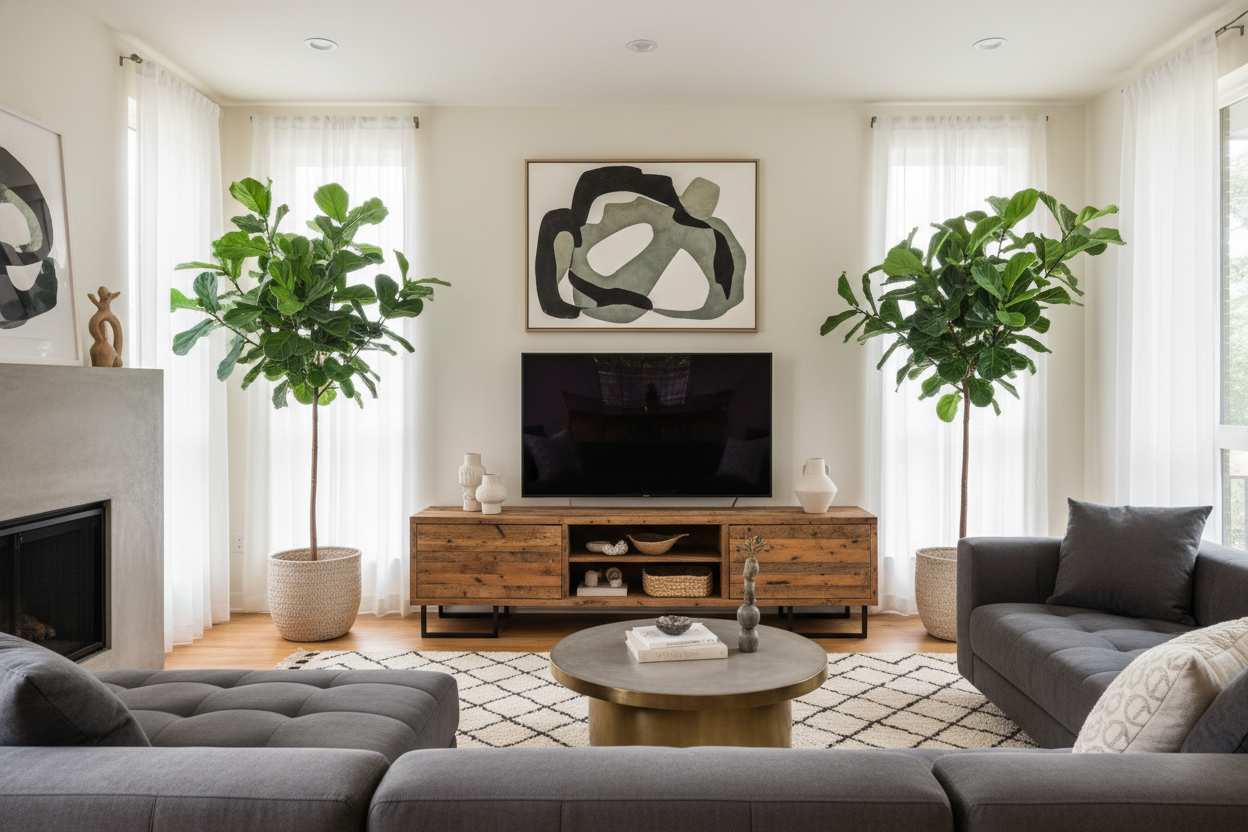
I’m a huge fan of a natural wood and black finish. The black hardware or metal legs tie back to the black of the TV screen and soundbar, while the natural wood provides the warmth. It creates a cohesive look where the tech feels integrated rather than just 'placed' on top of something unrelated.
Keep your styling intentional. Don't clutter the top of the stand with a dozen tiny frames. A single ceramic vase or a small stack of linen-bound books is enough. Let the wood grain do the heavy lifting. My living room finally feels like a place where I can actually relax and watch a movie, rather than just a place where I'm staring at a screen in a cold room.
How wide should my stand be for a 50-inch TV?
A 50-inch TV is usually about 44 inches wide. You want your stand to be at least 50 inches wide to allow for about 3 inches of 'breathing room' on either side. If the stand is exactly the same width as the TV, the whole setup looks top-heavy and cramped.
Can I mix different wood tones in the same room?
Yes, as long as you keep the undertones consistent. If your floors are a cool, grey-toned oak, look for a stand with cool undertones. If you have warm honey-oak floors, stick with warm walnut or cherry. Mixing 'warm' and 'cool' wood tones is usually where people run into trouble.
Is solid wood actually better for heavy electronics?
For a 50-inch TV, weight isn't usually a huge issue, but durability is. Solid wood can handle the heat generated by game consoles and the weight of a heavy soundbar without bowing over time. Cheap particle board will eventually sag in the middle, which can actually damage your TV's stand or cause it to sit at an angle.

Dejar un comentario
Este sitio está protegido por hCaptcha y se aplican la Política de privacidad de hCaptcha y los Términos del servicio.