










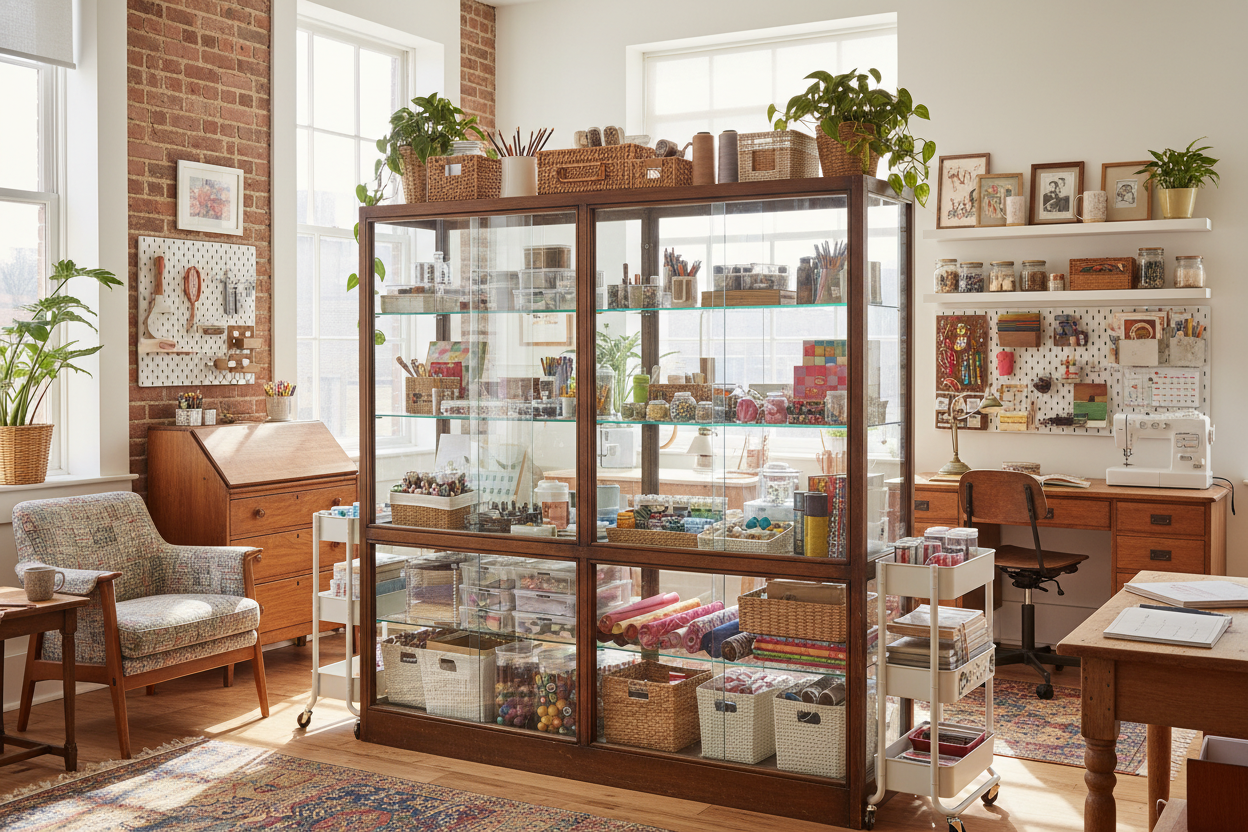
I was staring at a pile of $20-a-yard linen and vintage buttons that had effectively colonized my dining table for three weeks. Every time I tried to organize, I ended up with these deep, dark plastic bins where expensive materials went to die. I knew I needed a massive workspace, but the standard home office desks felt like they would buckle under my heavy-duty sewing machine. Then I saw it: a used glass display counter for sale from a jewelry shop that was going belly-up.
It was 72 inches of tempered glass and anodized aluminum. It looked industrial, slightly beat up, and completely out of place in a residential spare room. But the moment I cleared off the dust, I realized I had found the ultimate hobbyist hack. I finally had a surface that didn't wiggle when I cut fabric and storage that didn't hide my best supplies from me.
- Commercial glass is significantly thicker and safer than the 1/8-inch stuff used in cheap home furniture.
- Visual storage prevents 'inventory amnesia'—you won't buy a fourth pair of fabric shears if you can see the other three.
- The height of a retail counter (usually 38-42 inches) is much better for your back if you do a lot of standing work.
- You can find these for 20% of their original retail price if you are willing to move them yourself.
Why Traditional Craft Desks Weren't Cutting It
Most furniture marketed for 'crafters' is honestly a joke. It is usually made of thin MDF with a paper laminate that peels the second you spill a drop of solvent or glue. Worse, they are designed with deep, opaque drawers. In my experience, if I can't see my thread spools or my leather-working stamps, I forget I own them. I spent years digging through bins, wasting twenty minutes just to find a specific ruler.
Standard desks are also too low. If you are cutting patterns or assembling jewelry, you are hunched over a 29-inch surface that was designed for typing, not manual labor. After an hour, my lower back would be screaming. I needed something counter-height, something deep enough to hold a self-healing cutting mat, and something that didn't feel like it would snap if I leaned on it. Retail fixtures are built to survive thousands of customers leaning on them daily—they are over-engineered in the best way possible.
The Facebook Marketplace Lightbulb Moment
I found my unit on a Tuesday night while doom-scrolling. A local boutique was closing its doors and had listed three 'used show case' units for $150 each. For context, a new commercial display case of that size usually starts at $800 plus shipping. I hesitated for a second, wondering if it was too 'mall kiosk' for my house. I even sat there wondering, Is Searching for Display Cases Used for Sale Actually Worth It? considering the logistics of moving a 200-pound glass box.
I decided to go for it. Bringing home a used showcase display requires a truck, about four moving blankets, and a very patient friend. But once we hauled it into the room, the transformation was instant. Because the top is glass, I could store my most beautiful supplies—hand-dyed yarns and vintage lace—directly under the work surface. I was no longer working on a desk; I was working on a curated gallery of my own tools.
What to Inspect Before You Hand Over the Cash
Don't get blinded by a low price tag. When you are looking at a used glass display counter for sale, you need to be a bit of a jerk during the inspection. First, run your hand along the edges of the glass. You are looking for 'flea bites'—tiny chips that can eventually turn into full-blown cracks. If the top pane is badly scratched, keep in mind that you can't really 'buff out' scratches in tempered glass like you can with wood.
Check the sliding tracks. Most of these units have rear-entry sliding doors. If the track is warped or filled with years of retail grime, the doors will jump the rail and potentially shatter. Open and close them ten times. If it feels like grinding sand, walk away. Also, check the locks. Retail cases often come with plunger locks. If the seller doesn't have the key, you might have to drill it out and replace the cylinder, which is a $30 headache you should use to negotiate the price down.
Making a Retail Fixture Look Like Home Decor
The biggest risk with a used showcase display is that it can make your room feel like an abandoned RadioShack. The lighting is usually the culprit. Most old cases use 5000K 'daylight' fluorescent tubes that make everything look cold and clinical. I ripped those out immediately and replaced them with warm-toned LED strips (3000K is the sweet spot). It changed the vibe from 'storefront' to 'cozy studio' instantly.
Inside the case, don't just pile things in. Use wooden trays or acrylic dividers to group your items. This breaks up the long expanse of glass and makes it feel intentional. If you love this look but your room is too cramped for a 6-foot counter, you might want to look into a 4 Layer Glass Door Display Case With Led Light instead. It gives you that same high-visibility storage but uses vertical real estate rather than eating up your entire floor.
The Verdict: Is It Too Weird for a Normal House?
I’ll be honest: this thing is a beast. It has a massive footprint and it isn't something you can easily move when you decide to rearrange the furniture. If you live in a tiny studio, a full-sized counter is going to feel like an elephant in the room. In those cases, I usually recommend people check out a Corner Display Case to get the same vibe without losing the center of the room.
But for a dedicated craft space or a home office, it's the best furniture decision I've made. It’s a desk, a storage unit, and an inspiration board all in one. My supplies are no longer 'clutter'—they are part of the decor. If you have the floor space and a truck, stop looking at flimsy flat-pack desks and start hunting for retired retail gear. Your back (and your craft projects) will thank you.
FAQ
Is the glass top strong enough to hold a sewing machine?
Usually, yes. Most retail counters use 1/4-inch to 3/8-inch tempered glass supported by an aluminum frame. My heavy-duty Singer hasn't caused a single creak. Just don't drop a heavy hammer on it.
How do you hide the messy stuff?
I use the bottom 'deck' of the case for the pretty things and keep the messy tools in small decorative boxes. You can also frost the back sliding doors with inexpensive window film to hide the cords and chaos behind the unit.
Are they hard to clean?
It's a lot of glass, so yes, fingerprints happen. Keep a microfiber cloth and some vinegar spray nearby. It's a small price to pay for being able to see every single button and bead you own without opening a single drawer.



Dejar un comentario
Este sitio está protegido por hCaptcha y se aplican la Política de privacidad de hCaptcha y los Términos del servicio.