










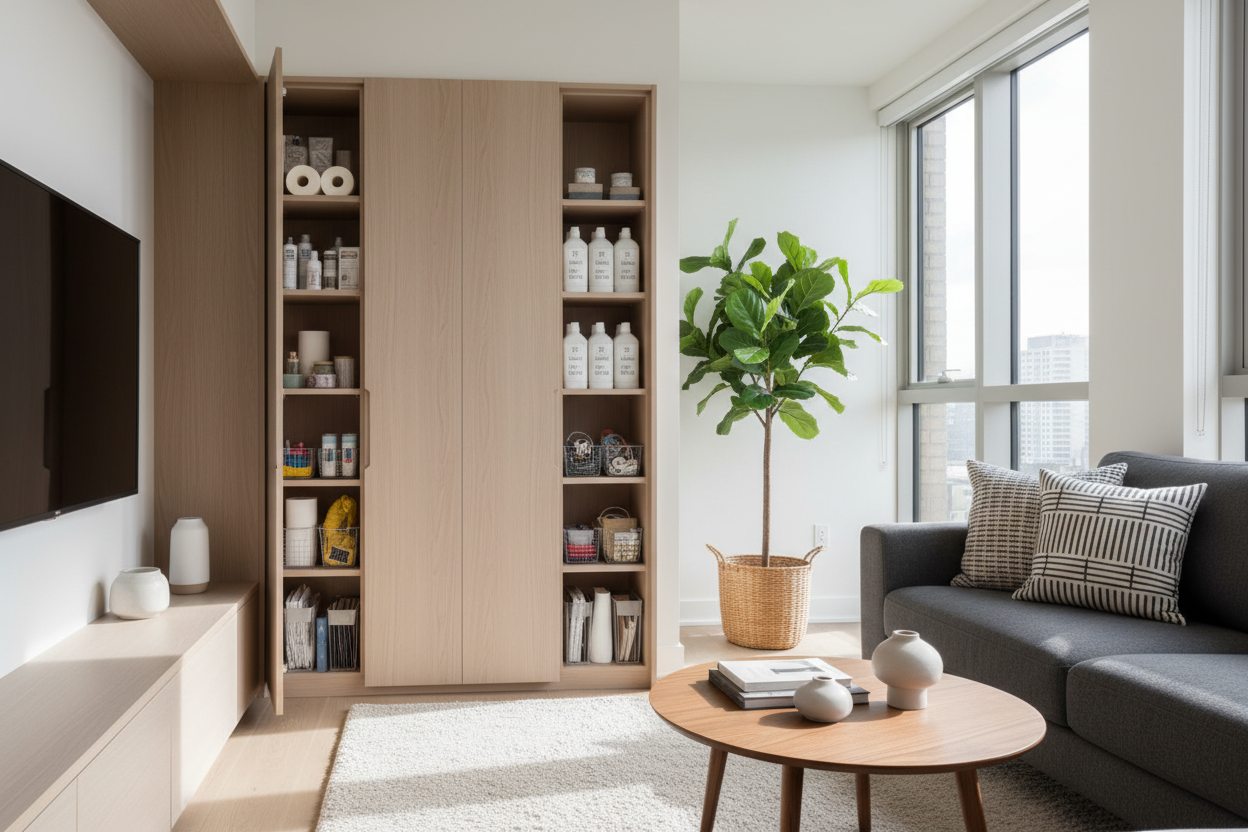
I spent three months staring at a 20lb bag of dog food and a mop bucket that lived permanently in the corner of my kitchen. It wasn't just messy; it was a personal affront to my sanity. My apartment has 'character,' which is landlord-speak for 'we forgot to build a single utility closet.'
I tried those over-the-door organizers, but they just made the door heavy and loud. I looked at rolling carts, but they just collected dust and looked like a temporary solution that became permanent. Finally, I realized the answer was hiding in a 12-inch gap of dead wall space. I needed a narrow cupboard that could swallow the chaos whole.
- Measure your gap twice; 12 inches is standard, but baseboards can steal half an inch of floor space.
- Opt for solid doors to hide visual clutter like cleaning supplies and bulk snacks.
- Adjustable shelving is the only way to fit both a tall broom and small canned goods.
- Always use wall anchors—skinny furniture is notoriously tip-heavy once you load the shelves.
The 'Dead Zone' Dilemma (And Why I Was Going Crazy)
Every small kitchen has one: that awkward strip of wall that isn't wide enough for a 'real' piece of furniture but is just large enough to become a magnet for junk. In my case, it was a 14-inch stretch between the end of my counters and the back door. Because I had no pantry or broom closet, this became the graveyard for my Swiffer, a gallon of white vinegar, and a mountain of reusable grocery bags.
Looking at that pile every morning while making coffee felt like starting the day with a failure. I considered installing floating shelves, but shelves are for things you want people to see. Nobody needs to see my half-empty box of heavy-duty trash bags. I needed a skinny cupboard that could provide the height I needed without jutting out so far that I'd hit my hip on it every time I walked by. The frustration of zero utility storage is real, and standard 24-inch deep kitchen cabinets were way too bulky for this specific sliver of floor.
Enter the Slimline Cupboard (My 12-Inch Savior)
The lightbulb moment happened when I stopped looking for 'kitchen furniture' and started looking for 'slimline storage.' I found a 12-inch wide slim cupboard that was 72 inches tall. It was essentially a vertical locker made of wood. The depth was just 11 inches, meaning it wouldn't block the swing of my back door or make the entryway feel like a tunnel.
There is a big difference between display storage and 'hide the mess' storage. For example, a black cabinet with glass doors is a stunning choice if you want to show off your curated collection of stoneware or vintage glassware. But if your goal is to stash a neon-yellow mop and a cardboard box of Borax, glass is your enemy. You want solid doors. I chose a simple shaker-style white finish that blended into my walls. The moment I shut those doors on my pile of cleaning supplies, my blood pressure dropped ten points.
Don't Underestimate a Skinny Cupboard's Capacity
You might think a 12-inch footprint is useless, but it’s all about verticality. Most of these units come with four or five shelves. I did a little surgery on mine: I left the bottom three feet completely open by removing the lower shelves. This created a perfect 'garage' for my broom, mop, and the handheld vacuum. It's a slimline cupboard hack that most people overlook because they feel obligated to use every shelf the box includes.
On the top half, I kept the shelves close together. This became my 'overflow pantry.' It holds the tall boxes of cereal that don't fit in my main cabinets and the three extra jars of peanut butter I bought on sale. It’s the same logic you’d use when hunting for the perfect small cupboard for your living room—you have to think about the specific items you're housing before you screw the shelves into place. My 12-inch unit now holds more than my actual upper cabinets do simply because the shelf heights are customized to my stuff.
How to Make It Look Intentional, Not Shoved in a Corner
The biggest risk with freestanding slimline cupboard units is that they can look like an afterthought. To avoid the 'dorm room' aesthetic, I did two things immediately. First, I swapped out the cheap plastic handles it came with for heavy unlacquered brass pulls that matched my existing kitchen hardware. It’s a $15 fix that makes a $150 cabinet look like a custom build.
Second, you must anchor it. Because these units are tall and narrow, they are inherently unstable. I used a heavy-duty toggle bolt to secure mine to the stud. It doesn't wobble when I pull the door open, which makes it feel like a permanent part of the architecture. I also put a small tray on top to hold my mail, which helps integrate the unit into the room's workflow rather than letting it sit there like a lonely wooden pillar.
When You Should Actually Just Go Bigger
I love my skinny cupboard, but let's be honest: it's a compromise. If you are a family of four or someone who likes to bake five-tier cakes, a 12-inch wide unit is going to feel like a joke within a week. You’ll be constantly playing Tetris just to get a box of crackers out, which defeats the purpose of being organized.
If you have the luxury of 30 inches of wall space or more, stop looking at the 'slim' category. You should instead invest in a large food pantry kitchen cupboard. A wider unit gives you deeper shelves and often better weight distribution for heavy items like stand mixers. But if you're like me and you're fighting for every square inch in a cramped galley kitchen, the 12-inch hack is a total lifesaver for hiding the ugly necessities of life.
FAQ
Will a 12-inch cupboard actually hold a vacuum?
A stick vacuum like a Dyson or a Shark? Absolutely. A full-sized upright bagged vacuum? Probably not. Measure the 'head' of your vacuum before buying. Most stick vacs are about 10 inches wide, so they slide right into a 12-inch opening with room to spare.
Is particle board okay for a kitchen cupboard?
It's fine as long as it's not sitting in standing water. If your kitchen is prone to leaks or you're putting it right next to a dishwasher, look for 'MDF with a water-resistant laminate' or solid pine. Raw particle board will swell and crumble if it gets wet frequently.
How do I stop the cupboard from tipping?
Use the L-brackets that come in the box, or better yet, buy a 'furniture anti-tip kit' from the hardware store. Since these cupboards are narrow, the center of gravity shifts the moment you open a door filled with heavy canned goods, making them a tipping hazard for kids or pets.


Dejar un comentario
Este sitio está protegido por hCaptcha y se aplican la Política de privacidad de hCaptcha y los Términos del servicio.