










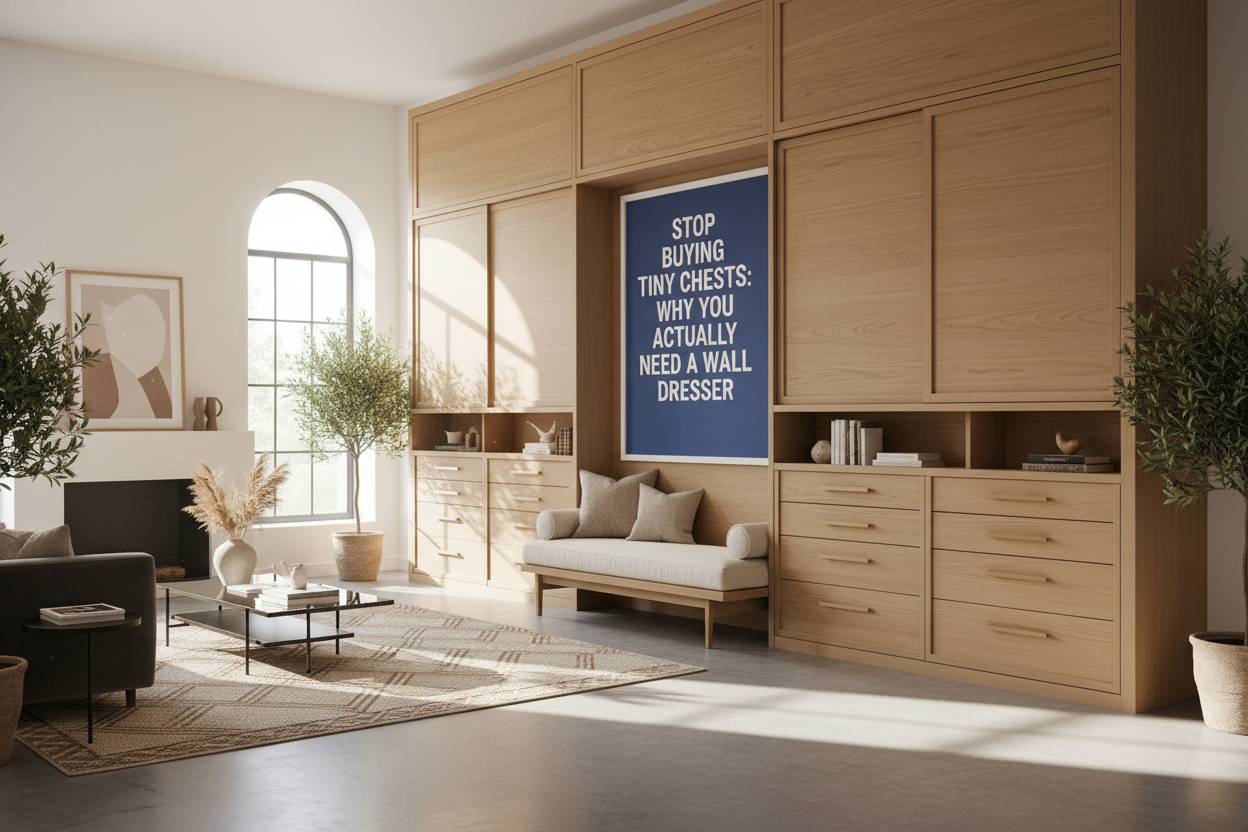
I spent three years living out of a 'clothes chair.' You know the one. It starts with a single pair of jeans on Monday and ends with a structural hazard that could crush a small pet by Friday. My problem wasn't that I was inherently messy; it was that my standard chest of drawers was a joke. It was 30 inches wide and couldn't even hold my socks properly, let alone my entire wardrobe. That is when I realized I needed a wall dresser.
- Maximum Storage: Wall units utilize the full width of your room, eliminating the 'floordrobe' once and for all.
- Built-in Look: Pushing multiple units together creates a high-end, custom appearance for a fraction of the price.
- Visual Calm: One continuous line of furniture looks less cluttered than three mismatched pieces.
- Surface Area: You gain a massive landing strip for decor, mirrors, or a TV without needing extra stands.
The 'Clothes Chair' Phase of My Life is Finally Over
For a long time, I thought I just had too much stuff. I kept buying those trendy, mid-century modern chests that look great on Instagram but hold about four sweaters before the drawers start sticking. My bedroom was a graveyard of small, inefficient furniture pieces. I had a dresser, a separate plastic bin for gym clothes, and a nightstand that was basically a coaster on legs.
The shift happened when I stopped looking for 'a dresser' and started looking for a storage solution that actually respected the dimensions of my room. A dresser wall unit isn't just about having more drawers; it is about reclaiming the floor. When you commit to a wall dresser unit for bedroom storage, you are deciding that your clothes deserve a home that isn't a heap on the upholstery. It is the only way I have managed to keep my floor clear for more than 48 hours at a time.
Why Your Standard Dresser is Failing You
Most traditional bedroom setups are designed for a house from 1954. They give you a bed, two nightstands, and a single upright chest. But here is the truth: standalone dressers are space-wasters. They leave these awkward 12-inch gaps on either side that serve as nothing but dust bunny nurseries. You can't put anything there, and you can't clean back there without a specialized vacuum attachment.
Standard small dressers also become 'dumping grounds.' Because the surface area is so limited, it quickly gets covered in mail, spare change, and half-worn laundry. When you have a full wall dresser, the scale of the piece changes how you treat it. Instead of a cluttered surface, you have a long, intentional architectural element. You aren't just shoving things into a box; you are utilizing the horizontal real estate of your room to create a functional boundary. If your current dresser feels like it is bursting at the seams, it isn't because you have too many clothes—it is because your furniture is under-performing.
Enter the Full Wall Dresser: Storage on Steroids
A full wall dresser is exactly what it sounds like: a continuous run of drawers that spans the majority, if not the entirety, of a wall. This isn't a single piece of furniture you find at a boutique; it is a strategy. You can achieve this by sourcing a massive, long-form piece like a 63-inch modern oak dresser and flanking it with matching units, or by lining up three identical chests side-by-side.
The visual impact is massive. Instead of your eye jumping from a dresser to a gap to a wall to a chair, it follows one clean, horizontal line. This actually makes small bedrooms feel larger because it reduces visual 'noise.' You are mimicking the look of $10,000 custom built-ins for the price of a few flat-pack boxes. I personally used three six-drawer units pushed tight together. It gives me 18 drawers of glory. I have a drawer specifically for 'socks I lost the mate to' and I still have room for my actual jeans. That is the kind of luxury a standard chest can't offer.
How to Fake the Custom Built-In Look
If you want your bedroom wall unit dresser to look like it was installed by a master carpenter, you have to do a little legwork. First, measure your wall three times. You want the units to fit as snugly as possible. If you have a 120-inch wall, don't buy 100 inches of dresser and leave ten inches of dead space on each side. That looks like an accident. Buy 118 inches and let it feel intentional.
Pro tip: remove your baseboards. If you want that flush, 'built-in' look, the furniture needs to sit right against the drywall. Most people skip this and end up with a two-inch gap that drives them crazy. You can also use a bedroom desk and dresser layout strategy where one end of the wall unit transitions into a workspace. This keeps the height consistent across the room. If the units are different brands, a fresh coat of paint across all of them in the exact color of your wall will make them 'disappear' into the room, making the space feel airy despite the massive amount of storage.
Floating Shelves vs. Wall Drawers for Bedroom Storage
I see a lot of people trying to solve storage with floating shelves. Don't do it. Unless you are a literal monk with three perfectly folded linen shirts, open shelving in a bedroom is a recipe for anxiety. Wall drawers for bedroom organization are superior because they hide the chaos. You can have a 'junk drawer' (or five) and your room still looks like a sanctuary. Closed storage provides visual calm. It allows the bedroom to be a place of rest rather than a reminder of your laundry backlog.
Styling Your Bedroom Wall Unit Dresser So It Doesn't Look Like a Warehouse
The danger of a massive dresser wall unit is that it can look a bit like a kitchen laboratory if you aren't careful. You have to break up that long horizontal surface. I like to use the 'Rule of Three.' On one end, I'll have a tall, oversized leaning mirror to add verticality. In the middle, a stack of books and a tray. On the other end, a substantial table lamp with a warm bulb.
If your room is particularly narrow and a deep dresser feels like it's eating the floor, consider adding a dresser hutch or vertical shelving on top of one section. This draws the eye upward. Use textures like wood grain or matte black hardware to keep the unit from looking like a giant white blob. I once made the mistake of buying high-gloss units for a sun-drenched room; the glare was blinding. Stick to matte or natural wood finishes for a large-scale bedroom wall unit dresser to keep the vibe cozy rather than clinical.
FAQ
Can I use a wall dresser in a small bedroom?
Yes, and you probably should. While it sounds counterintuitive to put a huge piece in a small room, one large unit is actually less 'busy' than four small pieces of furniture. It streamlines the space.
How do I stop the drawers from sagging?
Avoid cheap 1/8-inch particle board bottoms. Look for dressers with reinforced drawer bases or solid wood construction. If you're buying budget, you can DIY reinforce the bottoms with a bit of wood glue and extra brackets.
Do I need to anchor a wall dresser?
Absolutely. Especially if you have kids or live in an earthquake zone. When you have that many drawers, the weight distribution can shift dangerously if multiple drawers are pulled out at once. Bolt it to the studs.


Dejar un comentario
Este sitio está protegido por hCaptcha y se aplican la Política de privacidad de hCaptcha y los Términos del servicio.