










I spent three weeks staring at my vintage Marantz receiver and a stack of Blue Note records, refusing to put them behind a solid wood door. It felt like a crime against aesthetics. But when my new tv stand open shelves finally arrived, I had a brief moment of panic as I looked at the three-way power splitter and the dusty ethernet cables dangling like limp vines behind the frame. It’s the classic interior design catch-22: you want the airy, architectural look, but your tech wants to look like a science experiment.
Quick Takeaways
- Hide power strips in decorative opaque boxes on the bottom shelf.
- Follow the 1/3 rule: one part tech, one part media, one part empty space.
- Use velcro ties that match your frame color to route cables down the legs.
- Avoid open shelving in tiny studios where visual 'noise' can feel overwhelming.
The Reality Check of Exposed Tech
The first thing you learn about an open media console is that it has zero secrets. If you’re the type of person who deals with clutter by shoving it into a drawer and leaning against it until it closes, an open concept tv stand is going to be your personal nightmare. It forces a level of intentionality that most of us aren't used to in the 'living room tech' department.
When everything is on display, your surge protector becomes a focal point. I realized quickly that I couldn't just have a tangled nest of plastic sitting there. An open shelf media stand requires you to treat your gear like art. If it doesn't look good, it needs to be managed or hidden in a very specific way. You aren't just buying furniture; you're buying a display case for your life.
My 'Rule of Thirds' for Open Media Consoles
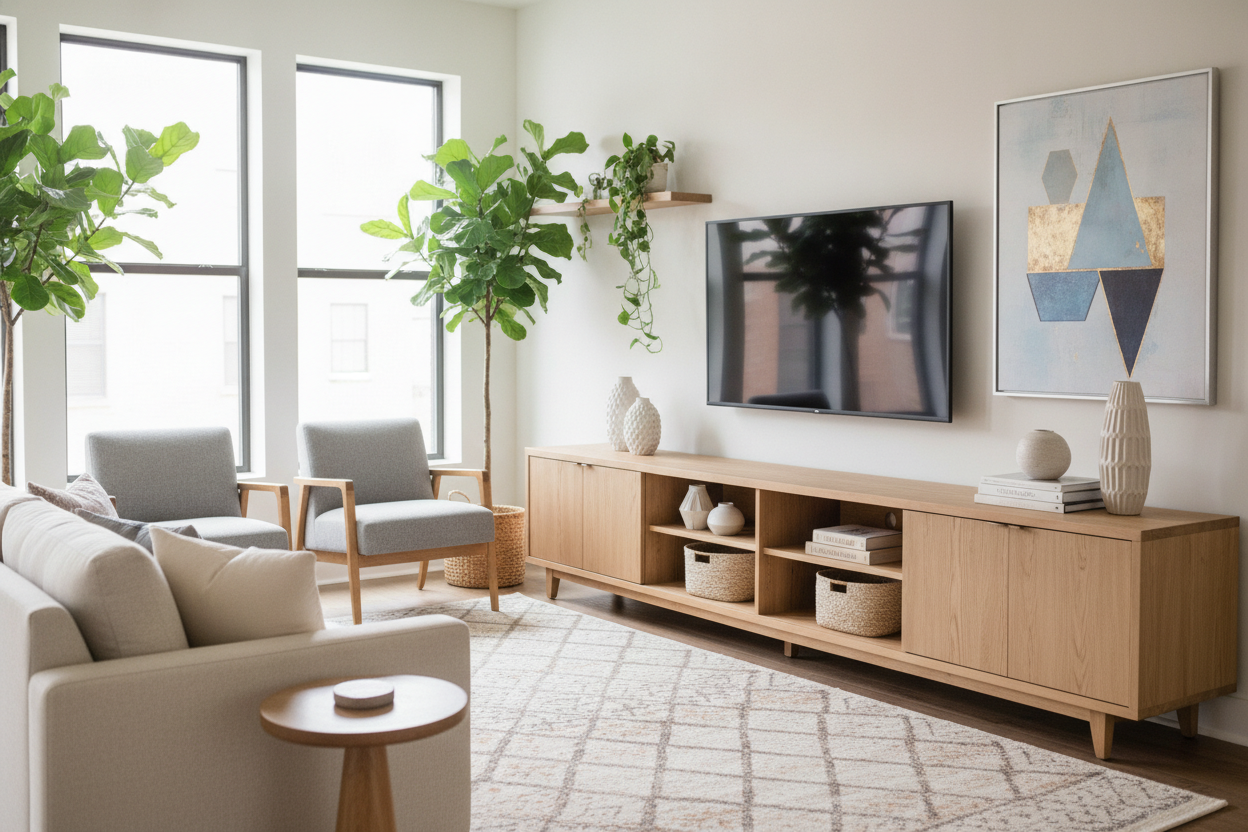
To keep my open shelf entertainment center from looking like a chaotic electronics bin, I developed a strict styling formula. I divide the unit into thirds. The first third is for the functional tech—the turntable, the receiver, or the gaming console. These items need airflow anyway, so an open shelving tv console is actually better for their lifespan than a stifling closed cabinet.
The second third is for texture: records, coffee table books, or a few wooden bowls. This softens the hard edges of the plastic and metal gear. The final third is the most important: negative space. You have to leave some areas empty. If you pack every square inch of your open storage, the room starts to feel heavy and claustrophobic. That empty space lets the design of the stand actually breathe.
How I Tackled the Dreaded Cable Chaos
If you have an open back tv stand, your cable management game has to be elite. I don't use plastic zip ties because they're permanent and ugly. Instead, I use black velcro strips. I bundle the power cords and HDMI cables together and strap them directly to the back of the metal or wood legs. If you run them vertically along the frame, they virtually disappear from most angles.
For the 'brain' of the operation—the power brick and the router—I use a matte decorative box with a lid. I cut a small notch in the back of the box, tuck the messy stuff inside, and place it on the bottom shelf of the open storage tv stand. From the sofa, it just looks like a clean styling choice. This is the only way to survive an open back media console without losing your mind every time you look at the floor.
Hybrid Units: When You Still Need a Little Hiding Spot
I’ll be honest: not everyone is cut out for a 100% open shelving tv stand. If you have three different gaming controllers, a collection of loose batteries, and four remotes, you’re going to hate having nowhere to put them. This is where a hybrid piece comes in. A TV stand with slatted doors is the perfect compromise.
You get the visual lightness of an open tv console, but the slatted doors act like a screen. They hide the plastic clutter while still allowing infrared signals from your remote to pass through. I usually put my 'ugly' tech behind the doors and keep my pretty vintage turntable on the open shelf. It’s the best of both worlds for people who aren't quite ready for the full-exposure lifestyle.
Is an Open Design Actually Right for Your Room?
An open wood tv stand can make a medium-sized living room feel twice as large because you can see the floor and the wall behind it. It’s a great trick for making bulky furniture feel weightless. However, you have to be honest about your habits. If you hate dusting or if your 'media collection' is a pile of loose discs and tangled wires, this style will only stress you out.
I’ve also found that an open-shelf TV stand for small space can sometimes backfire. In a tiny apartment, every bit of visual texture counts as 'noise.' If your stand is filled with stuff, it can make the whole room feel cluttered. But if you can commit to the 'Rule of Thirds' and handle your cables, there is nothing better for showing off a curated collection.
FAQ
Do open TV stands get dustier?
Yes, absolutely. Without doors, your tech is a magnet for dust. I keep a microfiber cloth in a nearby drawer and give my receiver a quick wipe once a week. It’s a small price to pay for the look.
Are open shelves sturdy enough for heavy TVs?
It depends on the material. Look for units with steel frames or solid kiln-dried wood. Avoid the super-thin MDF 'one shelf' units if you’re rocking a 75-inch screen; they will sag in the middle within six months.
Can I put a soundbar on an open shelf?
You can, but make sure the shelf is deep enough so the soundbar doesn't overhang. Also, ensure the shelf height allows for the upward-firing speakers if your soundbar supports Dolby Atmos.

Dejar un comentario
Este sitio está protegido por hCaptcha y se aplican la Política de privacidad de hCaptcha y los Términos del servicio.