










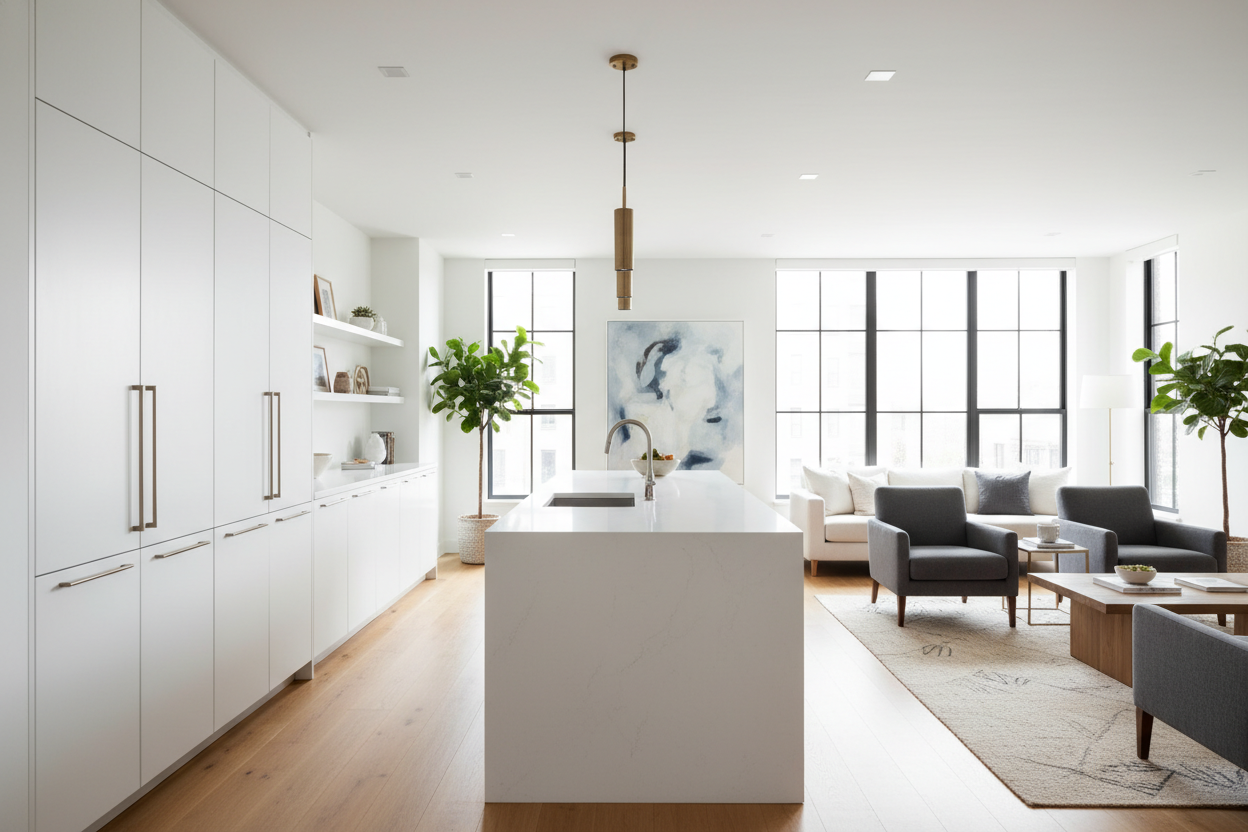
Three years ago, I spent nearly $15,000 on 'custom' cabinetry that had more grooves than a vinyl record store. I thought I was buying 'character.' In reality, I was buying a part-time job as a professional crevice-cleaner. Staring at 47 browser tabs of kitchen inspiration at 1 AM finally led me to the truth: I didn't need more millwork; I needed less noise. I finally ripped it all out for a simple kitchen cabinet design, and my blood pressure has never been lower.
- Slab and Shaker doors are significantly easier to wipe down than anything with decorative beading.
- Minimalist cabinets allow your backsplash and hardware to actually stand out.
- Over-engineered internal pull-outs often break; standard shelves are forever.
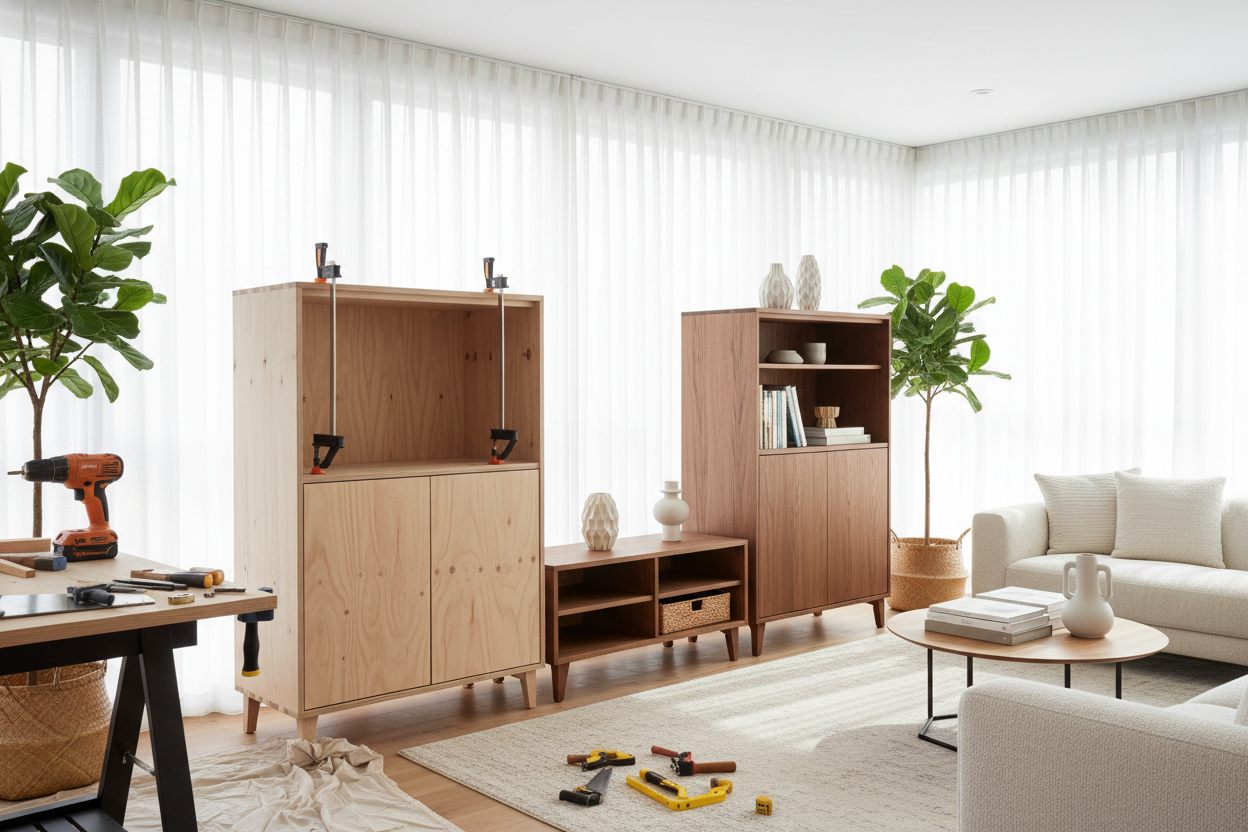
- Freestanding furniture is a better way to add storage than overcrowding your walls with built-ins.
The 'More is More' Millwork Trap (And Why I Escaped)
I fell hard for the Instagram-heavy trend of 'English Countryside' millwork. I'm talking double-beaded Shaker doors, intricate crown molding, and those tiny little decorative feet at the base of the cabinets. On a screen, it looks like a cozy, expensive tavern. In a real 12x14 kitchen where you actually fry bacon, it’s a visual and physical nightmare.
Within two years, those intricate routed edges felt like they were closing in on me. The kitchen felt cluttered even when the counters were empty. The shadows created by all those extra lines made the room feel smaller and, frankly, dated. It was 'too much' in a way that didn't feel high-end—it felt desperate. I realized that true luxury isn't about how many lines a carpenter can carve into a piece of MDF; it's about the quality of the finish and the flow of the room.
What Exactly Is a Simple Kitchen Cabinet Design Anyway?
When people talk about simple kitchen cabinets, they usually mean one of two things: slab (flat-panel) or a clean Shaker. A slab door is a single, smooth piece of wood or laminate. It’s the ultimate minimalist move. A clean Shaker door has a flat center panel and a square frame—no extra 'beading' or 'ogee' curves on the inside edge. This restraint is the secret to a simple design kitchen cabinet that stays relevant for decades.
By stripping back the cabinet profile, you stop competing with the rest of your kitchen. If you have a stunning Calacatta marble backsplash or a high-end brass faucet, simple cabinets act as the supporting cast that lets those stars shine. I’ve found that a 3/4-inch thick door with a crisp, 90-degree edge looks far more expensive than a thin door with a 'fancy' profile every single time.
The Brutal Reality of Cleaning Trendy Grooves
Let’s talk about the 'dust shelves.' Every little decorative groove in a cabinet door is essentially a tiny shelf for kitchen grease and dust to commingle. After six months of cooking, that mixture turns into a sticky, grey cement. I spent way too many Saturday mornings with a toothbrush and a bottle of Murphy’s Oil Soap trying to dig grime out of my 'beautiful' cabinet details.
Choosing simple kitchen cupboard designs isn't just an aesthetic choice; it’s a lifestyle upgrade. With my new flat-panel doors, I can wipe down the entire run of lowers in about ninety seconds with a damp microfiber cloth. There are no corners for the flour to hide in when I’m baking, and no grease traps next to the stove. It’s the difference between a kitchen that looks clean and a kitchen that actually is clean.
How to Make Basic Boxes Look Wildly Expensive
You might worry that a simple layout will look 'builder grade' or boring. It won't, provided you get the details right. One of my favorite simple kitchen cabinet ideas is to use a moody, sophisticated paint color. Think of a deep, desaturated green like Farrow & Ball’s 'Green Smoke' or a soft, warm mushroom. These colors give basic boxes a custom, high-end feel that white or light grey just can't touch.
Hardware is another place to spend. If you saved money on the cabinet doors, buy the heavy, solid brass unlacquered pulls. They develop a patina over time that feels incredibly intentional. I also love breaking up a long wall of solid doors with a single contrasting piece, like a black cabinet with glass doors. It acts as a visual anchor and gives you a place to show off your favorite ceramics without committing to the 'open shelving' dust nightmare.
Why Standard Doors Beat Fussy Internal Mechanisms
The kitchen industry loves to sell you 'solutions' like blind-corner pull-outs, motorized trash bins, and specialized spice drawers. I’ve owned them all, and I’m here to tell you: they are the first things to break. A standard simple kitchen cabinets setup—just a sturdy box with high-quality hinges—is much more reliable. When you over-engineer the interior, you’re stuck with that specific layout forever.
I’ve gone back to the classic 2 door kitchen cabinet layout for my lowers. Instead of a $600 pull-out wire rack that only fits specific-sized jars, I use $10 clear acrylic bins. If my storage needs change next year, I just move the bins. It’s flexible, it’s cheaper, and there are no ball-bearing slides to get stuck or rusted from a leaked bottle of olive oil.
Need More Room? Don't Add More Built-Ins
If you find that your simplified cabinet plan leaves you short on space, the instinct is often to add more wall cabinets. Resist that urge. Wall-to-wall uppers can make a kitchen feel like a claustrophobic box. Instead, keep your built-ins to a minimum and solve your storage issues with a standalone furniture piece. It adds 'soul' to the room and keeps the built-in portion of your kitchen looking lean and intentional.
For example, a large food pantry kitchen cupboard can hold all your dry goods, small appliances, and wine in one dedicated spot. It’s often cheaper than adding three extra custom cabinets and looks like a curated design choice rather than a storage afterthought. By keeping the main 'work' areas of the kitchen simple and using furniture for the heavy lifting, you create a space that feels like a room, not just a laboratory for food.
Is a simple cabinet design cheaper?
Usually, yes. Labor is the biggest cost in cabinetry. A slab or simple Shaker door requires less time to build and sand than a door with complex molding, which saves you money on the front end that you can spend on better countertops.
Do simple cabinets hurt resale value?
Quite the opposite. Heavily stylized cabinets date very quickly (think of the 'Tuscan' trend of the early 2000s). Simple, clean lines are the 'little black dress' of real estate—they appeal to almost everyone and are easy for a new owner to update with different hardware.
What is the best material for simple cabinets?
For a painted finish, high-density MDF is actually superior to solid wood because it won't expand and contract with humidity, meaning your paint won't crack at the joints. If you want a wood look, go for a high-quality white oak veneer for a consistent, modern grain.


Dejar un comentario
Este sitio está protegido por hCaptcha y se aplican la Política de privacidad de hCaptcha y los Términos del servicio.