










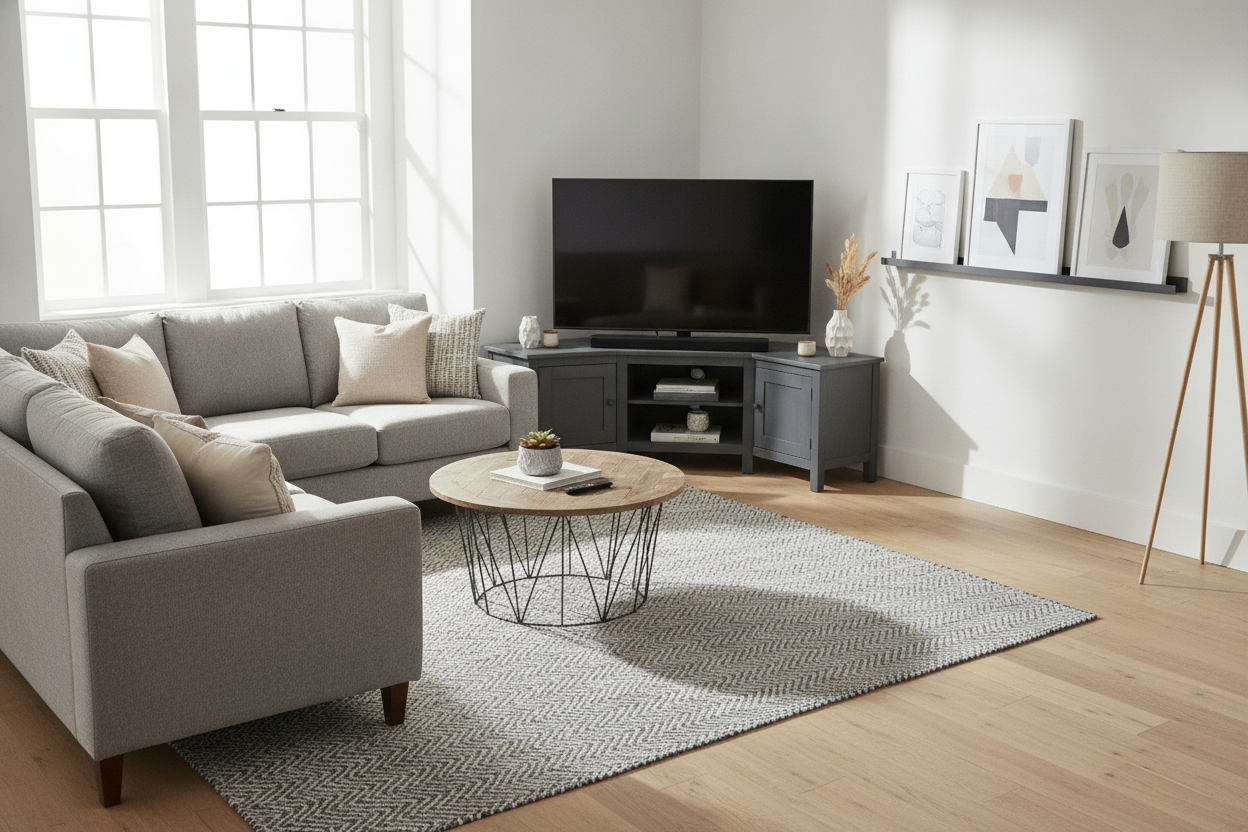
I spent three weeks staring at my living room floor plan like it was a high-stakes Sudoku puzzle. My rental has three doorways, two floor-to-ceiling windows, and a radiator that takes up the only decent stretch of drywall. Every time I looked at grey corner tv stands online, I felt like I was admitting defeat. I didn't want my apartment to look like a basement from 1996, but I also didn't want to have to shimmy sideways just to get to my kitchen.
Quick Takeaways
- Grey acts as a 'visual eraser,' helping bulky corner furniture blend into the walls.
- Modern corner units ditch the chunky oak for tapered legs and slim profiles.
- A 42-inch corner unit can often hold a 50-inch TV if you check the base measurements.
- Cable management is actually easier in a corner because there is a built-in 'dead zone' for wires.
The 'Impossible Floor Plan' Dilemma
My living room is where floor plans go to die. It is a 12x14 box, but between the door to the balcony and the walk-through to the bedroom, I have exactly zero uninterrupted walls. I spent hours measuring standard flat-wall TV stands, only to realize that even a modest 50-inch console would jut out into the walkway, practically begging me to stub my toe every single morning.
When you are dealing with a doorway-heavy room, the corners are usually the only 'dead space' you have left. The problem is that most of us treat corners like an afterthought. We shove a floor lamp there and call it a day. But when your main seating area is dictated by a window, the TV has to go somewhere that doesn't cause a permanent neck strain. I needed a solution that utilized that 90-degree angle without making the room feel like a claustrophobic cage.
Why I Avoided Corner Units (Until Now)
Let’s be honest: corner TV units have a branding problem. When I hear 'corner unit,' my brain immediately goes to those massive, honey-oak plywood monsters that dominated suburban basements in the 90s. They were heavy, they were ugly, and they had those weird glass doors that never stayed shut. I assumed a corner unit would automatically make my apartment look dated and cheap.
That changed when I stumbled across a mid-century corner TV stand with tapered dowel legs and a slate-grey finish. It wasn't a solid block of wood; it had 'air' underneath it. By lifting the unit off the floor, the room suddenly felt larger. It proved that the shape wasn't the problem—the clunky, floor-hugging design was. Modern manufacturers have finally figured out that people in small apartments still want style, even if they're forced into a corner.
The Magic of Cool Tones: Why a Gray Corner TV Stand Works
If you’re going to put a piece of furniture in a corner, you have to decide if you want it to be a focal point or if you want it to disappear. In a small, awkward room, you almost always want it to disappear. This is where a gray corner tv stand becomes a total cheat code. Unlike high-contrast black or heavy dark espresso, grey doesn't draw a hard line against your baseboards.
A cool-toned grey corner tv stand effectively recedes into the shadows of the corner. If you have light-colored walls—white, cream, or even a pale blue—the grey acts as a bridge. It’s neutral enough to handle the tech-heavy look of a soundbar and a gaming console without looking like a black hole in the corner of your eye. I’ve found that matte finishes work best; anything too glossy reflects the TV screen and ruins the 'invisible' effect you’re going for.
Matching Your Undertones
Not all greys are created equal. If your apartment has those classic 'rental beige' floors, a blue-toned charcoal grey is going to look jarring. You want to look for 'greige'—a grey with warm, brown undertones. If you have cool-toned LVP flooring or grey-washed wood, then you can go full slate or lead. Always check your baseboards; if they are a crisp, cool white, stick to a cool grey to keep the palette cohesive.
How Much Can They Actually Hold?
The biggest lie about corner units is that they have 'tons of storage.' Because of that triangular back, you lose about 30% of the shelf depth you’d get in a rectangular unit. My grey corner tv stand has two central shelves, but the sides are basically tiny triangles. You aren't fitting a massive vinyl collection in there.
However, that triangular 'dead zone' behind the unit is a godsend for cable management. I tucked a 12-outlet power strip and my entire mesh router system back there, completely hidden from view. For the internal shelves, I suggest using them for slim components like a PS5 (standing vertically) or a 4K player. Skip the decorative baskets—they won't fit the weird angles. Use that space for the stuff you need but don't want to see.
Other Layout Fixes If You Hate the Corner Look
If you absolutely cannot stomach the idea of a corner unit, you have to get creative with floating. If you have the floor space to spare, you can use a credenza with sliding glass doors and place it perpendicular to a wall, using it as a room divider. This works well in open-concept studios where you need to define the 'living room' from the 'bedroom.'
Another option is a floor-to-ceiling pole mount, but those usually look a bit too 'office lobby' for my taste. For most of us living in real-world apartments with weird radiators and too many doors, the corner unit remains the most practical choice. It’s about reclaiming that square footage and making the room flow again. My gray corner tv stand didn't just hold my TV; it gave me back my walking path.
FAQ
Will a 55-inch TV fit on a corner stand?
Usually, yes, but the edges of the TV will overhang the stand. As long as the TV's legs (the pedestal) fit securely on the top surface, you are fine. Just measure the width of your TV and compare it to the widest point of the stand.
Is grey furniture going out of style?
Deep charcoals and warm greige are timeless neutrals. The 'millennial grey' look of 2015 is fading, but using grey as a functional tool to help furniture blend into a small space will always be a smart design move.
How do I hide cables on a corner unit?
Since corner units sit at an angle, there is a natural gap behind them. Use zip ties to bundle your cables and drop them straight down the back into a cable management box hidden in that triangular floor space.

Dejar un comentario
Este sitio está protegido por hCaptcha y se aplican la Política de privacidad de hCaptcha y los Términos del servicio.