










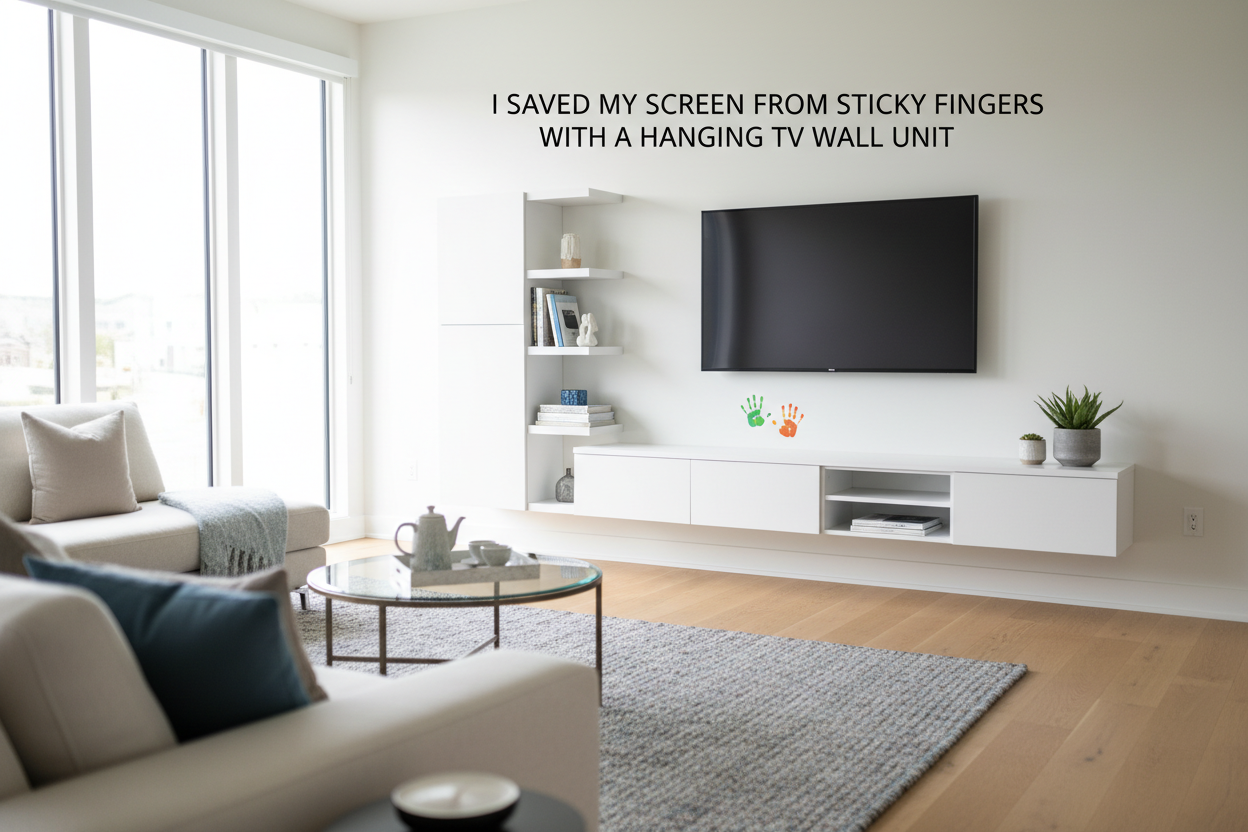
I spent twenty minutes scrubbing dried apple juice off my 65-inch OLED last Tuesday. If you have kids or a dog with a tail like a windshield wiper, you know the feeling. You spend thousands on a setup only to realize it is sitting at the exact height of a toddler's curiosity. I finally hit my breaking point when my two-year-old tried to use the disc drive of my PlayStation as a toaster for a slice of American cheese.
The solution wasn't just mounting the TV; it was getting the entire mess off the floor. Switching to a hanging tv wall unit didn't just save my electronics—it saved my sanity. Here is how I finally reclaimed my living room from the chaos of the 'danger zone.'
Quick Takeaways
- Floor-level consoles are magnets for dust, pet hair, and sticky fingers.
- A wall-mounted unit keeps expensive consoles and fragile screens out of reach.
- Cable management is 90% of the battle for a clean, safe look.
- Floating furniture makes small rooms feel significantly larger by showing more floor.
- Installation requires hitting studs—don't trust drywall anchors alone for heavy gear.
The Floor Console Was a Magnet for Sticky Fingers
Let's be real: traditional TV stands are basically low-altitude targets for disaster. My old oak console sat about 18 inches off the ground. That is the perfect height for a toddler to lean against, a puppy to chew on the corners, or a rogue Roomba to scuff the base. Every time I looked at the TV, I wasn't seeing the 4K resolution; I was seeing the greasy palm prints smeared across the bottom third of the screen.
Beyond the screen itself, the open shelves of a floor unit are a nightmare. My router, the cable box, and my Xbox were all sitting right there, glowing with tempting buttons. It wasn't a matter of 'if' something would get broken, but when. Plus, trying to vacuum under a heavy wooden cabinet is a chore I wouldn't wish on anyone. The dust bunnies under there had evolved into sentient life forms by the time I finally moved that beast of a stand.
Why a Hanging TV Wall Unit Was the Only Real Solution
I initially thought just mounting the TV to the wall would fix it. I was wrong. I ended up with a TV high on the wall and a floor console still sitting below it, which just created a giant gap of visible, dangling wires. It looked like a hospital waiting room. I realized I needed a cohesive hanging wall unit for tv that could house the tech and the screen as one elevated system.
I eventually settled on a floating TV stand wall mounted media console. By lifting the storage unit off the floor, the 'touchable' zone moved from 18 inches to about 36 inches. That might not sound like much, but in the world of a three-year-old, those extra 18 inches are basically the summit of Mount Everest. Suddenly, the glowing buttons and fragile discs were safely out of the strike zone, and I could actually breathe while my kids played in the same room as my electronics.
Hiding the Danger Zone (A.K.A. The Cords)
If the screen is the prize, the cords are the poison. Tangled HDMI cables are a hazard for kids and a chew toy for Labradors. When I installed my hanging unit, I made sure to use the internal cable channels. Some people prefer to go behind the drywall, which is great if you're handy with a saw, but a good unit will have pre-drilled ports to keep everything contained.
Now, instead of a 'spaghetti mess' spilling out from behind a cabinet, there is nothing but clean wall. The space between the bottom of the unit and the floor is completely clear. It doesn't just look better; it removes the temptation for kids to pull on wires to see what's at the other end. No more 'no-go' zones or plastic baby gates surrounding the entertainment center.
The Unexpected Bonus: It Actually Looks Chic
Usually, when you 'child-proof' a house, you end up with orange foam on the corners of tables and plastic latches everywhere. It's ugly. But moving to a wall-mounted setup actually improved the room's aesthetic. Because you can see the floor extending all the way to the baseboard, the whole room feels about 20% larger. It's a classic interior design trick that actually works in the real world.
I went with a white media center wall unit to match my walls. In a small living room, a dark, bulky floor console acts like a black hole, sucking up all the light. The white unit blends into the architecture, making the tech feel like it's part of the house rather than just stuff sitting in it. It feels intentional, modern, and—dare I say—adult, despite the mountain of LEGOs just a few feet away.
Read This Before You Start Drilling
Before you go ham with a power drill, you need to measure twice. The biggest mistake people make with a hanging tv wall unit is mounting it too high. You don't want to feel like you're in the front row of a movie theater. Sit on your actual sofa, look at the wall, and mark your natural eye level. That should be the center of your screen.
Also, please find your studs. A 75-inch TV and a solid media console weigh a lot. I've seen DIY disasters where people use butterfly anchors in drywall, only to wake up to a $3,000 crash in the middle of the night. If the studs don't line up perfectly with your unit's mounting holes, use a backer board or high-quality toggle bolts rated for at least 100 pounds. Once it's up, you can get back to styling a TV hanging wall cabinet with a few well-placed plants or books—things your kids finally can't reach.
My Personal 'Oh No' Moment
I'll be honest: my first attempt at this was a disaster. I mounted the unit without checking if my soundbar would fit inside the cubby. It was a half-inch too wide. I ended up having to mount the soundbar separately, which defeated the whole clean look purpose. Measure your gear—every single piece—before you buy the furniture. Don't trust the photos online; check the internal dimensions in the specs.
FAQ
Can a floating unit hold a heavy TV?
Yes, provided you are anchored into wood studs. Most high-quality units are rated for 70-100 lbs, which is more than enough for modern LED screens. Just don't let your kids sit on the shelf.
How high should I mount it to avoid kids?
Usually, having the bottom of the unit about 24 to 30 inches off the floor is the sweet spot. It's high enough to stay out of reach but keeps the TV at a comfortable viewing height from the couch.
Do I need a professional to install it?
If you can find a stud and use a level, you can do it yourself. If the idea of drilling into your wall makes you sweat, hire a handyman for an hour. It's cheaper than replacing a smashed TV.

Dejar un comentario
Este sitio está protegido por hCaptcha y se aplican la Política de privacidad de hCaptcha y los Términos del servicio.