










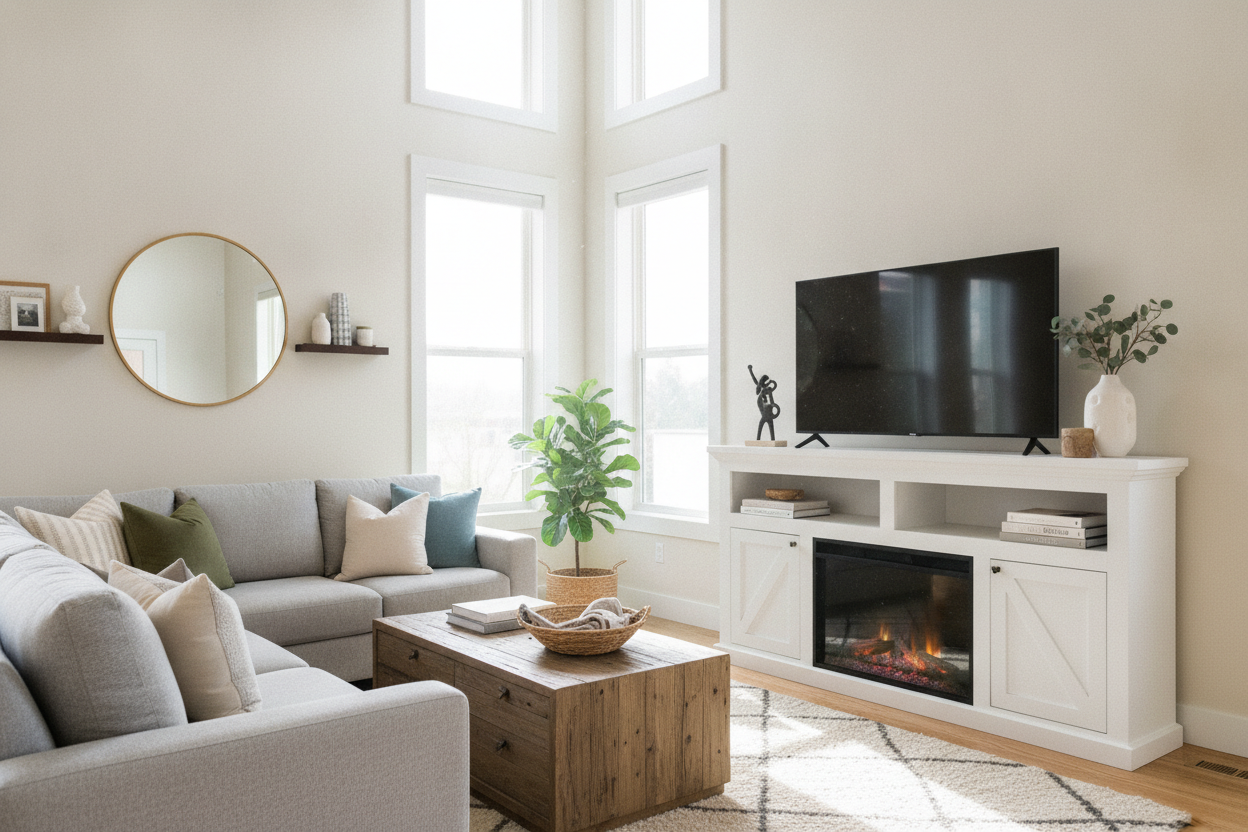
My living room used to feel like a high-end cardboard box. It had beige walls, beige carpet, and a total lack of soul. I spent three months staring at a 12-foot expanse of drywall, trying to figure out if I should hire a contractor for a $10,000 stone hearth or just move. Then I found a fireplace tv stand mantel that actually looked like a piece of architecture, and I realized I didn't need a sledgehammer to fix my house.
Quick Takeaways
- Architectural Presence: A mantel unit provides a vertical focal point that low-profile stands can't match.
- Eye-Level Comfort: Keeps your screen at the correct height, unlike mounting over a high masonry fireplace.
- Storage and Style: You get the cozy vibes of a fire plus a 5-to-8 inch deep ledge for actual decor.
- Plug-and-Play: Most units run on a standard 120V outlet and don't require venting or gas lines.
The Agony of the Builder-Grade Blank Wall
If you live in a house built after 1990, you know the struggle. Builders love to leave one massive, featureless wall in the 'great room' and expect you to figure it out. For years, I tried to fill that void with traditional tv stands. They were fine, but they always felt like floating boxes. They were too low, too thin, and they did nothing to break up the vast sea of drywall.
When your furniture is only 18 inches tall and your ceilings are 9 feet, the proportions are just wrong. It makes the room feel unfinished, like you're still in the process of moving in. I tried the gallery wall approach, but it just looked cluttered. I needed something with visual weight—something that felt like it was part of the house, not just something I bought on a whim. That is where the traditional mantel ledge comes in. It draws the eye upward and creates a 'destination' in the room.
Enter the Faux Hearth (And Why the Ledge Matters)
The difference between a cheap heater and a fireplace tv stand with mantel is all in the ledge. A true mantel unit has a thick, overhanging top that mimics the look of a real masonry hearth. This isn't just about aesthetics; it's about anchoring the room. When the top of the unit sticks out a few inches past the firebox, it creates a shadow line that makes the piece look permanent.
When you look to choose the perfect tv stand with fireplace, pay attention to the depth of that mantel. If it is less than five inches deep, it will look like a toy. You want something substantial. I looked for a unit with a crown-molding-inspired edge. It provides that architectural 'oomph' that makes people ask, 'Was that here when you bought the place?'
The firebox itself is the secondary feature. The real win is the structure around it. Most of these units are made from high-density MDF with a wood veneer, but if you find one with a decent finish, it’s indistinguishable from a custom-built surround. It gives the room a center of gravity that a thin metal stand never could.
Wait, You Actually Get a Ledge to Decorate?
Let’s be honest: the best part of a fireplace isn't the heat—it's the decorating. Before I got my mantel unit, I had nowhere to put my favorite 11x14 framed prints or my brass candlesticks. Now, I have a dedicated stage. During the holidays, I finally have a place to hang stockings without using those ugly adhesive hooks on the wall. I can drape a cedar garland across the ledge and it stays put. It’s a small detail that makes the house feel like a home instead of a rental.
How I Faked the 'Built-In' Look on a Tuesday Afternoon
I didn't just push the unit against the wall and call it a day. To really sell the 'built-in' illusion, I flanked my fireplace tv stand mantel with two narrow bookshelves that matched the height and color of the unit. This created a full-wall feature for under $800. I chose a white fireplace heater tv stand because it blended perfectly with my existing 5-inch baseboards. By butting the unit up against the wall and running a small bead of caulk along the side where it met the bookshelves, it suddenly looked like a custom carpenter had spent three days in my living room.
Cable management is the other secret. Nothing ruins the 'stone hearth' vibe faster than a tangle of black HDMI cables. I used a paintable cord cover to hide the wires running from the TV down to the back of the mantel. Because the unit has a solid back, I could hide my router, power strips, and gaming consoles inside the side cabinets, keeping the focus entirely on the fire and the decor. It took me about four hours from unboxing to the final 'styling' phase.
Neck Pain Averted: The Hidden Ergonomic Win
We’ve all seen it: the 'TV too high' phenomenon. People with real fireplaces are often forced into balancing a screen over an existing fireplace, which usually means the TV is six feet off the ground. It’s like sitting in the front row of a movie theater. Your neck hurts after twenty minutes of Netflix.
With a fireplace TV stand, the mantel is usually around 30 to 35 inches high. This puts your TV at the perfect ergonomic height for viewing from a standard sofa. You get the cozy ambiance of the flickering flames below the screen without the chiropractor bill. It’s the best of both worlds—the traditional look of a hearth with the practical functionality of a media center.
Personal Experience: My Assembly Mishap
I’ll be real: my first attempt at one of these was a disaster. I bought the cheapest model I could find, and the instructions were basically a blurry photocopy. I put the 'H' bracket on backward and didn't realize it until the very last step. I had to take the whole thing apart. Lesson learned: spend the extra $100 for a unit with solid hardware and clear instructions. Also, check the weight limit. My current unit supports 100 lbs, which is plenty for a 65-inch TV, but those flimsy $200 models will bow in the middle if you aren't careful.
FAQ
Is it safe to put a TV directly on the mantel?
Yes. These units are designed so the heat blows out of a front-facing vent, usually located just above the firebox or at the base. The top mantel surface stays cool to the touch, so your electronics won't melt.
Does it cost a lot to run the heater?
Most units use about 1500 watts on the high setting. If you’re just running the 'flame effect' without the heat, it costs pennies. Using the heater is comparable to running a high-end space heater—great for zone heating one room, but don't try to heat your whole house with it.
Can I change the light settings?
Most modern units come with a remote that lets you adjust the brightness and sometimes even the color of the flames. I personally stick to the 'orange' setting for realism, but the 'blue' flame is a fun party trick.

Dejar un comentario
Este sitio está protegido por hCaptcha y se aplican la Política de privacidad de hCaptcha y los Términos del servicio.