










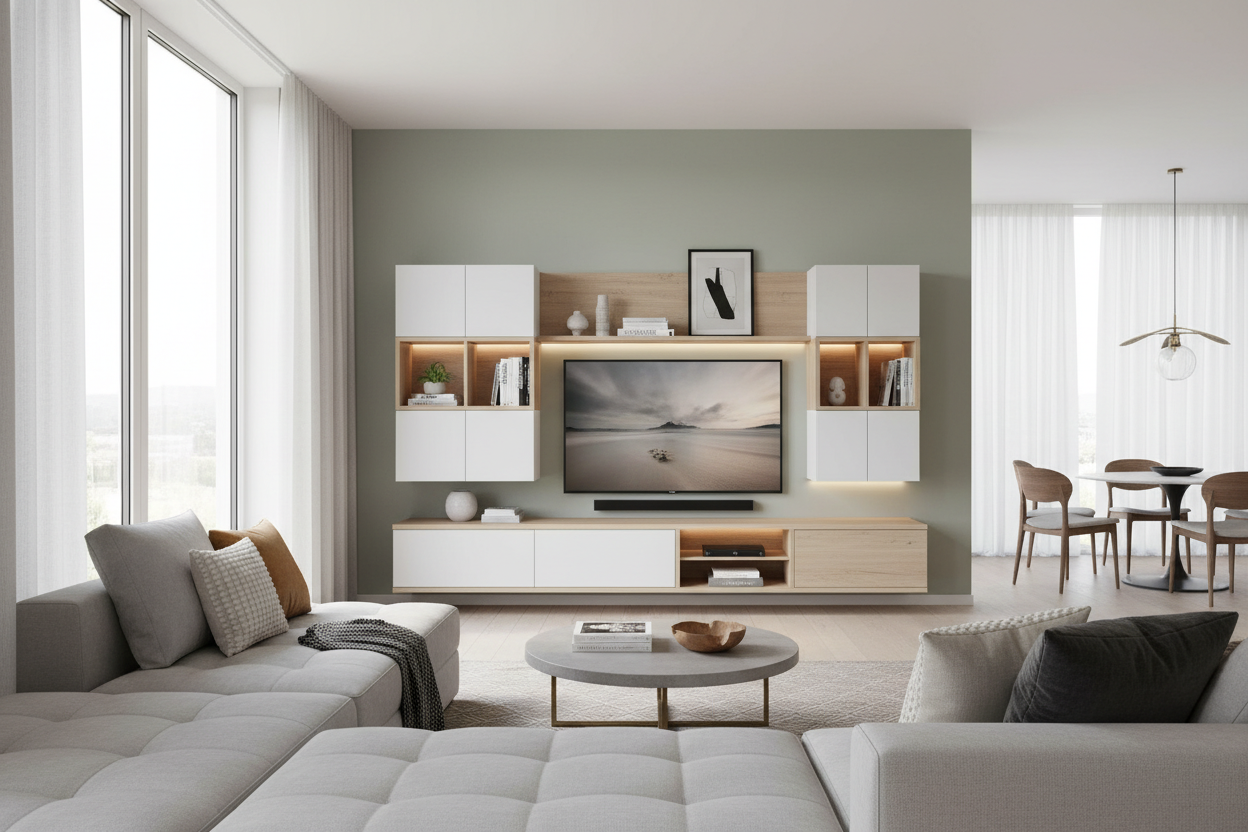
I spent three hours last Saturday staring at my living room wall, sweating, trying to figure out how to fit a new 75-inch TV onto a stand that was clearly designed for a 50-inch screen from 2012. My old console was a solid oak beast that weighed more than my first car. It was beautiful, sure, but it was also a tombstone for my living room's potential. That's when I finally ditched the 'statement piece' for an entertainment center modular system.
Quick Takeaways
- Modular units adapt to your TV size, so you don't have to buy new furniture when you upgrade your tech.
- They are significantly easier to move, breaking down into manageable sections rather than one massive block.
- You can customize the layout to fit around radiators, windows, or off-center outlets.
- The aesthetic is 'built-in' without the permanent price tag or commitment.
The Day I Realized My 200-Pound Console Was a Mistake
I bought 'The Beast'—as my friends called it—back when I thought heavy furniture was the only way to prove I was a real adult. It was a 72-inch long, single-piece sideboard made of solid walnut. It took three delivery guys and a lot of swearing to get it up to my third-floor apartment. It looked great for exactly two years. Then, I wanted a bigger TV. Then, I moved to a place with a fireplace that made the console stick out into the hallway. Suddenly, my expensive investment was a massive, immovable liability.
The breaking point came when I realized the feet of my new OLED screen literally hung off the edges of the walnut top. I was stuck. I couldn't stretch the wood, and I couldn't move the unit alone to even see where the cables were tangled behind it. I ended up selling it on Craigslist for a quarter of what I paid, just so someone would come and haul it away. That's when I started looking into a modular entertainment unit. I needed something that didn't treat my floor plan like it was set in stone.
What Makes an Entertainment Center Modular Setup Better?
When people hear 'modular,' they often think of those cheap plastic cubes from college dorms. That's not what we're talking about here. A high-quality modular system is a collection of curated pieces—low-profile bases, vertical towers, and bridge shelves—that work together to create a cohesive look. You aren't buying one rigid block; you're buying a kit of parts that you can arrange to fit your specific needs.
By using a modern entertainment center wall unit, you get the visual weight of a custom built-in without the four-figure contractor bill. If you want more storage for your vinyl collection, you add a tower. If you want a minimalist look, you keep just the base and a few floating shelves. It’s about flexibility. Most high-end modular systems use cam-lock connectors or simple bracket systems that let you snap pieces together in an afternoon, making the 'assembly' feel more like an upgrade than a chore.
3 Reasons I'm Never Going Back to Fixed Furniture
I’ve lived with both, and the difference is night and day. Fixed furniture is a snapshot of who you were when you bought it; modular furniture is a partner for who you might become next year.
It Actually Fits My Awkward Wall
My current living room is a designer's nightmare. There is a radiator on the left, a window that is about six inches off-center, and a light switch that seems to exist specifically to be blocked by furniture. A standard 80-inch console would have covered the radiator or blocked the window. With my modular setup, I simply placed the main base under the TV and moved the storage tower to the opposite side of the light switch. It saved my awkward living room by letting the furniture adapt to the architecture instead of fighting it. I even left a small gap between the units to allow for airflow near the heater, which is something you just can't do with a single-piece unit.
Upgrading the TV Doesn't Mean Trashing the Stand
Let’s talk about the 'TV creep.' Every five years, screens get bigger and cheaper. If you have a fixed hutch with a 'TV cavity,' you are limited by those dimensions forever. If you buy an 85-inch screen but your hutch only fits a 65-inch, you're buying new furniture. With a modular system, you just slide the side piers further apart. If the base is too narrow, you can often buy a matching extension or a wider center module for a fraction of the cost of a whole new set. It’s the only way to future-proof your living room without feeling like you're stuck in 2015.
Moving is No Longer a Nightmare
The last time I moved, I did it with a modular setup. Instead of begging four friends to help me carry a 200-pound oak behemoth up a flight of stairs—and inevitably scratching the walls—I just unbolted the three sections. Each piece was light enough for one person to carry comfortably. They fit into the back of a standard SUV, no box truck required. When I got to the new place, the layout was different, so I swapped the left and right towers. It took twenty minutes to reconfigure, and my back didn't hurt for a week afterward.
How to Style Separate Pieces So They Don't Look Like a Dorm
The biggest fear with modular gear is that it will look 'disjointed.' To avoid that, you need an anchor. I always recommend starting with a stylish black TV stand as your base. Black or dark charcoal finishes tend to hide the seams between modules better than light wood grains. It creates a solid visual foundation that makes the separate pieces look like one intentional unit.
Next, handle your cables. Nothing ruins the 'high-end' look faster than a nest of wires visible in the gaps between your modules. Use adhesive cable channels on the back of the units to route everything to a single power strip. Finally, use 'bridge' elements. A long floating shelf that spans across the top of the base and the side towers ties everything together vertically. It draws the eye upward and creates that 'wall unit' feel that makes the room look finished and expensive.
Is the Switch Worth the Investment?
If you plan on living in your current home for the next 30 years and never plan on buying a different sized TV, sure, buy a solid, one-piece console. But for the rest of us who move, upgrade, and change our minds, the modular route is the only one that makes sense financially. You stop buying 'disposable' furniture that gets ruined during a move or becomes obsolete when a new tech standard drops. You can browse customizable entertainment centers and find a style that fits your current vibe, knowing you can add to it or subtract from it later. It's about buying furniture that actually works for your life, rather than forcing your life to work around a heavy box of wood.
FAQ
Is modular furniture as sturdy as solid pieces?
If you buy pieces made with kiln-dried hardwood or high-density fiberboard (HDF), yes. Avoid the paper-thin particle board found in the 'big box' bargain bins. A good modular base should support 150+ pounds without bowing.
How do I make sure the modules don't slide apart?
Most systems come with joining brackets or 'mending plates' that screw into the back. If yours doesn't, a simple $5 bracket from the hardware store will keep everything locked tight on high-traffic floors.
Can I mix and match brands?
It's risky. Even if two brands say 'White,' the undertones will be different. Stick to one collection from a single manufacturer to ensure the heights, depths, and finishes match perfectly.

Dejar un comentario
Este sitio está protegido por hCaptcha y se aplican la Política de privacidad de hCaptcha y los Términos del servicio.