










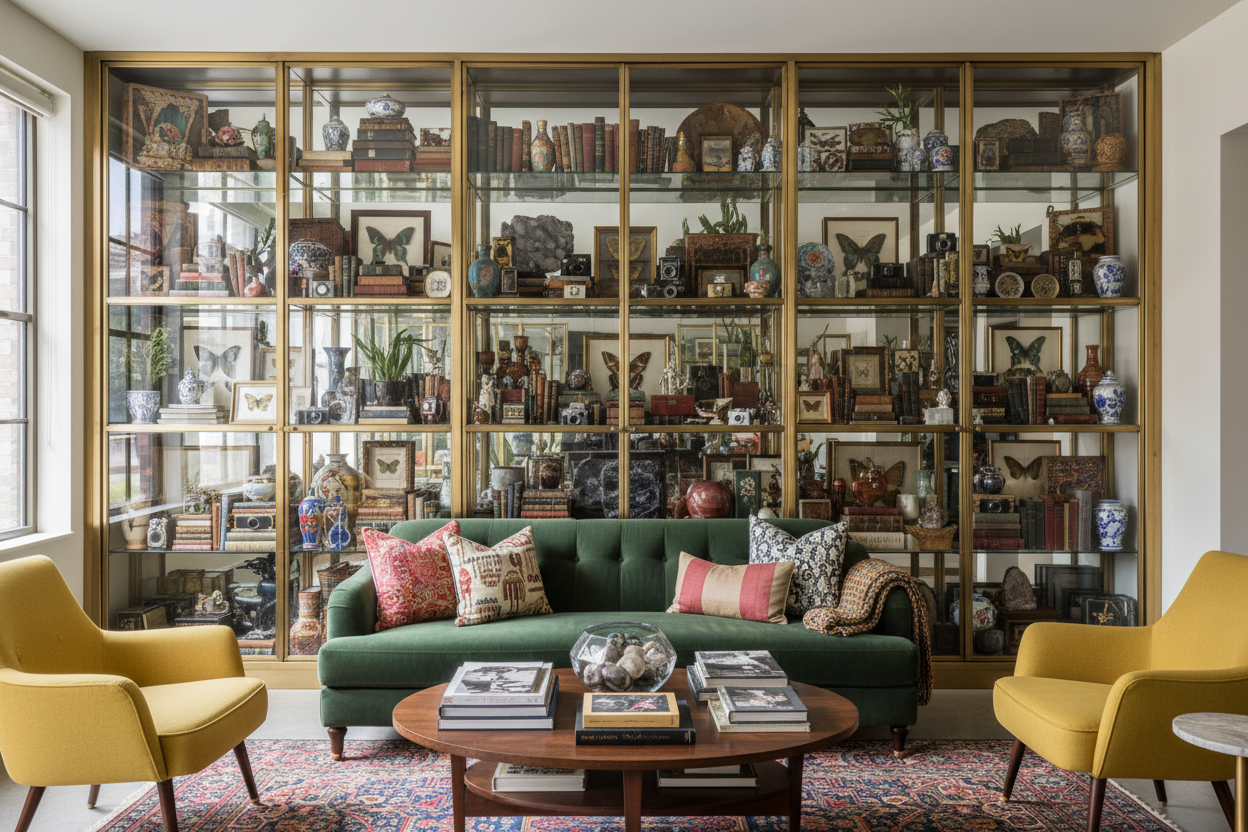
I spent three years staring at my living room wall, convinced that twelve mismatched floating shelves were the peak of 'minimalist' design. I was wrong. Every time I added a new shelf to accommodate my growing collection of vintage cameras and ceramic bowls, the room felt more fractured. It didn't look like a curated gallery; it looked like a yard sale had exploded in slow motion. I finally realized I needed a glass display case large enough to swallow the chaos whole and give my eyes a place to rest.
- One massive cabinet creates less visual noise than ten small shelves.
- Glass doors are the ultimate defense against the soul-crushing weekly dusting ritual.
- Vertical storage preserves floor space while maximizing your display potential.
- Negative space inside the case is what separates a 'collection' from a 'hoard.'
The 'Death by a Thousand Knick-Knacks' Phase
The floating shelf trap is real. You start with one, it looks clean, so you add three more. Before you know it, your wall is a patchwork of brackets and dust bunnies. In my 12x14 living room, those shelves were actually making the space feel cramped because they broke up the vertical plane of the wall into dozens of tiny, cluttered segments. It was visual static.
Every time I walked past, I noticed a crooked shelf or a layer of grey fuzz on my favorite objects. The 'open shelving' dream is only a dream if you have a full-time cleaning crew. For the rest of us, it’s just a recipe for high-maintenance clutter. I realized that by trying to keep things 'light' with small pieces, I was actually making the room feel heavy and disorganized.
Why I Finally Committed to a Glass Display Case Large Enough to Matter
The turning point happened when a friend asked if I was 'still moving in' because my decor looked so temporary. That hurt. I decided to ditch the shelves and invest in a single, commanding piece of furniture. I hunted for a large glass case that had enough physical gravity to anchor the room. I eventually landed on a large display cabinet storage shelf that offered a mix of glass visibility and hidden drawer storage.
The shift was immediate. By containing everything within one frame, the 'clutter' suddenly became a 'curated exhibit.' There is a psychological relief in having your things behind doors. It signals that the items are intentional and protected, rather than just sitting around waiting to be knocked over. Plus, the solid footprint of a substantial cabinet actually makes the floor feel more open because the rest of the walls are now completely clear.
Styling a Large Glass Case (So It Doesn't Look Like a Retail Store)
The biggest mistake I made early on was trying to fill every square inch. If you pack a massive cabinet to the rafters, it looks like a pawn shop. You need negative space—areas where the eye can just see the back of the cabinet. I use old art books as risers to give small objects some height, which prevents that flat, 'retail counter' look. Grouping by color or material (like putting all the brass together) helps keep the internal logic consistent.
I quickly learned that fixed shelves are the enemy of good styling. I opted for an adjustable glass display cabinet because my collection isn't uniform. I have 14-inch tall vases and 3-inch tall figurines; without adjustable heights, you end up with awkward gaps that make the whole display look amateur. Being able to drop a shelf by two inches to accommodate a specific piece makes a world of difference in how professional the final setup looks.
Figuring Out the Floor Plan
I know what you're thinking: 'I don't have room for a giant cabinet.' I thought the same thing until I actually measured. A large cabinet usually only takes up about 15 to 20 inches of depth. By placing mine against the longest blank wall, it became a focal point rather than an obstacle. If you're struggling with where to put it, there are some great strategies on where to put a big glass display case that focus on anchoring the piece to your existing layout.
If you’re dealing with a truly tiny floor plan where a wide wall isn't available, don't try to force a rectangular monster into a high-traffic walkway. Instead, look into a corner display case. It utilizes that dead zone behind a door or next to a window that usually goes to waste, giving you the height and storage of a large unit without eating into your 'walking' room. I almost went this route before realizing my main wall could handle the full-sized version.
The Verdict: Was Giving Up the Floor Space Worth It?
I gave up roughly six square feet of floor space, and in exchange, I got back my sanity. The room feels twice as big now that the walls aren't covered in individual shelves. My collection looks expensive, my dusting time has dropped by 90%, and the room finally feels finished. If you're drowning in small-scale storage, stop buying more shelves. Buy one big, beautiful case and call it a day.
Frequently Asked Questions
How do I keep the glass from streaking?
Stop using the cheap blue stuff. Use a mix of 50/50 white vinegar and water with a high-quality microfiber cloth. Buff it in circles, and then do a final pass with a dry cloth. It’s the only way to get that 'invisible' look.
Is a large glass case safe for homes with kids?
Only if you anchor it to the wall. Most large units come with anti-tip kits—use them. Also, look for tempered glass; it’s much stronger and breaks into small dull bits rather than dangerous shards if the worst happens.
Does a big cabinet make a room look dark?
Actually, the opposite. Because it's glass, it reflects light and creates depth. If you're worried, choose a model with glass side panels rather than solid wood ones to let light pass through the entire unit.


Dejar un comentario
Este sitio está protegido por hCaptcha y se aplican la Política de privacidad de hCaptcha y los Términos del servicio.