










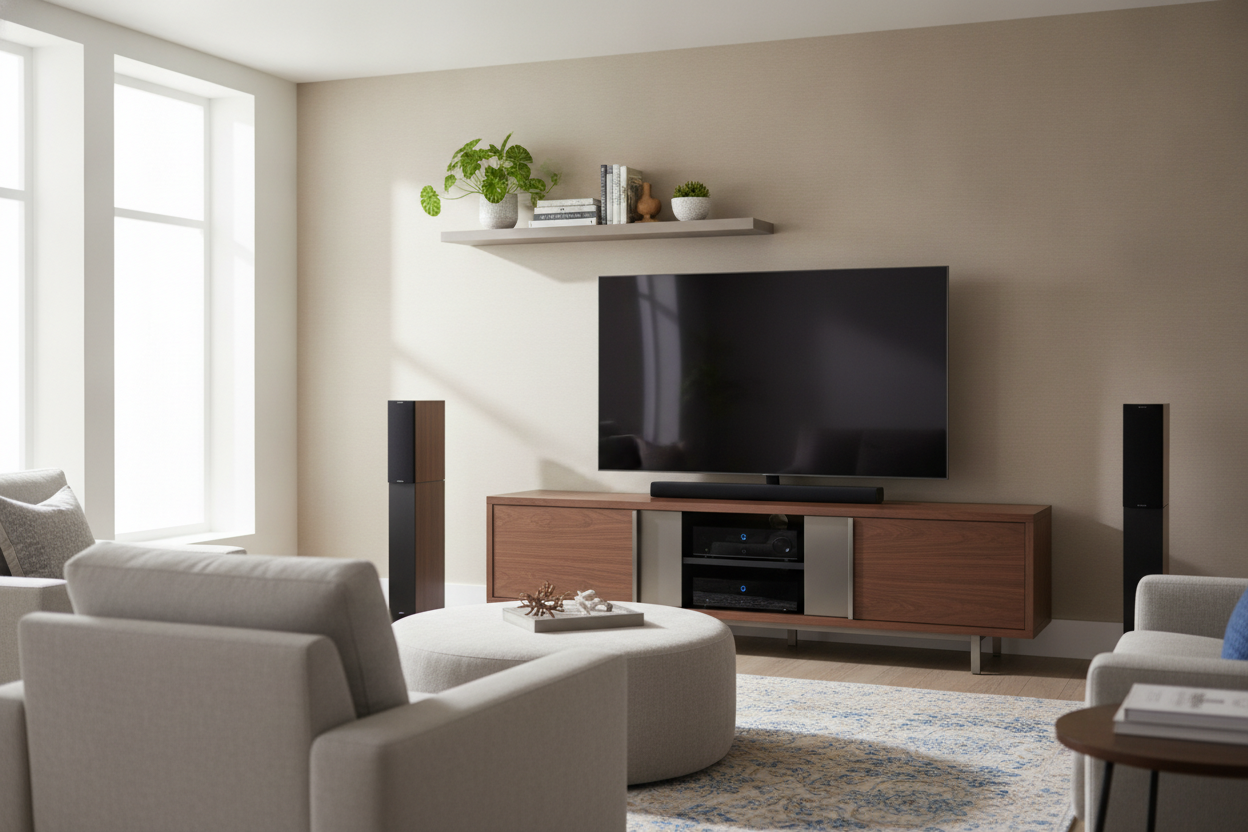
I remember standing in my living room, staring at a black metal tripod that looked like it belonged in a high school AV club. My partner called it 'the spider.' It was holding our center speaker right in the middle of the main walkway, a 20-pound obstacle I tripped over twice in one week. I realized then that traditional center channel speaker stands were the enemy of a peaceful, well-designed home.
Quick Takeaways
- Integrated shelves eliminate the floor clutter and tripping hazards of tripods.
- Built-in cable management hides the 'spaghetti' mess of 12-gauge speaker wire.
- A solid wood console can dampen vibrations better than thin, ringing metal stands.
- Front-flush placement on a shelf preserves dialogue clarity without the 'echo' effect.
- Matching your console color to your speaker grille makes the tech virtually disappear.
The Awkward Reality of Home Theater Gear
Building a home theater usually feels like a series of compromises. You want the immersive sound of a 5.1 system, but you also want a living room that doesn't look like a Best Buy clearance aisle. The center speaker is the biggest offender. It handles about 70% of a movie's dialogue, so it has to be front and center, but it’s usually a bulky, unappealing brick of MDF and plastic.
For years, I fell for the audiophile trap of using a dedicated center channel stand. I thought it was the only way to get the height right. Instead, I ended up with a room that felt cramped and industrial. The speaker sat on a pedestal like a weird trophy, and the wires were constantly visible, no matter how much Velcro I used.
Why I Finally Ditched Dedicated Speaker Stands
The footprint of a center channel stand is deceptively large. Because these speakers are wide and heavy, the stands need a broad base to stay stable. In a typical living room, that base eats into your walking path or forces your TV stand further away from the wall. It’s a waste of square footage that most of us can't afford.
Then there’s the aesthetic. Most centre speaker stands look like office equipment. Even an expensive adjustable center speaker stand rarely matches the vibe of a velvet sofa or a vintage rug. It creates a visual 'stop' in the room that draws your eye straight to the gear rather than the decor. After the third time my vacuum cleaner slammed into the metal base, I knew the tripod had to go.
The Sweet Spot: A TV Stand With a Center Channel Shelf
The solution wasn't getting rid of the speaker; it was finding a media console center channel setup that actually worked. I spent weeks measuring my gear before I realized that most standard furniture isn't deep enough for high-end audio. You need a tv stand for large center channel speaker units that offers at least 8 to 9 inches of vertical clearance and enough depth for the connectors in the back.
I eventually landed on a tv stand with adjustable center shelf. This was a total shift for me. Having a dedicated tv stand center channel speaker shelf meant the speaker sat at the perfect height—just below the TV—without taking up an extra inch of floor space. If you are currently shopping for tv stands, please don't guess on the dimensions. Measure your speaker, add two inches for the wires, and look for open-front shelving to keep things cool.
Does Moving the Speaker Into a Console Ruin the Sound?
This is the big question every audio nerd asks. If you shove a speaker deep into a wooden cubby, it will sound boomy and muffled. But there is an easy fix: pull the speaker forward until the front baffle is slightly past the edge of the shelf. This prevents sound waves from bouncing off the shelf surface before they reach your ears.
I actually found that a rustic entertainment center with shelves made of heavy, solid materials worked better than my old metal stand. Metal stands can ring or vibrate at certain frequencies. A heavy wood console acts as a natural dampener, keeping the bass tight and the dialogue crisp. Just make sure the shelf is sturdy; a 30-pound speaker will make a cheap, thin shelf sag in about a month.
3 Rules for Hiding a Massive Speaker in Plain Sight
If you want your media console center speaker to blend in, you have to be intentional. First, match your colors. If you have a black speaker, a stylish black tv stand entertainment center makes the speaker grille almost invisible. It just looks like a dark shadow in the shelf.
Second, balance the visual weight. If your center speaker is huge, flank the TV with some taller decor or books on the side cabinets to even things out. Third, manage your heat. Even if it's not an amp, speakers appreciate a little breathing room. An open-back tv stand for large center channel units allows for airflow and makes routing your HDMI and speaker cables a five-minute job instead of an afternoon headache.
FAQ
Can I put my center speaker behind a cabinet door?
Only if the door has an acoustic mesh or speaker cloth. Solid wood or glass doors will block the sound and make everyone sound like they are talking through a pillow.
How high should the center speaker be?
Ideally, the tweeter should be at ear level when you are sitting down. If your console is low, you can use small rubber wedges to angle the speaker slightly upward toward your face.
Will a large speaker fit in a standard TV stand?
Usually, no. Most standard stands have shelves only 5 or 6 inches tall. You specifically need a tv stand with space for center speaker gear, which typically features a wider, taller central bay.

Dejar un comentario
Este sitio está protegido por hCaptcha y se aplican la Política de privacidad de hCaptcha y los Términos del servicio.