










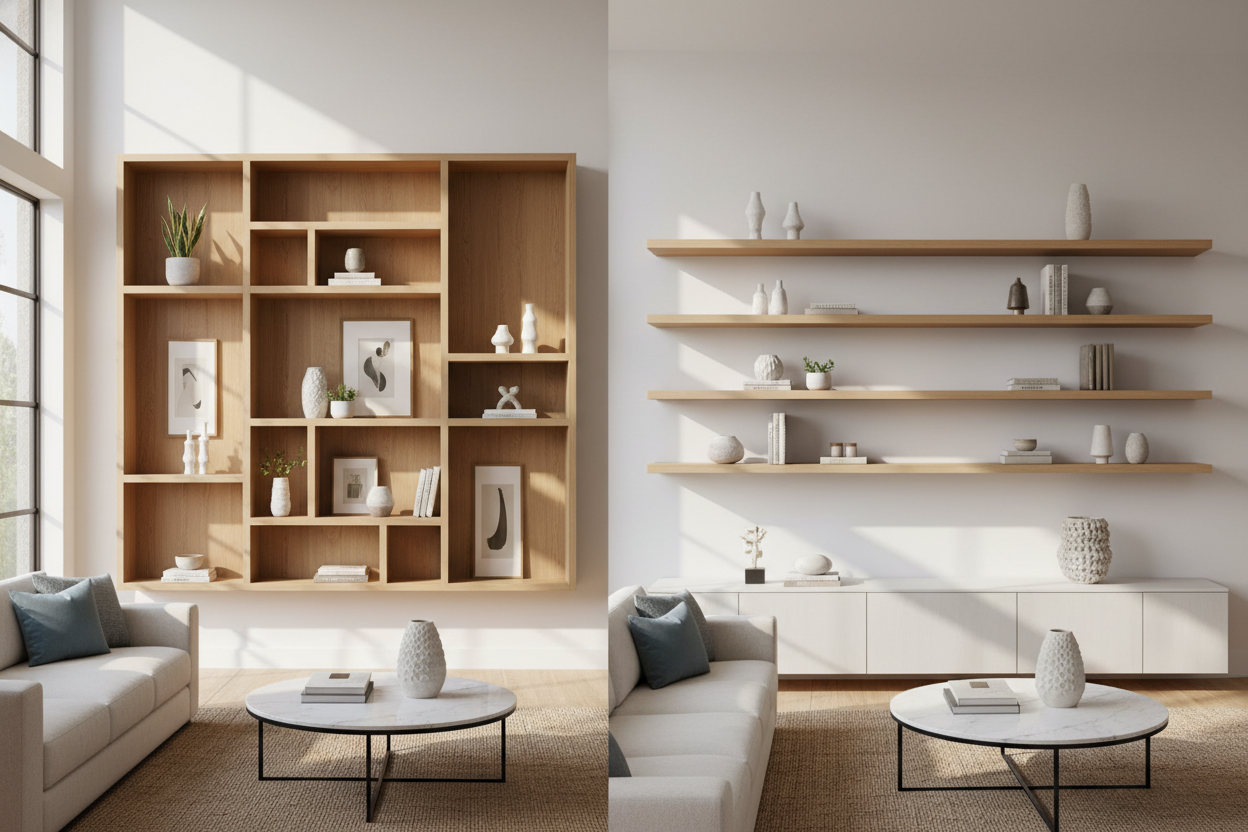
I spent three hours last Sunday trying to make a single floating ledge look 'effortless.' By the end, I had sixteen holes in my drywall and a pile of books that refused to stay upright. That is the dirty little secret of the minimalist aesthetic: it is actually incredibly high-maintenance. If you want a look that works without a degree in spatial geometry, a box display shelf is the superior choice every single time.
- Floating shelves require heavy-duty bookends or they become a mess.
- Box shelves provide natural 'frames' that make random items look like a curated collection.
- The structural sides of a box prevent the 'leaning tower of books' disaster.
- Negative space is easier to manage when it is contained within a grid.
The Pinterest Illusion of the Perfect Floating Ledge
We have all seen the photos. A single white oak plank holding one ceramic vase, a perfectly draped ivy plant, and three artfully leaned magazines. In reality, unless you live in a vacuum, those magazines will slide. Professional stylists often rely on a designer secret to display storage: they use hidden museum wax or heavy-duty anchors just to keep things from looking cluttered.
For the rest of us, borderless shelves mean constant micro-adjustments. Every time you pull a book out, the rest of the row threatens to tumble. It is a visual balancing act that requires a level of patience most people do not have after a 9-to-5. When you lack a physical border, your items just look like they are floating in an abyss rather than being part of a cohesive design.
Why Built-In Boundaries Make Styling Foolproof
A box display shelf acts like a picture frame for your stuff. There is a psychological relief in having a physical boundary. When you place an object inside a defined square or rectangle, your brain registers it as 'finished.' You are not fighting the infinite white space of an entire wall; you are just filling a small, manageable container.
This grid system forces you to group items intentionally. Instead of a chaotic row of mismatched heights, the box creates a rhythm. I have found that even my most random thrift store finds look expensive once they are tucked into a sturdy wooden frame. It turns 'stuff' into 'content.'
The 'Shadowbox Effect' for Small Objects
If you have a collection of small trinkets—think vintage matchboxes or tiny brass animals—they usually just look like dust-collectors on a long open shelf. Grouping them inside geometric display box shelves turns them into a miniature museum exhibit. By utilizing the negative space around each object within its own little 'room,' you give the eye a place to rest.
If you are worried about fitting larger pieces, look for units with adjustable shelf storage so you can swap out the grid size as your collection grows. This flexibility is what keeps a box system from feeling too rigid over time.
No More Avalanches: Wrangling Books and Decor Together
Let us talk about the bookend problem. I hate bookends. They either slide across the shelf or they are so bulky they take up half the space. A display box with shelves solves this because the vertical walls are the bookends. You can lean a stack of hardcovers directly against the side of the box, then place a sculptural candle next to it without worrying about a domino effect.
I like to alternate between vertical and horizontal stacks within the cubbies. It is a classic trick for how to display them properly without needing a PhD in library sciences. The horizontal stacks also double as pedestals for smaller objects, allowing you to use every inch of that vertical space.
Final Verdict: Which Style Belongs on Your Wall?
Floating shelves are great if you only own three things and do not mind dusting them every 48 hours. But for the collectors, the readers, and the people who actually live in their homes, the box system is the winner. It is the ultimate hack for making a messy life look like an intentional design choice.
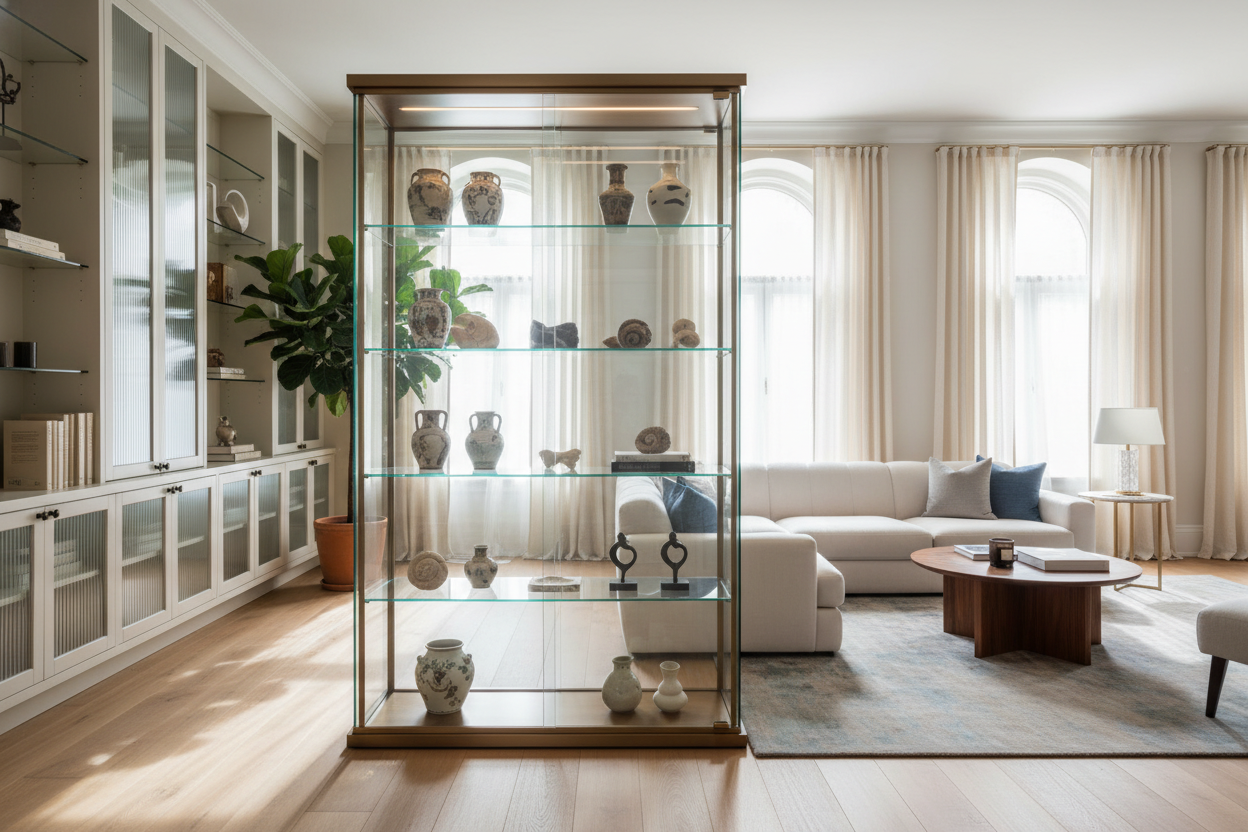
If you realize your collection has outgrown the wall entirely, you might want to upgrade to a full-sized transparent display bookcase to keep the dust off your treasures while maintaining that structured look. It provides the same framing benefits but on a much grander scale.
My Personal Lesson Learned
I once bought a set of three 'invisible' floating shelves for my office. I spent a Saturday morning mounting them with surgical precision. By Saturday night, my cat had knocked over a glass jar of pens, and by Sunday, the shelves were sagging because I had overloaded them with heavy art books. I swapped them for a 12-compartment box shelf. Not only did it hide the messy drywall holes I had made, but it also survived the cat.
FAQ
Are box shelves harder to install?
Usually, they are easier. Because they have a larger footprint against the wall, they often have more mounting points, which makes them feel way more secure than a single-bracket ledge.
Do they make a small room feel smaller?
Actually, the opposite. A structured grid creates a sense of order, which can make a cluttered room feel more organized and spacious than a bunch of floating items scattered around.
What material should I look for?
Skip the hollow MDF if you can. Look for solid wood or high-quality plywood veneers. If it feels like it is made of cardboard, it will sag within six months under the weight of real books.

Dejar un comentario
Este sitio está protegido por hCaptcha y se aplican la Política de privacidad de hCaptcha y los Términos del servicio.