










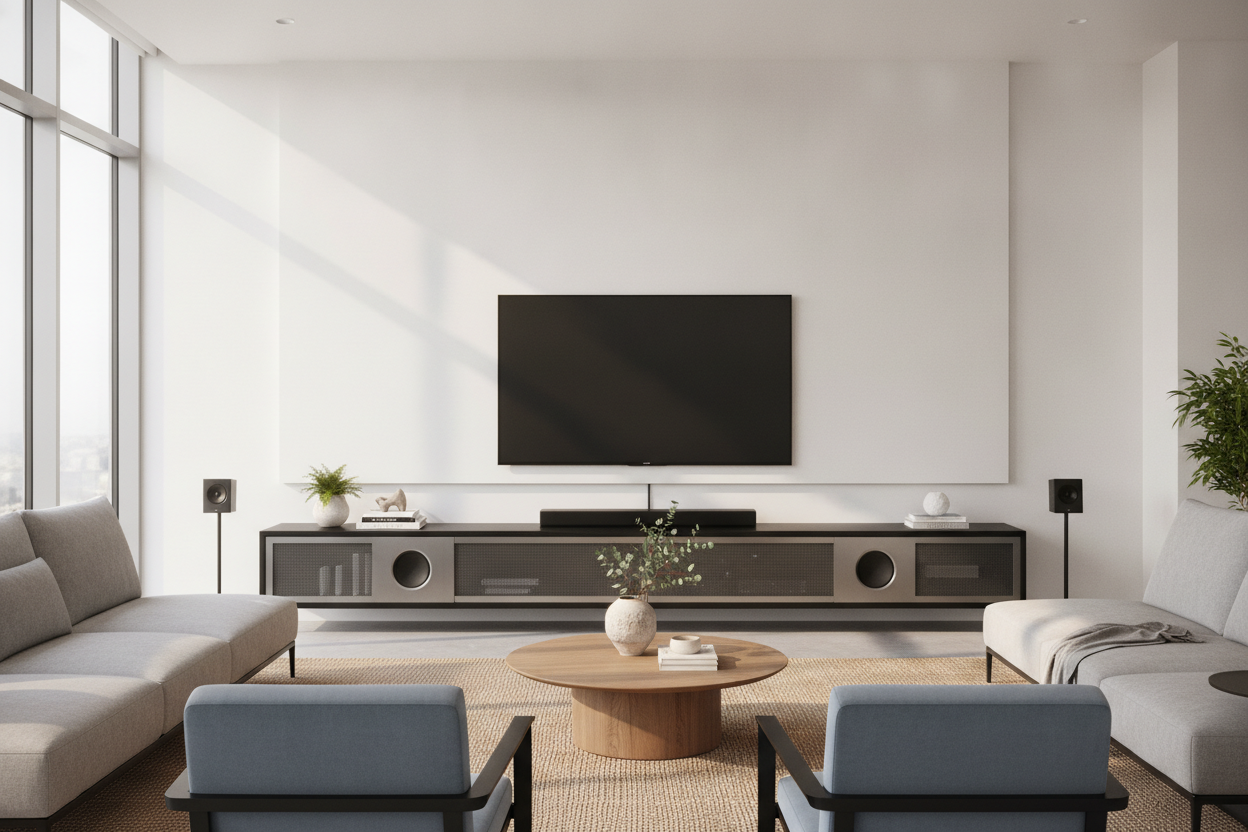
I spent three hours last Saturday on my hands and knees behind my media console, untangling a bird's nest of HDMI cables and copper speaker wire. My dust bunnies had evolved into sentient life forms living amongst the tangled mess of my 5.1 setup. I realized that my quest for perfect audio had turned my living room into a storage closet for a 1990s RadioShack.
The breaking point was when my dog, a 60-pound lab mix, caught his tail on a rear-channel wire and nearly pulled a bookshelf speaker onto his head. That was the day I decided to ditch the components and look for a tv stand with built-in surround sound. I wanted my floor space back without sacrificing the rumble of a movie night.
- Eliminates cable clutter by housing all speakers and amplifiers in one unit.
- Offers a cleaner, more minimalist aesthetic for modern living rooms.
- Easier setup than traditional component systems—usually just one or two plugs.
- Better for small apartments or renters who can't run wires through walls.
- Audio quality is surprisingly punchy, though not a match for high-end dedicated systems.
The Day I Finally Snapped Over Speaker Wires
For years, I told myself that the aesthetic chaos was the price of admission for good sound. I had wires taped along the baseboards and a receiver that hummed like a refrigerator. It looked like a Best Buy backroom exploded in my living room. Most standard TV stands are just boxes with holes in the back; they do nothing to actually manage the bulk of five different speakers and a massive amplifier.
I tried those plastic cord hiders, but they just looked like white scars running across my grey walls. When you have a dedicated center channel, two towers, and two rear satellites, you aren't decorating a room—you're managing a logistics hub. I wanted a space where I could actually sit down without seeing a tangled mess of black rubber out of the corner of my eye.
What Even Is a TV Stand With Built-In Sound?
We aren't just talking about a hollow shelf where you toss a soundbar. A true tv stand with built-in sound system is a piece of furniture where the audio components are literally part of the chassis. The speakers are often tuned to the wooden or MDF enclosure of the stand itself, which can actually help with resonance and bass response.
Think of it as a super-powered soundbar that has been integrated into the structural frame of the console. These units usually feature a set of mid-range drivers and tweeters facing forward, with a subwoofer often hidden in the base or firing downward. You get a wide soundstage because the speakers are physically further apart than they would be in a standard 30-inch soundbar.
The Pros: Why My Living Room Looks Human Again
The immediate relief of plugging in exactly one power cord cannot be overstated. My living room suddenly felt twice as large because the visual noise was gone. When you use a stylish black TV stand entertainment center with the tech already inside, the furniture becomes the focal point, not the hardware.
It is also a massive win for anyone with toddlers or pets. There are no speaker stands to tip over and no tempting wires to chew on. Plus, dusting becomes a thirty-second task instead of a precision archaeological dig around sensitive equipment. It’s the ultimate move for the minimalist who still wants to feel the floor shake when an explosion happens on screen.
The Cons: What Audiophiles Might Hate
If you’re the type of person who spends $400 on silver-plated oxygen-free cables, you’re going to find flaws here. You lose the ability to perfectly angle your rear speakers for that 1% improvement in spatial imaging. You’re also stuck with the internal amp, so you can't swap it out for a tube-driven boutique model later.
However, for 90% of us watching Netflix or playing PS5, the trade-off is worth it. You also stop worrying about overheating your receiver inside a cramped cabinet. These integrated units are designed with their own thermal management, so you aren't accidentally baking your electronics in a wooden box with no airflow.
How to Shop for an Entertainment Center for Surround Sound
When you start looking for an entertainment center for surround sound, don't just look at the wood finish. Check the wattage—you want at least 100W for a medium-sized room to ensure the audio doesn't distort when things get loud. Bluetooth connectivity is a must-have so you can stream music from your phone without turning the TV on.
Measure your space twice. If you're looking at a massive entertainment center with overhead cabinets, make sure the built-in speakers aren't going to be muffled by your decor or books. You want a clear line of sight from the speaker mesh to your ears. Also, ensure the unit has enough HDMI ARC or Optical inputs for your specific TV model.
The Verdict: Should You Actually Buy One?
If you are a renter who can’t drill into walls, or a parent tired of cord-chaos, this is a no-brainer. It solves the biggest headache of home theater setups: the clutter. I don't miss my old receiver for a second. My living room finally feels like a place to relax rather than a tech project I'm constantly trying to hide.
If you have a dedicated, windowless basement theater room, stick to your separate components. But for a real-world living room where people actually eat, play, and live? The integrated route is the only way to keep your sanity and your sound quality in one piece.
Is the sound as good as a separate 5.1 system?
It's about 85-90% as good. You lose some of the true 'behind you' surround effects, but the clarity and bass are usually much better than a standalone soundbar because the furniture cabinet acts as a larger acoustic chamber.
Can I connect my gaming console directly to it?
Most modern units use HDMI ARC or eARC. You plug your console into the TV, and the TV sends the high-quality audio down to the stand through a single cable. It's incredibly simple.
What happens if the speakers break?
This is the main risk. Unlike separate speakers, you can't just swap one out. However, most reputable brands use modular internal components that can be serviced, or they offer solid warranties to cover the electronics for the first few years.


Dejar un comentario
Este sitio está protegido por hCaptcha y se aplican la Política de privacidad de hCaptcha y los Términos del servicio.