










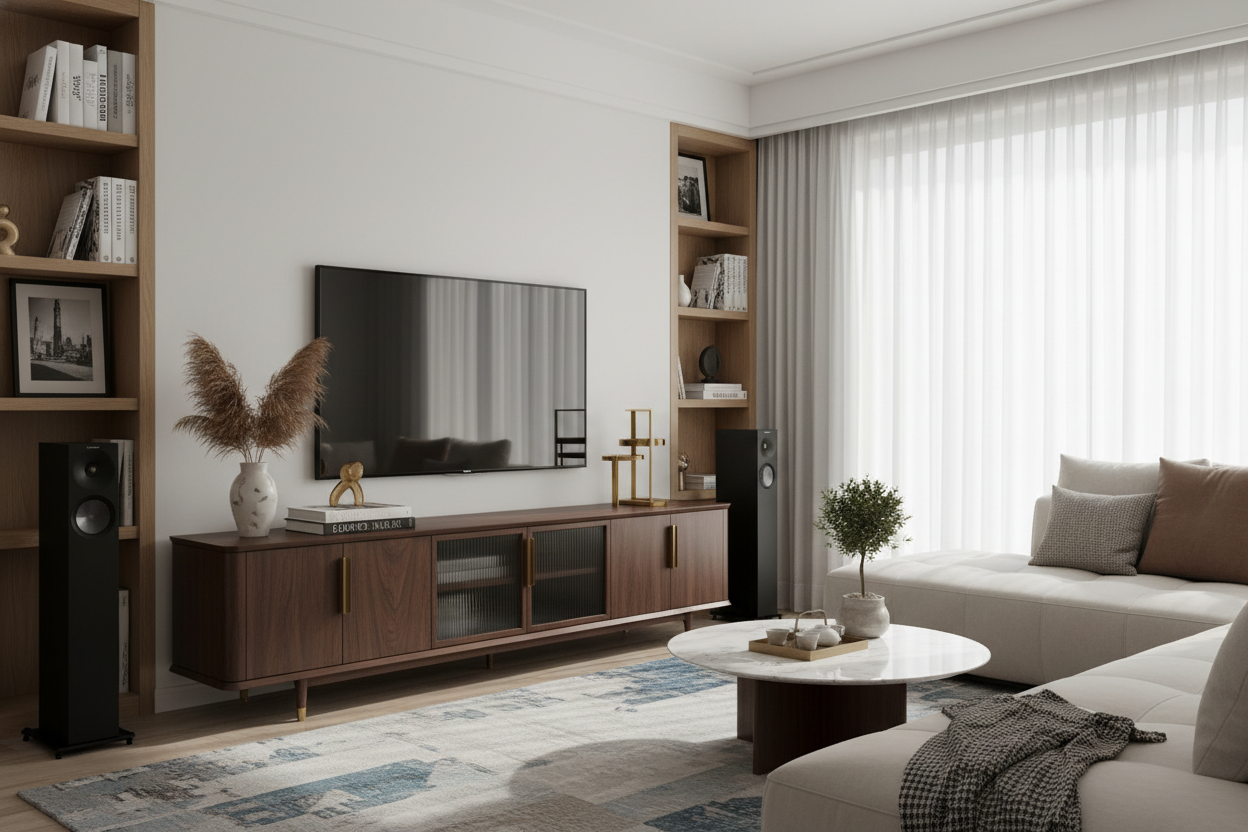
I spent three hours last Tuesday trying to align the doors on a cheap flat-pack media console, only to realize the pre-drilled holes were off by a full quarter-inch. It is a classic trap: the piece looks stunning in a tiny Instagram thumbnail, but feels like balsa wood once it hits your living room. When you are staring at a $2,000 price tag for a designer tv cabinet, it is easy to feel like you are just paying for a brand name and a fancy logo.
But after years of assembling, breaking, and eventually hauling cheap furniture to the curb, I have realized the 'luxury' tax often covers things you cannot see until they fail. If you are tired of your living room looking like a temporary dorm setup, it is time to look at what actually happens behind those cabinet doors.
Quick Takeaways
- Real wood veneers and solid frames prevent the 'peel and chip' effect common in budget MDF.
- High-end hardware like Blum hinges ensures doors stay level and close silently for years.
- Structural reinforcement is non-negotiable for modern 75-inch+ screens to prevent sagging.
- Integrated cable management in designer pieces saves you from the 'spaghetti wire' nightmare.
The MDF vs. Solid Wood Reality Check
Most budget consoles are made of low-density particle board wrapped in a paper-thin laminate. One spilled glass of water and the 'wood' swells like a sponge. A high-end unit uses either kiln-dried solid wood or high-grade plywood with thick, real wood veneers. These materials do not just feel heavier; they handle humidity and life much better.
I have seen cheap units start to peel at the corners within six months just from the friction of opening a drawer. Designer pieces use edge-banding that is actually integrated, meaning you can't just pick it off with a fingernail. If you want a piece that survives a move—or a toddler—skip the paper-wrapped stuff.
Let's Talk About Hardware (Because Cheap Hinges Suck)
The easiest way to spot a cheap cabinet is to listen to it. Does it rattle? Do the doors slam with a plastic thud? Premium units use soft-close hinges and heavy-duty drawer glides that can actually support the weight of a heavy receiver or a stack of coffee table books. Flimsy hardware leads to sagging doors, which are among the most common tv stand and cabinet mistakes I see in otherwise beautiful homes.
Beyond the hinges, look at the back panel. A designer unit will have a finished back or at least a sturdy, recessed panel with dedicated cord cutouts. Budget units usually have a piece of flimsy cardboard tacked on with tiny nails that pops off the moment you try to shove a power strip behind it.
Proportions and the Dreaded Middle Sag
TVs are getting bigger, but budget furniture construction has not caught up. If you put a massive 85-inch screen on a unit designed for a 50-inch TV, you will notice a 'smile' forming in the center of the top board within weeks. A true designer piece is engineered with internal vertical supports or steel-reinforced frames to carry that load.
For anyone rocking a theater-sized screen, you need a large tv cabinet with spacious storage that is built to handle the weight without bowing. It is not just about aesthetics; it is about making sure your $1,500 television does not end up on the floor because a cam-lock nut gave out.
Getting the Bespoke Look Without the Custom Price
You do not always have to go to a boutique showroom to get that architectural feel. I often look for retail pieces that incorporate high-end textures like fluted wood or tambour doors. A modern tv cabinet table with storage can offer that sleek, low-profile silhouette that makes a room feel larger without the custom-built price tag.
I also love mixing materials to break up the 'wall of wood' look. Choosing black cabinets with glass doors can make a bulky media unit feel like a curated display case rather than just a box for your Xbox. Fluted glass is especially great because it hides the clutter of wires and cable boxes while still letting remote signals through.
The Final Verdict: When to Splurge and When to Save
If you are in a rental you plan to leave in a year, buy the cheap flat-pack. But if this is your 'forever' home—or at least your 'next five years' home—the investment in a designer-quality piece pays for itself in avoided frustration. You are paying for doors that stay straight, surfaces that do not bubble, and a frame that does not wobble every time someone walks past the TV.
My Personal Experience
I once bought a stunning mid-century 'replica' console for $300. It looked perfect for three months. Then, the weight of my soundbar caused the top to dip just enough that the center drawer got stuck. I ended up having to screw a 2x4 into the back of it just to keep it functional. It was a DIY disaster that convinced me I would rather save up for six months and buy one 'real' piece than replace a 'fake' one every two years.
FAQ
Will my remote work through solid cabinet doors?
Usually no, unless the doors have mesh, slats, or IR-friendly glass. Most people with solid doors use an 'IR repeater'—a tiny $20 gadget that relays the signal inside the cabinet.
How much wider should the cabinet be than the TV?
Ideally, the cabinet should be at least 6 to 10 inches wider than the TV on both sides. A TV that overhangs the edges of the cabinet looks top-heavy and accidental.
Is 'solid wood' always better than veneer?
Not necessarily. High-quality veneers on stable plywood are actually less likely to warp or crack than solid wood in homes with big temperature swings. It is about the quality of the core, not just the surface.

Dejar un comentario
Este sitio está protegido por hCaptcha y se aplican la Política de privacidad de hCaptcha y los Términos del servicio.