










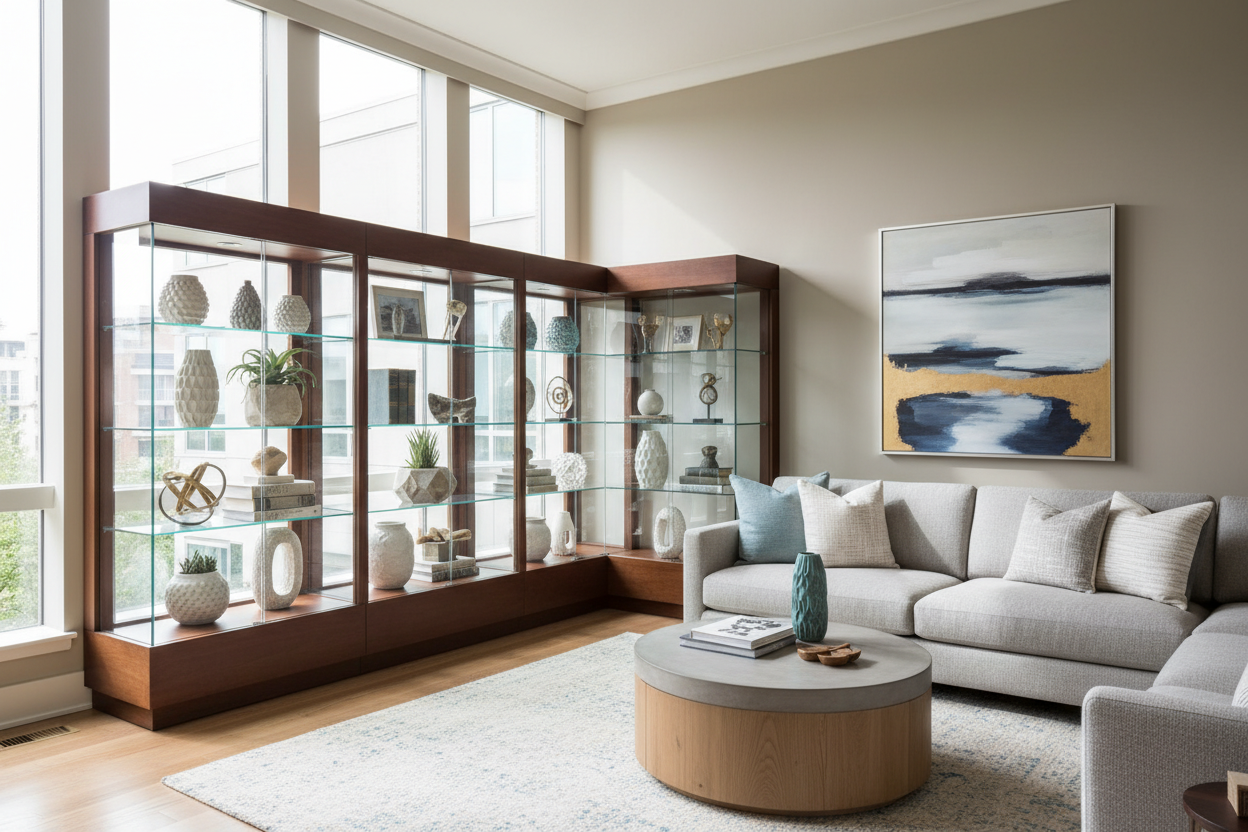
Every living room has one: that awkward, empty corner where a standard bookshelf doesn't quite fit, but leaving it bare makes the room feel unfinished. It is a common design dilemma that often leads to forcing oversized plants or random accent chairs into tight spots. The real solution is an l shaped display cabinet.
By wrapping around the corner, these pieces utilize dead space while creating a striking focal point for your curated collections. In this guide, we will break down exactly how to choose, place, and style these unique cabinets without overwhelming your room.
Quick Decision Guide
- Measure your baseboards: Always account for baseboard depth when measuring corners so the cabinet sits flush against the walls.
- Consider lighting early: Built-in LED puck lights or strip lighting are essential to prevent the corner from feeling dark and cavernous.
- Watch the visual weight: Glass-front or open-shelving designs keep the corner feeling airy, whereas solid wood doors can make a small room feel boxed in.
- Anchor it properly: Due to their asymmetrical weight distribution, L-shaped units must be securely anchored to both wall studs to prevent tipping.
Maximizing Floor Plans with Corner Cabinets
Measuring for the Perfect Fit
An l shaped display cabinet is brilliant for space planning, but it requires precise measurements. You are not just measuring width and height; you have to account for the depth of both returns. I always advise clients to leave at least 36 inches of clearance between the front of the cabinet and the nearest piece of walking-path furniture, like a sofa or dining chair.
Also, pay attention to the swing radius if your cabinet has glass doors. A beautiful piece loses its charm quickly if the door hits a window sill or a radiator every time you open it to dust your ceramics.
Styling Your L Shaped Display Case
Balancing Visual Weight and Texture
The biggest mistake people make with an l shaped display case is treating it like a storage locker. Because it commands a corner, it naturally draws the eye. You need to balance the visual weight by mixing materials and embracing negative space.
Do not line up items in a straight row. Instead, create varying heights using books as risers. Mix organic textures like unglazed pottery or trailing plants with reflective surfaces like brass accents or crystal. Leave at least one-third of every shelf empty to let the collection breathe.
Lessons from My Own Projects
A few years ago, I installed a stunning, custom floor-to-ceiling l shaped cabinet in a client's suburban dining room. It had frameless glass doors and mirrored backings. On paper, it was the perfect transitional piece to display their vintage barware.
In reality, it was a maintenance nightmare. I learned the hard way that mirrored backs in a corner unit amplify glare from nearby windows, creating harsh reflections rather than a soft glow. Furthermore, the frameless glass doors meant every single fingerprint from their two toddlers was illuminated by the internal LED lights. We ended up having to frost the lower glass panels just to keep the piece looking presentable. Now, I always recommend solid lower doors for homes with kids or pets, reserving the glass display for the upper half.
Frequently Asked Questions
How do I light an l shaped display cabinet?
If your cabinet doesn't come with built-in lighting, use battery-operated LED puck lights attached to the underside of each shelf. For glass shelves, a vertical LED strip hidden in the front inner corners provides the most even, museum-quality lighting.
Is this type of cabinet good for small spaces?
Yes, but opt for a design with a smaller footprint and glass doors. Wrapping the corner actually frees up flat wall space for other furniture, making the room feel larger as long as the cabinet's color matches or closely blends with your wall color.
Can I use an L-shaped cabinet as a room divider?
While most are designed to sit flush against a corner wall, low-profile, double-sided L-shaped units can work beautifully to delineate an open-concept living and dining area. Just ensure the back of the cabinet is finished.


Dejar un comentario
Este sitio está protegido por hCaptcha y se aplican la Política de privacidad de hCaptcha y los Términos del servicio.