










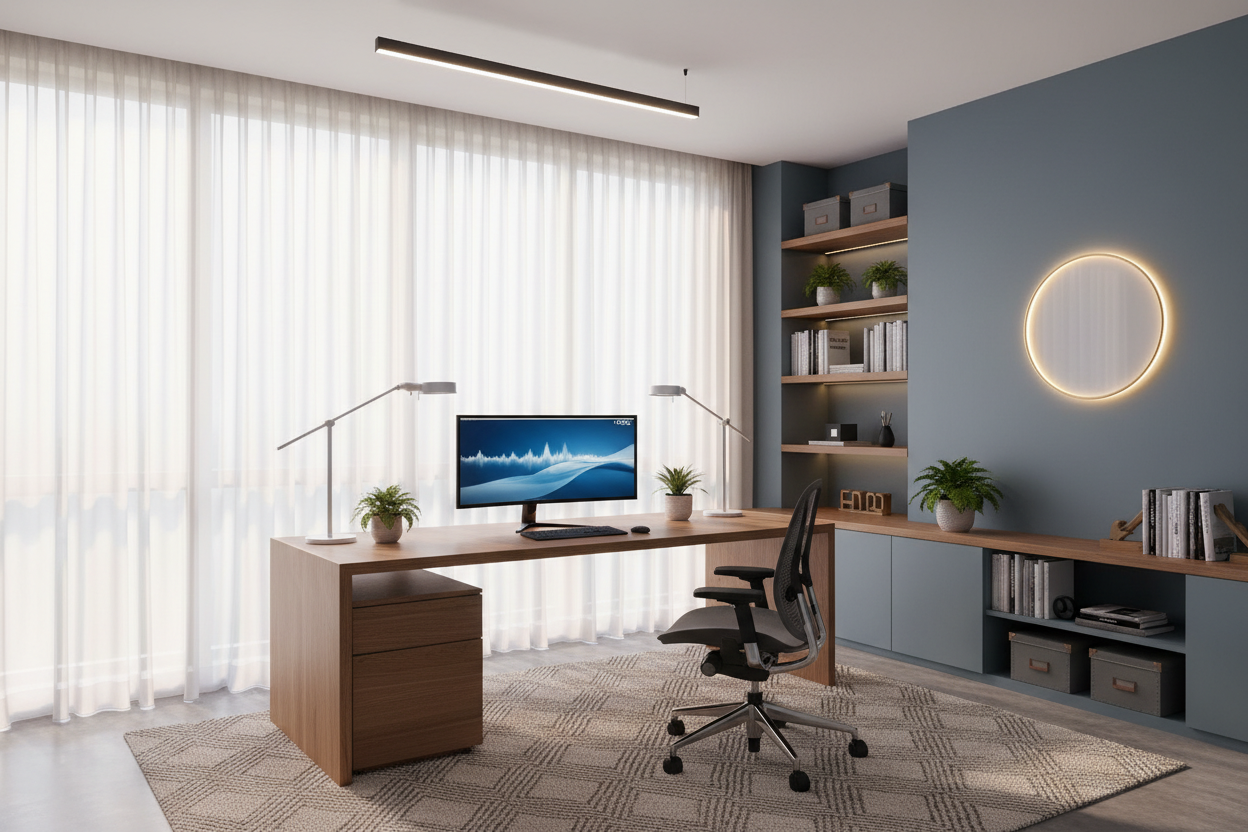
We have all experienced it: the mid-afternoon headache, the squinting at the screen, or the lethargy that sets in when working in a dimly lit room. Most homeowners treat **lighting an office** as an afterthought, relying on a single overhead bulb or a leftover table lamp. However, as an interior designer, I can tell you that light is the invisible architecture of your workspace. It dictates not just how the room looks, but how you feel and perform within it.
Key Features to Look For
Before we dive into layout and aesthetics, here is a quick checklist of the technical elements required for effective workspace illumination:
- Color Temperature (Kelvin): Aim for 3500K to 5000K. This mimics daylight and keeps the brain alert, unlike warm residential bulbs.
- Lumens (Brightness): You generally need 3,000 to 6,000 lumens total for a standard office, distributed across multiple sources.
- Adjustability: Look for articulating arms and dimmer switches to control glare and intensity throughout the day.
- CRI (Color Rendering Index): A CRI of 90+ ensures colors (on paper and screens) look accurate, which is vital for creative work.
The Art of Layering Light in Office Spaces
The biggest mistake I see in home office lighting is relying on a single source. To create a professional, comfortable environment, we must employ a tiered approach. This is known as layering.
1. Ambient Lighting: The Foundation
This is your general illumination. In a corporate setting, these are the overhead troffers. In a home office, we want something softer yet expansive. Recessed cans or a semi-flush mount fixture work well here. If you are dealing with small home office lighting constraints, consider an LED ceiling panel that diffuses light evenly to avoid harsh shadows in the corners of the room.
2. Task Lighting: The Workhorse
This is the best light for working. Task lighting focuses beams specifically where you read, write, or type. The best office lighting setup always includes a dedicated desk lamp. When selecting home office desk lighting, prioritize an adjustable arm. This allows you to direct the beam away from your monitor to prevent screen glare, which is a primary cause of digital eye strain.
3. Accent Lighting: The Mood Setter
Often ignored in lighting solutions for office design, accent light adds depth. Without it, a room feels flat and sterile. This could be LED strip lighting behind a bookshelf, a picture light over a diploma, or a floor lamp in the corner. This layer softens the contrast between your bright screen and the dark room, reducing eye fatigue.
Ergonomics and Placement Strategies
Having the best light fixture for home office use means nothing if it is placed incorrectly. The goal is to eliminate shadows and glare.
If you are right-handed, place your desk lamp on your left side (and vice versa). This prevents your hand from casting a shadow across your notebook while writing. Furthermore, ensure your office room lighting does not reflect directly off your computer screen. If you can see the bulb in your monitor, you need to move the fixture or adjust the angle.
Small Space and LED Solutions
For those converting a closet or a nook, small office lighting ideas require creativity. Floor space is premium, so look to the walls. Sconces with swing arms are excellent lights for office space that is limited. They free up desk real estate while providing necessary lumens.
Furthermore, home office LED lighting is the industry standard now. Integrated LED fixtures allow for slimmer profiles—perfect for low ceilings—and offer tunable white light, allowing you to shift from cool, focus-driven light in the morning to warmer, relaxing light as you wrap up your day.
My Personal Take on Lighting an Office
I learned a hard lesson about private office lighting early in my career while designing a workspace for a graphic designer. We selected a stunning, high-gloss lacquer desk and paired it with a powerful, downward-facing architectural pendant. It looked incredible in the portfolio photos.
However, two weeks later, the client called complaining of migraines. The issue? The high-gloss finish acted like a mirror, bouncing the intense overhead beam straight into her eyes. It was a blinding glare trap. We had to swap the pendant for a fixture with a fabric drum shade to diffuse the light and add a matte desk pad to kill the reflection.
Another detail I always check now: video call appearance. I advise clients to place a soft light source behind their monitor (facing their face). Without it, the bright monitor makes you look blue and washed out, or overhead lights cast dark shadows under your eyes (the "raccoon effect"). A simple ring light or a wall-bounced lamp makes you look infinitely more professional on Zoom.
Conclusion
Curating the lighting for an office is about balancing function with visual comfort. By layering your light sources and paying attention to color temperature, you transform a utility room into a sanctuary of focus. Don't settle for a dark corner; illuminate your work, and you will likely find your workflow brightens along with it.
Frequently Asked Questions
What is the best color temperature for office lighting?
For productivity, cool white light between 3500K and 5000K is ideal. It mimics natural daylight, suppressing melatonin and keeping you alert. Avoid warm white (2700K) for task areas, as it can induce relaxation and sleepiness.
How do I light a small home office without desk space?
Utilize vertical space. Wall-mounted sconces, clip-on lights for shelves, or floor lamps are excellent small office lighting solutions. LED strips under shelving units can also provide task lighting without occupying any surface area.
Is LED lighting better than incandescent for offices?
Yes. Best LED office lighting is superior because it emits less heat (keeping the small room cool), consumes less energy, and offers a wider range of color temperatures. Look for LEDs with a high CRI to ensure your environment looks natural.


Dejar un comentario
Este sitio está protegido por hCaptcha y se aplican la Política de privacidad de hCaptcha y los Términos del servicio.