










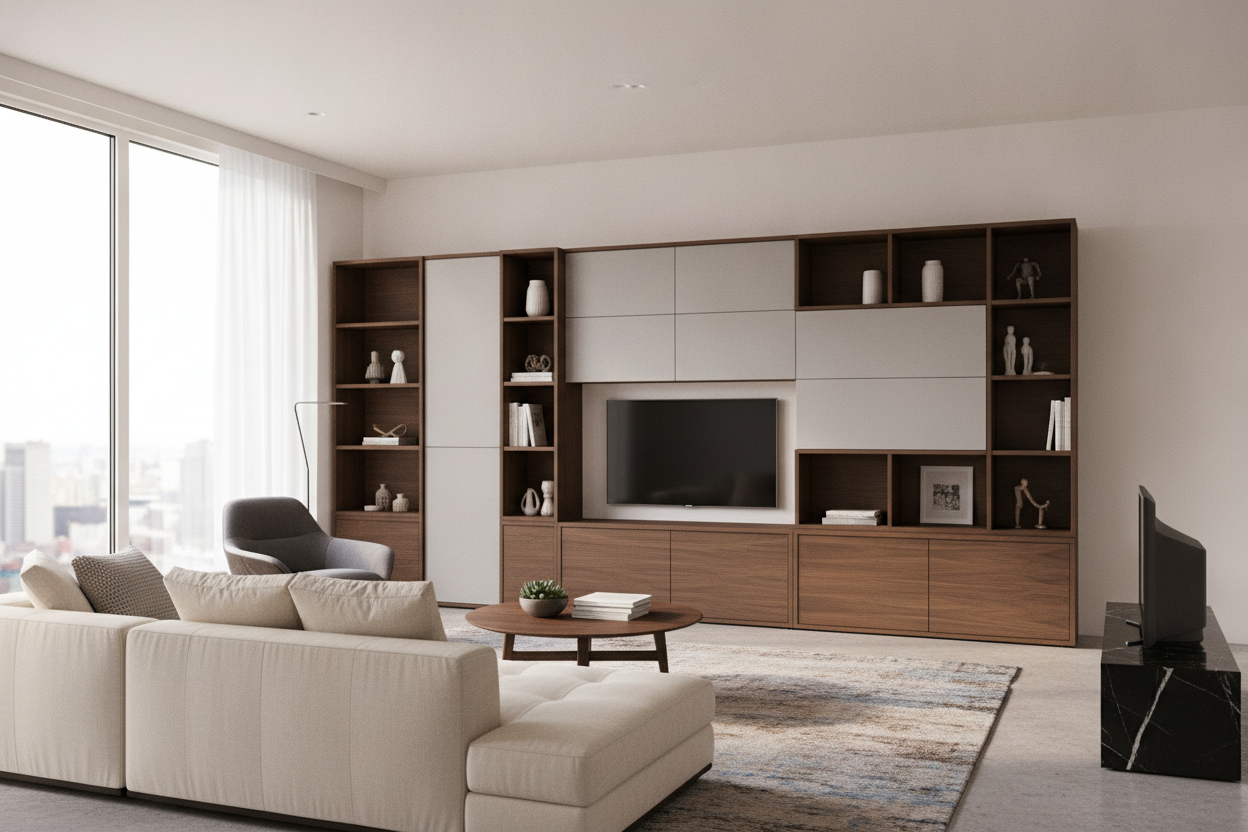
I remember staring at my seven-foot-long media console in the back of a U-Haul, realizing I’d have to take the front door off its hinges just to get it inside my new place. It was a heavy, awkward beast that only fit against one specific wall in my old apartment. That is when I realized that flexible tv unit combinations are the only sane way to furnish a living room if you plan on living there for less than twenty years.
Quick Takeaways
- Stop buying 200lb single-unit entertainment centers that dictate your floor plan.
- Modular setups allow you to bypass weird radiator placements and off-center windows.
- Mixing a low console with tall piers creates a custom 'built-in' look for half the price.
- Individual pieces have much higher resale value and better versatility for future moves.
The Problem With the Giant All-in-One Stand
Those massive wall units look great in a 4,000-square-foot showroom, but they are a death sentence for a rental. I once owned a 'media bridge' setup that required twelve cams and thirty screws just to hold the top shelf. Moving it meant a total teardown, and by the second reassembly, the particle board was already crumbling. It was a nightmare.
Beyond the physical weight, these monoliths force your hand. You can't put a chair in that corner because the unit is six inches too wide. You can't move the TV to the other wall because the unit won't clear the doorway. You become a servant to your furniture's dimensions, rather than the other way around.
What Exactly Are We Calling Modular Here?
Modular doesn't have to mean plastic cubes or industrial wire shelving. It simply means treating your media wall as a puzzle rather than a single block. Instead of one $1,200 unit, you buy a solid base and add flanking elements that can stand on their own.
This strategy allows you to scale up or down. If your next living room is smaller, the side cabinets go to the bedroom or the entryway. You aren't stuck with a piece of furniture that doesn't fit your life. It's about buying for the long haul by buying smaller pieces that play well together.
The Bookshelf and Credenza Mashup
This is the classic 'high-low' move that I swear by. You take a solid, wide base—something like a mid-century modern stand with slatted doors—and flank it with two narrow, tall bookshelves. It gives you that library vibe without the permanent commitment of a contractor or a 300lb wall unit.
I made the mistake once of buying bookshelves that were the exact same height as the TV. Don't do that. It looks like a flat line and feels incredibly 'heavy' in a small room. Make sure the bookshelves are at least 12 to 18 inches taller than the TV to keep the proportions from looking squat. It draws the eye upward and makes the ceiling feel higher.
Floating Shelves Meet Low-Profile Cabinets
If you hate the 'heavy' look of traditional furniture, go for a long, low anchor. I love using a storage credenza with sliding glass doors as the base. It keeps the electronics hidden but the glass adds a bit of reflection so the unit doesn't feel like a dark void against the floor.
Pair a low cabinet with two or three asymmetrical floating shelves above the TV. It creates an airy, modern look that doesn't overwhelm the room. This is especially great for those 'weird' walls where a full-sized entertainment center would block a walkway or a light switch.
How to Mix Pieces Without Looking Like a Thrift Store
The secret to a cohesive look is matching your wood 'temperature.' If your console is a warm acorn, don't pair it with a grey-wash oak. They will fight. Keep the hardware consistent—if one piece has brass pulls, spend the $20 to swap the others to match. It makes separate pieces look like they were born to be together.
It is also about what designers actually think about storage: you need a 60/40 split of closed vs. open space. Too much open shelving looks like a cluttered garage; too much closed cabinetry looks like a kitchen. Balance a solid wood console with open-frame metal shelving to keep things visually light.
The Move-Friendly Magic of Breaking Things Up
When I finally ditched my last monolith, I replaced it with three separate pieces. Two years later, I moved to a place with a fireplace where the TV had to go in a corner. I just split the set. The main stand stayed in the living room, and the side units became a bar in the dining room and a plant stand in the office.
If you are ready to stop the furniture-induced headaches, browse individual TV stands and build your own layout. You'll thank yourself during your next move when you're carrying three light boxes instead of one back-breaking crate.
FAQ
How do I hide cables with modular units?
Use a 'J' channel cable racer along the back of the units or simple velcro ties. Since the pieces aren't connected, you actually have more gaps to route wires discreetly behind the legs rather than through a single, tiny hole in a backboard.
Should the TV be centered between the side units?
Not necessarily. Off-center TVs look great when balanced by a tall lamp or a stack of art books on the other side of the console. Asymmetry often looks more intentional and high-end than forced symmetry.
Can I mix different brands?
Absolutely. Just keep the depths within two inches of each other. If your console is 18 inches deep and your bookshelves are only 10 inches deep, it will look like the console is 'eating' the shelves. Keep them relatively flush for the best look.


Dejar un comentario
Este sitio está protegido por hCaptcha y se aplican la Política de privacidad de hCaptcha y los Términos del servicio.