










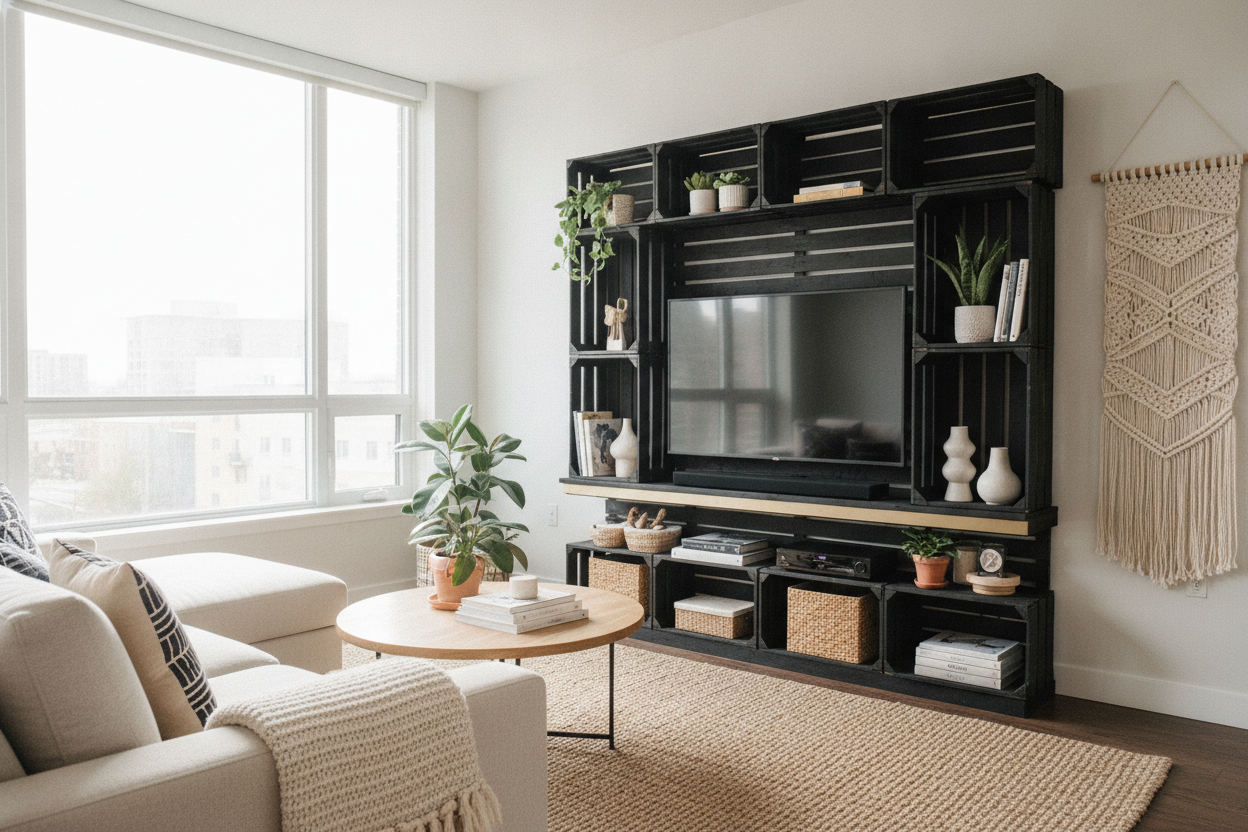
I spent three years staring at a $400 media console that I absolutely hated. It was one of those mass-produced MDF beasts that looked 'mid-century modern' in the professional studio photos but felt like a cheap, wobbly plastic box in my actual living room. It dominated the wall, collected a thick layer of dust underneath that my vacuum couldn't reach, and made my 12-foot wide room feel like a cramped hallway. I finally hit my limit when I realized I was paying a premium for 'storage' that only held a tangle of old HDMI cables and a Wii I haven't touched since 2014.
That was the night I decided to build my own diy tv shelf and reclaim my floor space. It took one Saturday, a single piece of premium wood, and about $40 in hardware to create something that looks significantly more expensive than the furniture it replaced.
Quick Takeaways
- Skip the big box pine; spend your money on a single high-quality hardwood offcut.
- Wall studs are mandatory—do not trust drywall anchors alone with your electronics.
- Floating shelves make a small room feel twice as large by exposing the floorboards.
- Cable management is the difference between a 'project' and a 'piece of furniture.'
The Breaking Point: Why I Ditched My Giant Media Console
The moment I decided to clear out my old setup wasn't about aesthetics; it was about the sheer frustration of living in a small space with 'big space' furniture. Every time I dropped a remote or a charging cable, it disappeared into the dark abyss behind that 150-pound console. Moving it required two people and a prayer that the cam-locks wouldn't snap. I finally replaced my bulky console because I realized that in a small room, every square inch of visible floor is a victory.
By mounting a simple, thick shelf directly to the wall, the room opened up instantly. It stopped being a room dominated by a 'TV area' and started feeling like a curated living space. You don't realize how much visual weight a floor-standing unit carries until it's gone. Now, my robot vacuum can actually clean the entire floor, and the room feels lighter, airier, and significantly more intentional.
Sourcing the Wood (Spoiler: Skip the Big Box Lumber Aisle)
If you walk into a major home improvement store and buy a standard 2x12 'whitewood' board, your shelf is going to look like a DIY project—and not in a good way. Construction lumber is often wet, prone to warping, and has that distinct 'unfinished basement' vibe. For a diy tv shelf that actually looks high-end, you need to find a local lumber yard or a specialty wood shop. I looked for 'hardwood offcuts' and found a stunning piece of white oak for less than the price of a takeout dinner.
The texture and grain of real hardwood do all the heavy lifting for you. You don't need fancy joinery when the wood itself is the star. I've found that a walnut floating TV shelf provides a rich, dark contrast that makes even a basic living room look like a custom build. If you can't find a local yard, look for butcher block scraps or even a high-quality 'project board'—just make sure it’s at least 1.5 inches thick to give it that 'custom furniture' presence.
The Hardware You Actually Need for DIY TV Shelves
This is where most people get nervous, but it’s actually the simplest part if you follow one rule: find the studs. I used heavy-duty steel floating shelf brackets that look like long metal rods attached to a backplate. You screw the plate into the wall studs, and the shelf—which you’ve drilled holes into—slides right on. It's incredibly sturdy. I’m talkin' 'you could sit on this' sturdy, though I wouldn't recommend it.
If your studs aren't perfectly centered where you want the shelf, you can use a backplate that spans multiple studs. Never, and I mean never, rely on standard plastic drywall anchors for diy tv shelves. If you absolutely cannot hit a stud on one side, use 1/4-inch toggle bolts. They have a metal 'wing' that opens up behind the drywall and can hold a surprising amount of weight. But for the primary support? Studs are non-negotiable. I spent $15 on a decent stud finder, and it’s the best investment I’ve made for my walls.
How I Hid the Cords Without Tearing Up the Drywall
The biggest fear with a floating shelf is the 'medusa' of black cables hanging down. Since I’m a renter, I wasn't about to start cutting holes in the drywall to fish wires. Instead, I used a paintable cord channel. It’s a slim plastic tube that sticks to the wall with adhesive. I painted it the exact same 'eggshell white' as my walls, and it practically disappeared. It’s a five-minute fix that makes the whole setup look professional.
For the power strip, I mounted it to the underside of the shelf using heavy-duty command strips. This keeps the 'brain' of the operation hidden from view. All the excess cable length is bundled up with velcro ties and tucked behind the soundbar. It’s not about having zero cords—it’s about controlling where they go. When you can't see the mess from the sofa, the illusion of a floating, minimalist setup is complete.
When to Build vs. When to Just Buy
I love my DIY shelf, but I'll be the first to admit it isn't for everyone. If you need to store a massive gaming collection, three different consoles, and a vintage record player, a single shelf is going to feel cluttered very fast. DIY is perfect for the minimalist who just has a soundbar and maybe a small streaming box. It’s about editing your life down to what you actually use.
If you find that you’re constantly swapping out gear or you need a place for your kids' toys, you might be better off with adjustable shelf storage. Those systems offer the flexibility to move things around as your needs change without having to break out the power drill again. But if you’re looking for a permanent, high-end focal point that saves you hundreds of dollars, the DIY route is a no-brainer. I'd take my $40 oak slab over that $400 MDF box any day of the week.
FAQ
Do I need a lot of tools to build a DIY TV shelf?
Not really. You need a drill, a level, and a stud finder. If you don't have a saw, most lumber yards will cut your wood to the exact length you need for a tiny fee. The most 'technical' part is drilling the deep holes into the back of the wood for the brackets, which just requires a bit of patience and a steady hand.
Can a floating shelf hold a heavy TV?
I recommend wall-mounting the TV itself and using the shelf for your accessories. While a properly mounted shelf in studs can hold 50-100 pounds, it’s much safer to have the TV secured to its own VESA mount. This also allows you to set the shelf at the perfect height for your soundbar without worrying about the TV's footprint.
What is the best wood for a DIY shelf?
White oak, walnut, and maple are the gold standards. They are dense, take stain beautifully, and won't sag over time. If you’re on a tight budget, look for 'Project Panels' at a hardware store, which are pre-glued strips of solid wood that are much more stable than a single wide construction board.

Dejar un comentario
Este sitio está protegido por hCaptcha y se aplican la Política de privacidad de hCaptcha y los Términos del servicio.