











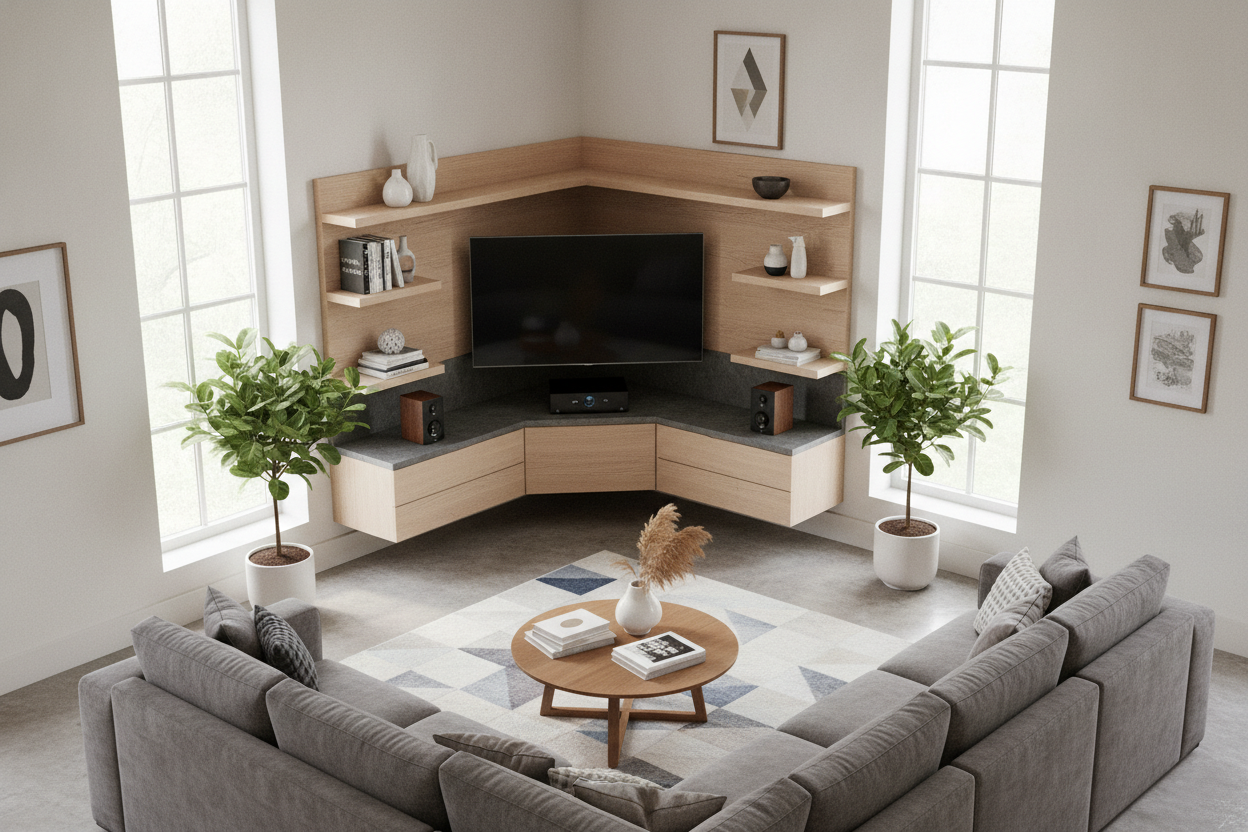
I spent three weeks staring at a floor plan that felt like a cruel joke. Between a massive floor-to-ceiling window and a fireplace that dominates the only long wall, I had exactly zero places to put a screen. I finally caved and looked into modern corner tv units, and honestly, it felt like admitting defeat—at first. I always thought corner stands were the design equivalent of a white flag, but when your floor plan is this difficult, you either adapt or you live in a room that feels like a storage unit.
- Corners solve the 'too many windows' layout crisis without blocking the light.
- Modern designs use fluted wood and powder-coated metal instead of dated 90s oak.
- A dark finish helps the tech blend into the corner shadows for a cleaner look.
- Adding height with plants or art makes the corner setup look like an architectural choice.
The 'No Good Walls' Dilemma
My living room is a 12x14 box of frustration. One wall is almost entirely glass, another features a massive fireplace with built-ins that are too shallow for a 55-inch screen, and the third is a high-traffic walkway to the kitchen. When you have zero usable wall space, you start doing weird things with floor plans. I tried floating the TV on a stand in the middle of the room, but it looked like a tech store display and I tripped over the power cord every single day. It was a mess of wires and bad sightlines.
I spent hours browsing standard flat TV stands, hoping I could somehow shimmy one against a window or block half the fireplace. It never worked. The scale was always off. A 60-inch console on a flat wall is fine, but when that same console cuts across a corner, it leaves a weird, dusty triangle of 'dead air' behind it that collects cat hair and lost remotes. I realized I needed something specifically engineered for that 90-degree angle if I wanted the room to feel like a home rather than a temporary staging area. You need a piece that actually hugs the wall, not one that just awkwardly leans against it.
Getting Over the '90s Triangle' Stigma
We all have the same mental image when we hear 'tv corner furniture.' It’s that chunky, honey-oak beast from 1998 with the glass doors and the gold-toned hinges. It usually had a VCR slot and enough bulk to survive a minor earthquake. Breaking that association was the hardest part of this process. I didn't want my living room to look like a time capsule of my parents' basement. I wanted something that looked like it belonged in a gallery, not a garage sale.
The good news? Design has actually caught up. Today’s tv corner furniture is a different species. I started seeing units with fluted wood textures—think thin vertical slats that add shadows and depth—and slim, metal legs that lift the piece off the floor. Lifting the unit is the secret. When you can see the floor going all the way to the corner, the room feels larger. I’ve assembled enough flat-pack MDF to know that it usually lasts about two moves before the screws start stripping. For a corner unit, I looked for something with a bit more structural integrity—high-grade veneers and powder-coated steel. It’s about finding that balance where the unit fits the geometry of the corner without looking like a heavy, solid block of wood.
Why I Specifically Hunted for a Dark Corner TV Unit
When you put a TV in a corner, you’re basically creating a dark pocket in the room. Instead of fighting that, I decided to lean into it. I started looking for a dark corner tv unit because black or deep walnut finishes act as a camouflage for the screen itself. When the TV is off, it’s just a giant black rectangle. On a white or light oak stand, that rectangle pops in a way that feels harsh and distracting. On a minimalist dark walnut finish, the screen and the furniture blur together into one cohesive element.
I found that a dark corner tv unit also adds a bit of much-needed gravity to an awkward layout. It anchors the space. I’ve argued before that a dark wood unit won't look dated as long as the lines are sharp and the hardware is minimal. In my case, it made the corner feel intentional, like a cozy media nook, rather than a place where I just shoved the tech because I ran out of options. The shadows in the corner actually work in your favor here, masking the depth of the unit and making it appear more integrated into the walls. It creates a sense of depth that a lighter unit just can't replicate.
How to Style a Corner Media Unit So It Looks Built-In
The biggest mistake people make with corner units is leaving them isolated. If you just plop a stand in the corner and call it a day, it looks like a floating island. To make it feel 'built-in,' you have to address the vertical space. I placed a six-foot fiddle leaf fig on one side of my unit. The organic shape of the leaves breaks up the hard lines of the TV and the stand, and the height draws the eye up toward the ceiling. It stops the corner from feeling like a low-slung 'dead zone' in the room.
Cable management is the other non-negotiable. Because corner units are often visible from side angles as you walk past, you can’t hide a rat’s nest of wires behind it like you can with a flat wall setup. I used adhesive cable clips and a power strip tucked inside the cabinet. For more ideas on how to pull this off, I looked into contemporary corner unit styling techniques that emphasize visual balance. I also added a piece of leaning art on the wall just slightly overlapping the side of the unit. This bridges the gap between the furniture and the wall, making the whole setup feel like a deliberate architectural feature rather than a furniture compromise.
The Unexpected Benefit: So Much More Floor Space
Once the corner media unit was finally in place and the TV was mounted, the shift in the room was immediate. By reclaiming the center of the main wall, I was able to move my sofa back about 18 inches. That doesn't sound like much, but in a small living room, it’s the difference between feeling cramped and having a clear walkway. The room literally opened up. I could finally fit a coffee table without having to shimmy around it like I was in a crowded bar.
I realized that the 'standard' way of decorating—TV on the long wall, sofa opposite—isn't always the best way for every house. Sometimes, the corner is the most efficient use of square footage. It keeps the screen out of the primary line of sight when you walk into the room, which makes the whole space feel less like a 'TV room' and more like a place for actual living. It wasn't a compromise; it was a layout hack I should have done years ago. My only regret was waiting so long to stop fighting the architecture of the house.
FAQ
Will a 65-inch TV fit on a corner unit?
It depends on the width of the unit's face. Most modern corner stands are designed for 50-55 inch screens. For anything larger, you'll want to ensure the stand is at least 55-60 inches wide so the edges of the TV don't hang off. If the TV is wider than the stand, it ruins the 'built-in' look and feels top-heavy.
Does corner placement cause glare?
Actually, it often helps. Because you can angle the TV precisely toward your seating, you can usually find a 'sweet spot' that avoids direct reflections from windows that would be unavoidable on a flat wall. It gives you more flexibility to pivot the screen away from the sun.
How do I hide the cables if the back is open?
Use Velcro ties and adhesive cable channels that run down the back legs of the unit. If the unit has an open back, try to match the cable sleeve color to your wall color. It takes an extra 20 minutes, but it makes the whole setup look ten times more expensive.

Dejar un comentario
Este sitio está protegido por hCaptcha y se aplican la Política de privacidad de hCaptcha y los Términos del servicio.