










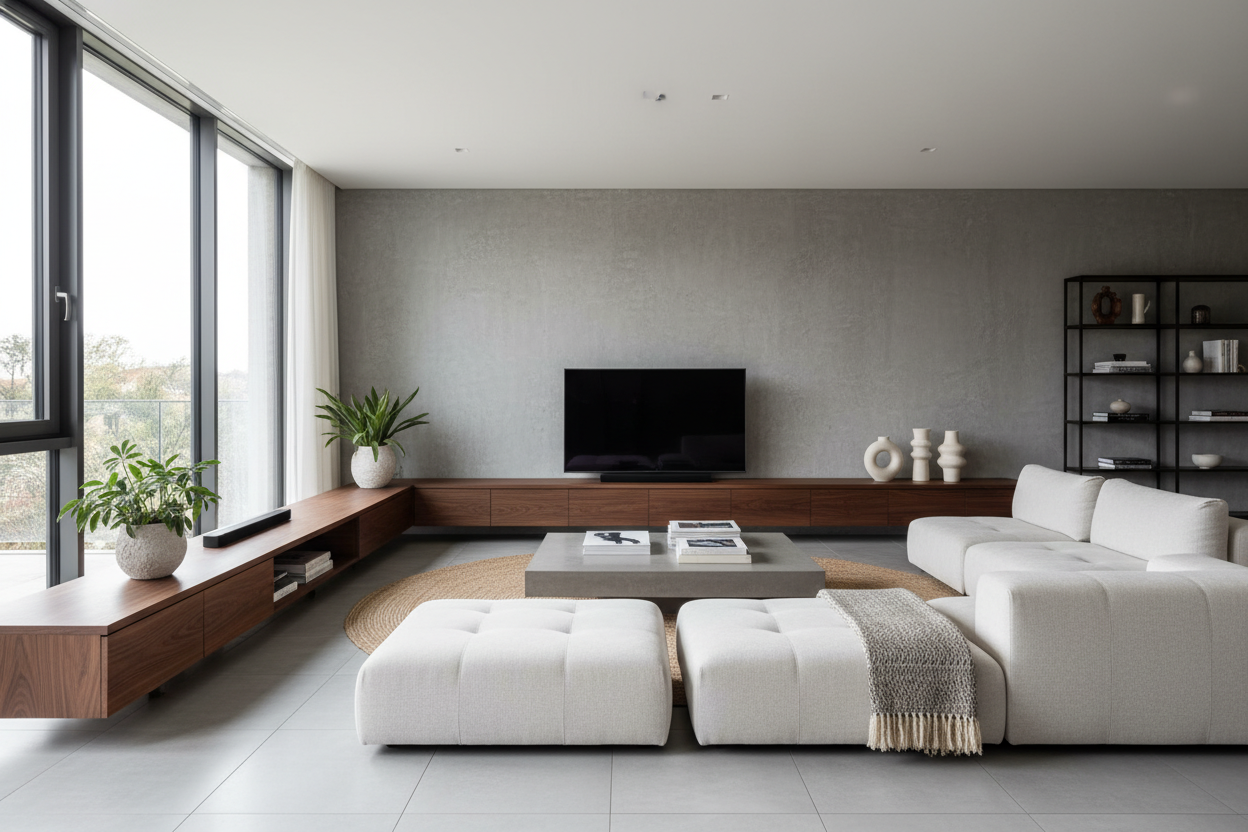
I spent three weeks staring at a 65-inch black rectangle that felt like it was swallowing my living room whole. It was perfectly centered on a 60-inch console, and every time I sat down, I felt like I was in a waiting room at a tire shop. The symmetry was suffocating.
The fix wasn't a smaller TV (obviously) or a hidden cabinet. It was extra long tv stands. By spreading out the horizontal footprint, I finally had the breathing room to treat my TV like a piece of art rather than a digital shrine. It changes the entire energy of the room from 'TV room' to 'curated lounge.'
- Asymmetry breaks the Best Buy showroom vibe and adds instant architectural interest.
- You need at least 20-30 inches of clearance on one side to make the look feel intentional.
- Visual weight is everything—balance the screen with a tall lamp or stacked books.
- Off-the-shelf units can look like custom millwork if you choose the right texture and length.
The 'Altar to Electronics' Problem in Our Living Rooms
Most people treat their TV like a religious relic. They find the exact center of the wall, find the exact center of the console, and plop the screen right there. It’s safe. It’s predictable. It’s also incredibly boring. It tells everyone who enters your home that the most important thing happening here is the Netflix algorithm.
When your TV is the dead-center focal point, the room becomes about the technology, not the people living in it. You end up with a giant void of black glass that demands your attention even when it’s off. It makes the space feel stiff and uninspired, like a floor model in a department store. I've seen $10,000 sofas look cheap because they were pointed at a perfectly centered, lonely TV.
I’ve found that the most high-end rooms don't highlight the TV; they integrate it. By shifting that screen to one side, you're signaling that the room has more to offer than just streaming. You're creating a gallery, not a viewing station. It allows the furniture to actually breathe.
Why Asymmetry Actually Requires Extra Long TV Stands
You can't just shove your TV to the left on a standard 50-inch unit and call it a day. It’ll look like you ran out of cord or your roommate moved the furniture while you were sleeping. To pull off the off-center look, you need scale. You need the furniture to extend far beyond the edges of the screen.
I’m talking about units that span 80, 90, or even 100 inches. When you're browsing through Tv Stands, look for something that is significantly wider than your screen. You want enough 'white space' on the console so the empty side looks like a deliberate design choice, not a mistake.
A tv stand extra long gives the eye a place to rest. It stretches the room horizontally, making your ceilings feel taller and your walls feel wider. It’s a classic interior design trick: use a massive horizontal line to ground a room that feels cluttered or cramped. It creates a foundation that makes the rest of your decor feel anchored.
The Visual Weight Rule: Styling the Empty Side
Once you’ve pushed your TV to one side, you have a big, empty platform to deal with. This is where most people panic and move the TV back to the middle. Don't do it. You just need to balance the visual weight. The screen is heavy and dark; you need something on the other side to counter it without competing for attention.
The TV is a heavy, dark object. To balance it, you don't need another heavy object; you need height and texture. I usually go for a tall, sculptural floor lamp behind the console or a high-quality table lamp on the surface. A stack of oversized coffee table books topped with a ceramic bowl also works wonders to ground the empty space.
If you're unsure where to start, there are plenty of deep dives on how to style wide media consoles. The goal is to create a 'vignette' that has nothing to do with electronics. Think leaning a large piece of abstract art against the wall or a vase with some dramatic, oversized branches. It draws the eye away from the screen and toward the decor, making the TV just another element in the room.
Does a TV Stand Extra Long Have to Be Custom Built?
A few years ago, if you wanted a 90-inch media console, you were looking at a $4,000 custom millwork bill or a trip to a high-end boutique. Thankfully, that’s not the case anymore. You can find ready-to-assemble pieces that look incredibly high-end if you pay attention to the materials and the silhouette.
For example, a modern white extra long barn door tv stand can span nearly 95 inches, providing that architectural 'built-in' look without the permanent commitment of a contractor. It’s about finding pieces that have enough physical presence to anchor the wall from corner to corner.
Texture is another big factor. If you’re worried about a long white or black slab looking too sterile, look for something like a modern tv stand with slatted doors. The vertical lines of the slats break up the horizontal mass and add a layer of warmth. It makes the whole setup feel more like a piece of heirloom furniture and less like a plastic appliance dock.
Getting Over the Symmetry Anxiety
I get it. Moving your TV three feet to the left feels 'wrong' at first. Our brains are wired to crave symmetry because it feels safe. But in interior design, 'safe' is often the enemy of 'soul.' Perfectly matched rooms feel like hotels where no one actually lives.
Real homes—the ones that feel curated and lived-in—always have a bit of imbalance. It creates a sense of movement and interest. When you finally stop centering your screen, you’ll realize the room feels more relaxed. It’s less about the 'big game' and more about the vibe of the whole space. It invites conversation rather than just staring at the wall.
Try it for a week. If you hate it, you can always slide it back. But I bet once you see how much better your art and lamps look on that extra long surface, you’ll never go back to the altar of electronics again. It's the easiest high-end upgrade you can make.
Personal Experience: The Sagging Center Mistake
I once bought a 75-inch console that was made of cheap, thin MDF because I was in a rush and liked the price tag. I didn't check the weight capacity or the support legs. Within two months, the middle started to sag like a hammock under the weight of my receiver and a few heavy books. It looked terrible and nearly ruined my gear. Now, I never buy an extra long unit unless it has at least two center support legs and a top board that's at least an inch thick. Solid wood or high-density particle board is a must—don't cheap out on the bones of a long piece or you'll be replacing it in six months.
FAQ
Will an off-center TV hurt my neck?
Only if you're sitting at a weird angle. Most people angle their sofa toward the TV anyway. As long as the screen is at eye level when you're seated, the horizontal shift won't affect your comfort. Just pivot your chair slightly.
What if my wall isn't long enough for a 90-inch stand?
If you can't go extra long, don't go asymmetrical. You need the extra length to make the 'empty' side look intentional. If your wall is small, stick to a centered layout but use floating shelves to add interest elsewhere.
How do I hide the cables if the TV is pushed to one side?
Use a console with built-in cable management ports, or use paintable cord covers. If you're sliding the TV to the side, make sure your cords are long enough to reach the nearest outlet without being pulled taut or hanging visible behind the 'empty' side.


Dejar un comentario
Este sitio está protegido por hCaptcha y se aplican la Política de privacidad de hCaptcha y los Términos del servicio.