










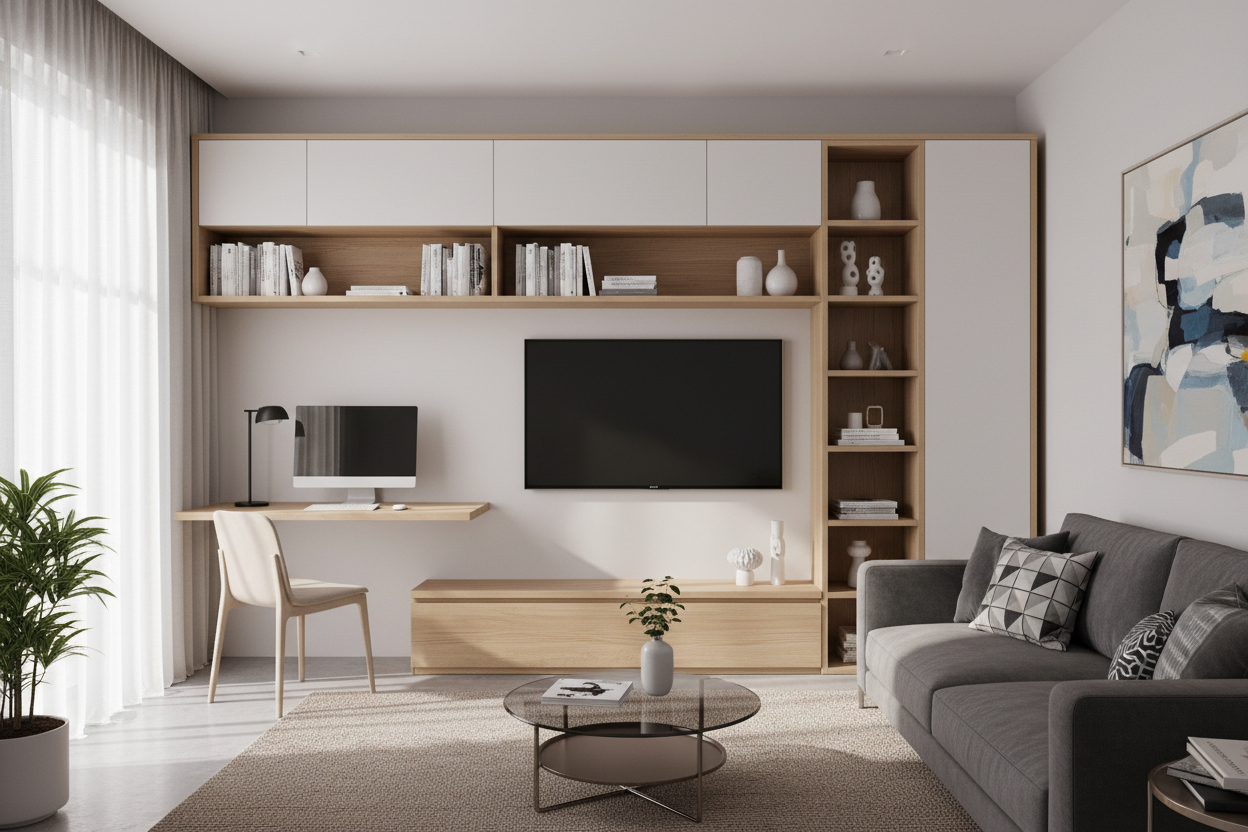
I spent three years staring at a wall in my 500-square-foot apartment that looked like a furniture graveyard. On the left, a mid-century media console I bought because it was on sale. On the right, a cheap metal desk that shook every time I typed an email. Between them? A tangled nest of power strips and dust bunnies that I tried to hide with a dying potted plant.
It looked messy because it was messy. Trying to force two different functions onto one wall using mismatched pieces is the fastest way to make a living room feel like a cramped dorm. The fix isn't buying a smaller desk or a thinner TV; it is investing in a tv and desk wall unit that treats the entire wall as one cohesive, architectural element.
- Visual Flow: Continuous horizontal lines prevent the room from looking chopped up into tiny, unusable zones.
- Verticality: Most of us ignore the top four feet of our walls. A wall unit uses that space for storage, making the ceiling feel higher.
- Cable Management: One unit means one hidden channel for all those ugly power cords and HDMI cables.
- Flexibility: High-quality modular systems can be reconfigured or moved when you eventually upgrade your square footage.
The 'Two Separate Zones' Mistake
When you put a freestanding desk next to a standalone media console, you create a visual 'gap' that serves no purpose. Your eye stops at the end of the desk, jumps across a foot of empty wall space, and then hits the TV stand. This constant starting and stopping makes a small room feel even tighter than it actually is. It is visual friction you don't need.
Most desks are about 30 inches high, while media consoles usually sit between 18 and 24 inches. That staggered height is a nightmare for the eyes. It feels cluttered, even if your desk is perfectly clean. A tv desk wall unit solves this by using a single top line or a connected shelving system that anchors the entire wall. It turns a collection of furniture into a feature wall.
Why a Unified System Actually Saves Space
Architects use long horizontal lines to make small rooms feel wider. A wall unit for tv and desk does exactly that. By stretching one piece of furniture across the wall, you trick your brain into thinking the wall is larger than it is. It is the same reason a large rug makes a room look bigger than a small one does. You are creating a sense of scale.
Then there is the vertical factor. Most of us leave the space above our TVs completely empty or fill it with a single, lonely shelf. A full wall unit lets you fit a desk and shelf unit into small spaces perfectly by utilizing every inch up to the ceiling. You are trading floor footprint for air space, which is a trade you should make every single time in an apartment. I went from having zero storage to having enough room for my entire book collection just by going vertical.
Ergonomics: Balancing Screen Height and Seating
The biggest hurdle with a hybrid setup is the height difference. You want your TV at eye level when you are slumped on the sofa, but your desk needs to be at a standard height for typing. If you try to use a standard writing computer desk as a TV stand, your neck will be screaming within an hour of a Netflix binge. It is too high for comfortable viewing.
Look for units that offer offset heights or adjustable mounting. The workspace should be at that 29 to 30-inch mark, but the TV mounting area or shelf should sit lower—usually around 22 to 24 inches from the floor for a standard sofa. If you are mounting the TV to the back panel of the unit, aim for the center of the screen to be roughly 42 inches from the floor. It is the sweet spot that works for both sitting at the desk and lounging on the couch.
Hiding the 5 PM Tech Clutter
Nothing kills a relaxing evening like staring at your work laptop and a tangled mess of HDMI cables while you are trying to watch a movie. I used to have my monitors out 24/7 until I finally hid my messy WFH setup inside a desk and TV unit with doors. Closing those doors at 5:01 PM is the best mental health boundary I have ever set.
A good unit will have built-in grommets and wire channels. If it doesn't, do not be afraid to get a 2-inch hole saw and make your own (as long as it is wood, not glass). Route your work cables behind the back panel so they never mingle with the TV cords. It keeps the 'office' side of your brain from bleeding into the 'living' side after hours. You want your home to feel like a home, not a corporate cubicle.
Modular vs. Custom: What Makes Sense for You?
Custom built-ins are gorgeous, but they are a permanent commitment and a massive financial hit. You are looking at several thousand dollars for anything decent, and you can't take it with you when you leave. For most renters or first-time buyers, modular is the way to go. Systems that use metal uprights and adjustable wood shelves give you that built-in look without the 'forever' price tag.
I personally prefer modular units with individual uprights. If I move to a place with a smaller wall, I can just remove one section and use it as a standalone bookshelf in a bedroom. You get the cohesion of a single unit with the flexibility of separate pieces. Avoid the flimsy particle board stuff that sags after six months; look for real wood or high-grade MDF with a solid veneer if you want it to survive a move.
Can I use a regular desk as part of a wall unit?
You can, but you need to bridge the gap. Use floating shelves above both the desk and the TV stand that span the entire width of the wall. This creates a frame that makes two separate pieces look like one integrated unit. It is a great budget hack if you already own pieces you love.
How much wall space do I actually need?
Ideally, you want at least 8 feet. That gives you 4 feet for a comfortable desk area and 4 feet for a medium-sized TV setup. Anything less than 6 feet starts to feel cramped, and you will likely be bumping your elbows on the TV while you type, which is incredibly distracting.
Is it better to mount the TV or set it on a shelf?
Mount it every time. Mounting the TV to the wall or the unit's back panel frees up the surface below for soundbars, remotes, or actual decor. It also looks much cleaner and more intentional than having a plastic stand sitting on a shelf. Plus, it is safer if you have pets or kids.


Dejar un comentario
Este sitio está protegido por hCaptcha y se aplican la Política de privacidad de hCaptcha y los Términos del servicio.