










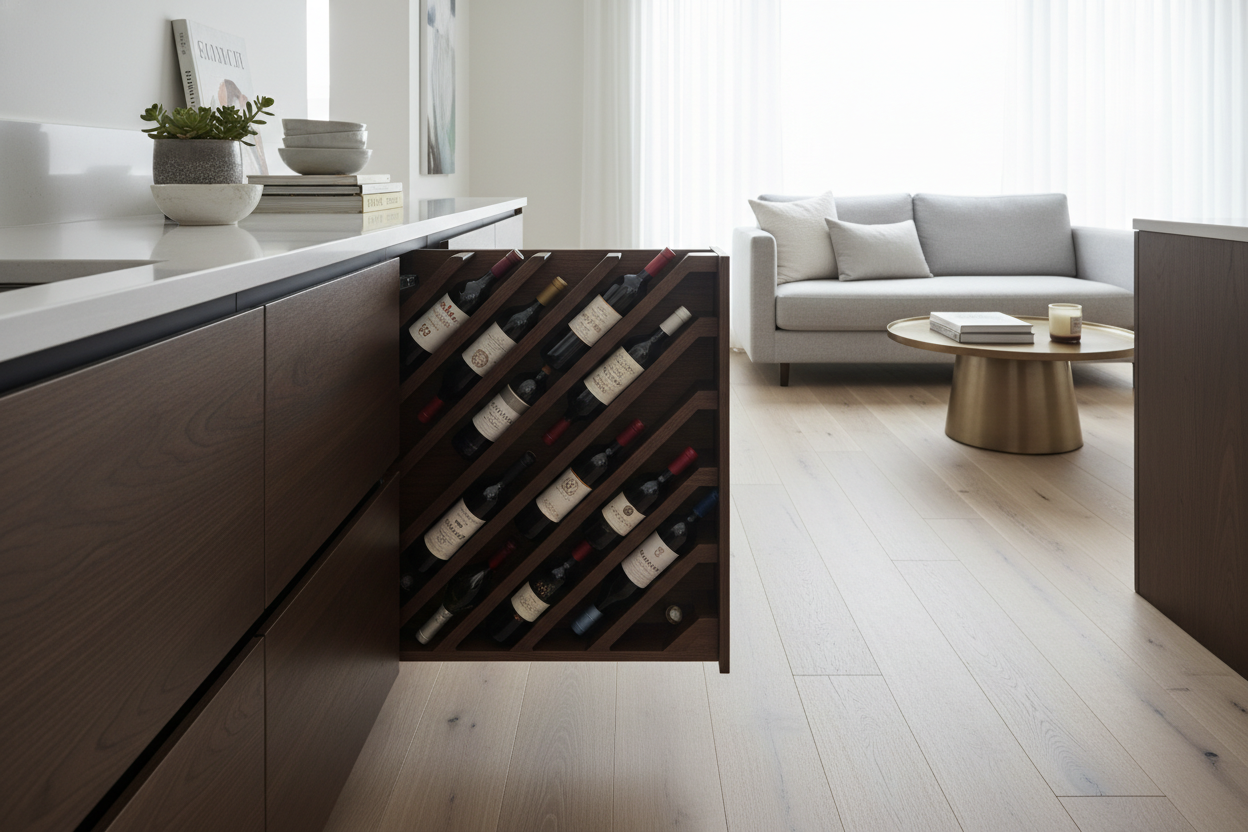
I spent three years living with a 'clink and hope' strategy in my kitchen. Every time I reached for the olive oil, a bottle of Malbec would roll toward the edge of the shelf like it was auditioning for a disaster movie. It is the classic builder-grade kitchen problem: deep, cavernous cabinets with absolutely zero plan for anything cylindrical. I tried stacking them in a pyramid, which worked until I wanted the bottle at the bottom.
Eventually, I realized I didn't need a full kitchen renovation or a thousand-dollar cooling fridge. I just needed a cupboard wine rack insert. It is one of those low-effort, high-reward fixes that makes your kitchen look like you actually have your life together. Instead of a pile of glass, you get a clean, organized grid that looks like it was built into the cabinetry from day one.
Quick Takeaways
- Wood inserts offer a custom, high-end look compared to flimsy wire alternatives.
- Measure twice: Always account for the cabinet hinge and the 'lip' of the frame.
- A wine drawer insert is the best way to utilize deep, low-reaching cabinets.
- If you have more than 12 bottles, it is time to look at a dedicated pantry unit.
The 'Bottle Avalanche' Ruining Your Kitchen
There is a specific kind of anxiety that comes with opening a cabinet and hearing glass clink against glass. Storing loose wine bottles in deep cupboards is a recipe for disaster. Not only is it a waste of vertical space, but it is also dangerous. I once had a Prosecco bottle take a dive and shatter on my quartz countertop because I thought I could balance it on top of a stack of Chardonnays. Lesson learned.
Once you decide to keep bottles on the counter, you quickly realize that standard kitchen cabinets are built for boxes and plates, not rolling glass. A wine bottle cabinet insert solves this by giving every bottle a designated home. It stops the rolling, prevents the clinking, and actually lets you see what you have in stock. No more digging through the back of the pantry to find that one bottle of Rosé you bought last summer. A wine rack insert for kitchen cabinet use turns a chaotic mess into a functional cellar-style display.
I have tried the cheap plastic bins, and honestly, they just slide around. A dedicated wine bottle cabinet insert stays put. It creates a structural grid that utilizes the full height of the shelf, which is usually wasted space anyway. It is about reclaiming your sanity and protecting your investment—because let’s be real, wine isn't getting any cheaper.
What Actually Makes a Good Cupboard Wine Rack Insert?
Not all inserts are created equal. I have made the mistake of buying the cheapest wire wine rack insert I could find on a late-night scrolling session. It arrived, I loaded it up, and the metal started to sag under the weight of six heavy bottles. It looked cheap, sounded rattly every time I opened the door, and eventually, I just threw it out. If you want that high-end, custom-built look, you have to go with a wood wine rack cabinet insert.
Solid wood—think oak, maple, or even a sturdy plywood with a nice veneer—adds weight and stability. It feels permanent. When you slide a wooden wine rack insert into a 15-inch or 18-inch cabinet, it fills the gaps and looks like a carpenter spent the afternoon installing it. Look for 'X wine rack insert' designs if you want to store different bottle shapes (like those fat Pinot Noir bottles or tall Rieslings) in the same cubby. The X-style wine cubby insert is much more forgiving than individual round holes.
If you prefer a modern aesthetic, a metal wine rack insert can work, but make sure it is heavy-gauge steel. You want something that doesn't flex. However, for most home cooks, the wine rack kitchen cabinet insert made of wood is the gold standard. It dampens the sound of the glass and matches the interior of most standard cabinets. Avoid the flimsy 'snap-together' plastic versions; they are fine for a dorm room, but they won't hold up to a real collection.
The Hidden Gem: Converting a Lower Drawer
If you have those deep lower drawers that usually end up as a graveyard for Tupperware lids, you are sitting on a gold mine. A wine drawer is one of the most ergonomic ways to store your stash. Instead of bending down and squinting into a dark cupboard, you pull the drawer out and see every label from above. It is a total shift in how you interact with your kitchen.
A wine drawer insert is essentially a scalloped tray that sits at the bottom of the drawer. You can find a wine rack insert for drawer spaces that can be trimmed to fit your exact width. This keeps the bottles from rolling side-to-side when you pull the drawer open. A wine rack drawer insert or a wine bottle drawer insert is particularly great for those 24-inch wide base cabinets. You can easily fit 5 or 6 bottles across, and if the drawer is deep enough, you can even double-stack them with a wine storage drawer system.
I personally use a wine bottle drawer for my 'everyday' bottles and save the wine rack shelf insert for the fancy stuff I want to show off. Just make sure your drawer glides are rated for the weight. A full drawer of wine can easily weigh 30-40 pounds. If your drawers feel flimsy, stick to the wine rack inserts for shelves instead.
How to Measure Without Messing It Up
This is where most people fail. They measure the outside of the cabinet and order an insert that is exactly that width. Then it arrives, and they realize the cabinet door hinge sticks out an inch, or the face frame of the cabinet is narrower than the interior. To get a wine bottle insert for cabinet use that actually fits, you need to measure the 'clear opening.'
Open the door fully. Measure the narrowest point—usually between the hinges or the frame edges. That is your maximum width. Then, measure the interior depth. Most standard base cabinets are 24 inches deep, but upper cabinets are usually only 12 inches. A wine bottle shelf insert designed for a base cabinet will stick out like a sore thumb if you try to put it in an upper. Also, check for any shelf pegs or hardware that might get in the way of a wine storage insert sliding in smoothly.
When You Should Just Buy a Dedicated Unit Instead
Look, I love an insert, but they have their limits. If you find yourself trying to cram 24 bottles into a single 12-inch cabinet, you are fighting a losing battle. There comes a point where an insert is just a band-aid. If your collection has outgrown your cupboard space, it is time to consider a cabinet organizer with wine holders that is designed from the ground up to handle the weight and volume.
I have seen people try to stack multiple wine bottle cabinet inserts on top of each other, only for the whole thing to become top-heavy and sketchy. If you also have a growing collection of bourbon, gin, and glassware, you might want to get a wine rack and drinks cabinet all-in-one. A dedicated unit gives you the stability of a permanent piece of furniture and usually includes a wine storage cabinet insert that is integrated into the design.
My rule of thumb: if you have a dozen bottles or fewer, a wine rack insert for kitchen cabinet use is perfect. It keeps things tidy and utilizes existing space. But if you are a true enthusiast, stop trying to hack your kitchen and buy a piece of furniture that respects the wine. A hybrid pantry or a dedicated bar cabinet will always look better and function more reliably than a cabinet stuffed to the gills with inserts.
FAQ
Will a wine rack insert fit my oversized Champagne bottles?
Most standard wine rack inserts for cabinet use are designed for 750ml Bordeaux-style bottles. If you drink a lot of Champagne or Burgundy, look for an 'X' style insert or a wine cubby insert with larger openings (at least 3.75 inches wide).
Are wire wine rack inserts better than wood?
Wire wine rack insert options are usually cheaper and easier to clean, but they lack the stability and 'built-in' look of wood. If you want a permanent feel, go with wood. If you are in a rental and need something temporary, wire is fine.
How do I stop the insert from sliding around?
If your wine insert for cabinet use feels a bit loose, use a small piece of non-slip drawer liner underneath it or a single command strip at the back. This prevents it from shifting every time you grab a bottle.



Dejar un comentario
Este sitio está protegido por hCaptcha y se aplican la Política de privacidad de hCaptcha y los Términos del servicio.