










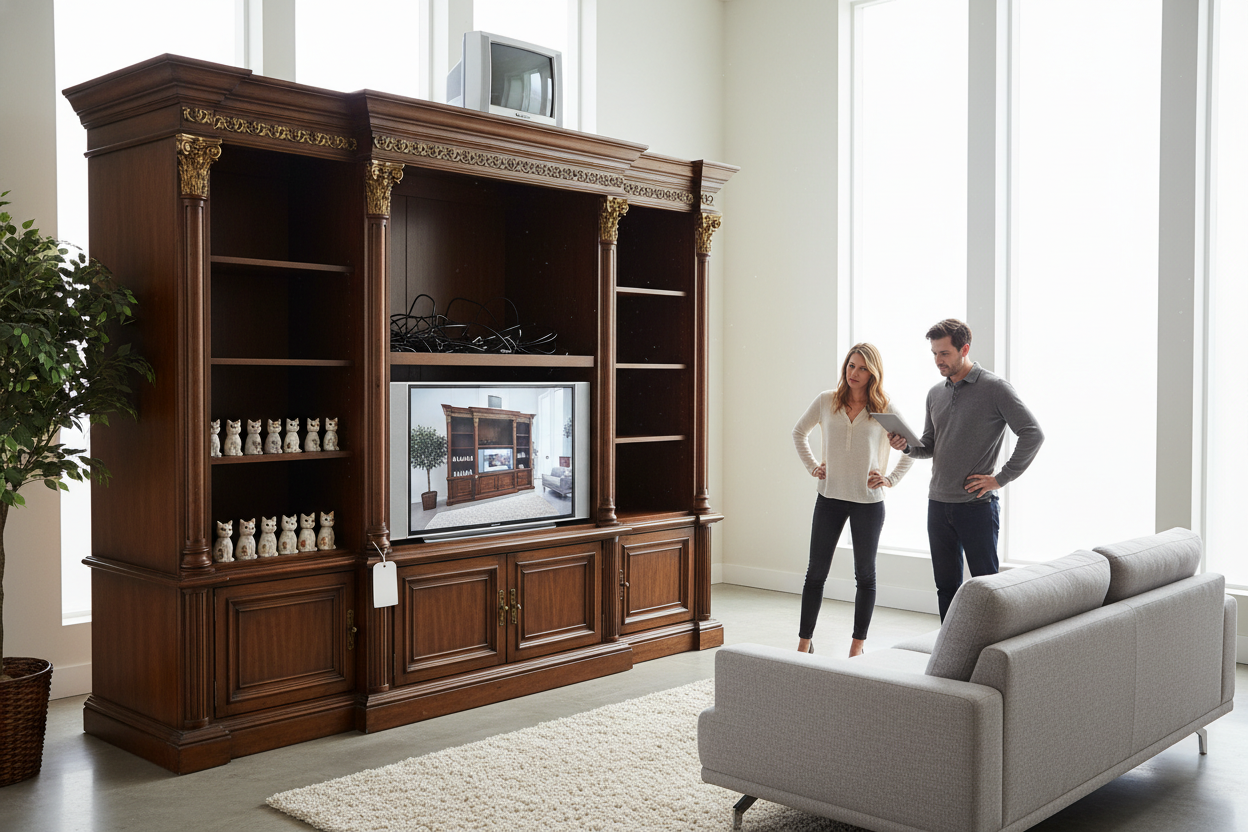
I once spent three weeks obsessing over a mid-century media console. In the catalog, it looked like a literal altar to home cinema—sleek, substantial, and expensive. When the boxes finally arrived and I spent four hours wrestling with cam locks and hex keys, I realized I'd been had. The piece was barely taller than my knees and looked like a toy in my living room.
This is the danger of relying solely on images for tv cabinet shopping from professional catalogs. They aren't just selling you a piece of wood; they're selling you a vibe that doesn't exist in your actual house. If you want to avoid a return-shipping nightmare that costs $150 in freight fees, you have to look past the gloss.
- Studio photos often use tiny 32-inch monitors to make small cabinets look massive.
- Professional lighting hides the grainy texture of cheap paper veneers.
- Real-life customer photos reveal the 'cable spaghetti' nightmare brands hide.
- If a photo shows no baseboards, the furniture was likely Photoshopped into a digital room.
The Day My 'Perfect' Console Arrived (And Looked Tiny)
The catalog shot featured a stunning walnut unit that seemed to dominate the wall. It looked massive. I didn't check the dimensions because I assumed the 65-inch TV in the photo was, well, a 65-inch TV. It wasn't. Brands often use 32-inch monitors or even smaller custom-made props to make their furniture appear grander. It's a classic trick of the trade.
When I finally set it up, my actual TV hung off the edges like a toddler wearing their dad's suit. It was embarrassing. I'd spent $600 on a glorified shoe rack. Now, I never buy anything without seeing a tv cabinet pic taken by a human being in a messy house. If I can't see how it looks next to a standard 12-ounce soda can or a real human hand for scale, I don't trust the listing.
Why Studio Lighting Lies to You
Catalog photographers use thousands of dollars in softboxes and reflectors to make surfaces look flawless. This is especially deceptive with dark finishes. For instance, a black cabinet with glass doors often looks like a solid, matte void in stock photos, but in your living room, it might show every fingerprint and look like cheap plastic under a standard ceiling fan light.
You need to find a tv cabinet image taken in 'gloomy' light. You want to see how the wood grain—or the wood-look laminate—reacts to the kind of low light you actually watch movies in. If the material looks like a flat, muddy mess in a customer's iPhone photo, it's going to look exactly like that in your house. Don't let a $5,000 lighting setup convince you that a $200 MDF unit has 'depth.'
How to Find Real Pictures of TV Cabinets Before Buying
Stop looking at the first three 'featured' reviews on the product page. Those are often curated by the brand's marketing team. Head straight for the 'most recent' filter and look specifically for the reviews with image attachments. I also search Instagram hashtags for the brand or the specific model name. People love to show off their new setups, and those unedited pictures of tv cabinets are worth more than a thousand professional renders.
YouTube is another goldmine. Search for unboxing videos or 'living room tours.' Seeing someone actually lift the pieces out of the box tells you more about the material quality than any 'about us' page. If the boards sound like hollow cardboard when they clink together on the floor, you've saved yourself a massive headache. Look for the weight of the box too—solid wood doesn't weigh 30 pounds.
Look for the Messy Cords (A Good Sign!)
A pristine, cord-free tv cabinet picture is a lie. Unless the brand drilled through their drywall for the shoot, there will be wires. I actually hunt for a tv cabinet pic that shows a bit of a mess. It tells me where the access holes are and if they're actually large enough for a modern surge protector or a bulky gaming console like a PS5.
Seeing how someone else struggled with their cable management actually inspired me to ditch my old stand. I ended up looking for a modern wall cabinet for living room storage specifically because a real user photo showed how it hid their router and three different HDMI switchers perfectly. If they hadn't posted that 'ugly' photo, I would have never known it could handle my tech hoard.
Red Flags in Any TV Cabinet Picture
Look at the floor. If the furniture is sitting flush against a wall with no baseboards, that's a studio set. Real houses have baseboards, which means your cabinet will likely sit an inch or two away from the wall. If the photo shows it perfectly flush, they’ve likely Photoshopped the unit into a digital room. This means the scale is almost certainly manipulated.
Another trick is the 'miniature decor' move. They'll put tiny vases, tiny books, and tiny lamps on the unit. It makes the surface area look vast. Measure your own soundbar and your own receiver before you click buy. If your receiver is 17 inches wide and the shelf in the photo looks 'huge' with a book on it, check the specs. That book might be a pocket-sized novel, not a coffee table book.
Units That Actually Live Up to the Hype
Proportions matter. A 70-inch TV needs a unit that is at least 80 inches wide to look balanced. I've found that a large tv cabinet spacious storage unit usually lives up to the expectations because it's hard to fake that much physical footprint. When you see customer photos of these larger pieces, they actually look like the catalog because the scale is finally correct for modern screens.
Stick to pieces that have high-resolution user photos showing the joinery. If the corners look crisp in a grainy cell phone shot, the manufacturing is likely solid. Don't be the person who buys a 'media center' that's essentially a glorified coffee table. Look for real-world depth—at least 16 inches—to ensure your equipment actually fits behind the doors.
FAQ
How much wider should my cabinet be than my TV?
Aim for at least 3 to 6 inches of overhang on each side. If your TV is 55 inches wide, get a cabinet that is at least 65 inches. Anything less looks 'top-heavy' and visually unstable.
Are customer photos always more accurate for color?
Usually, yes. Catalog photos are color-graded to look 'warm' or 'expensive.' A customer photo taken at noon will show you the true undertones of the wood or paint, which is vital if you're trying to match an existing oak floor or walnut coffee table.
Why do brands Photoshop TVs onto the wall?
It's cheaper than hiring a crew to mount a real TV. The problem is they often scale the digital TV image incorrectly, making the cabinet look much larger than it actually is. Always trust the tape measure over the tv cabinet image you see on the landing page.


Dejar un comentario
Este sitio está protegido por hCaptcha y se aplican la Política de privacidad de hCaptcha y los Términos del servicio.