










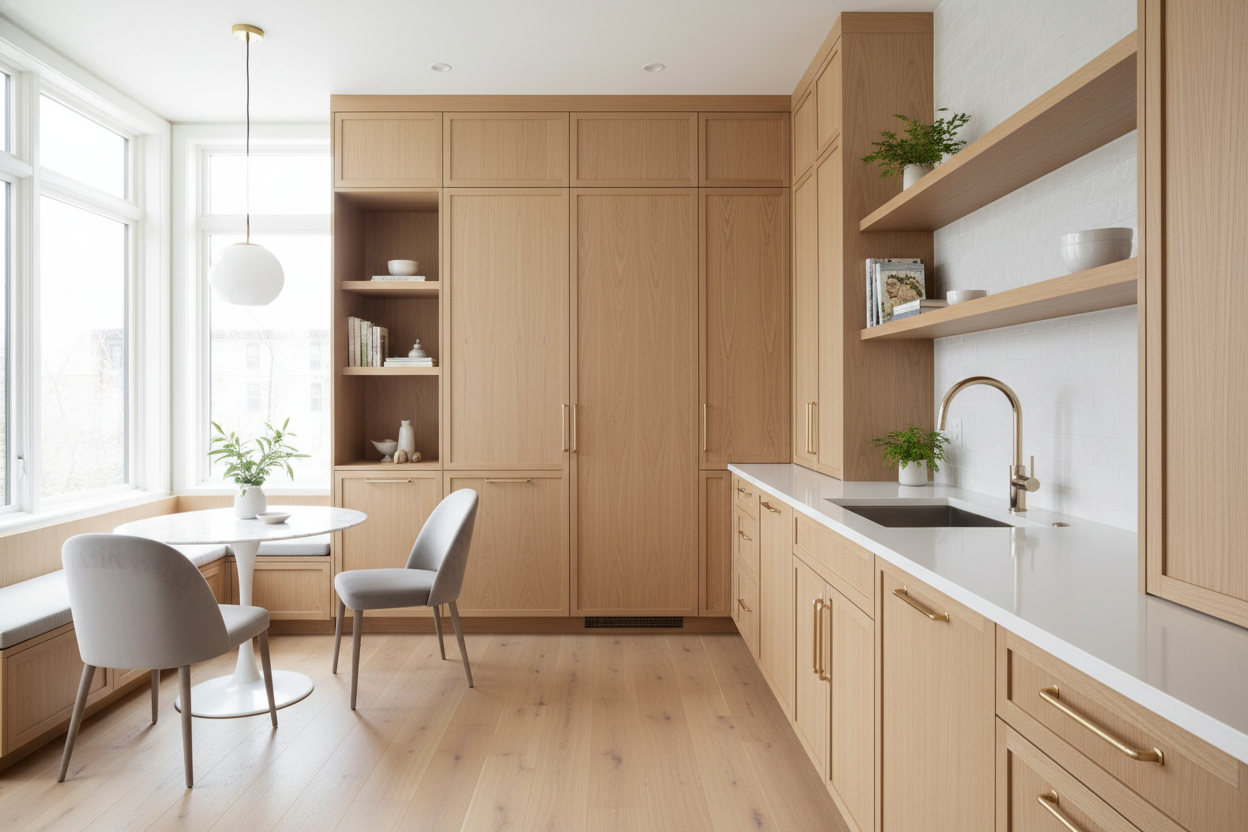
I remember staring at the CAD drawing for my first kitchen remodel and seeing a 6-inch gray block labeled 'filler.' My contractor told me it was just to make the standard cabinets fit the wall. I felt like I was paying $400 a square foot to house a piece of painted plywood. It felt like a scam then, and after years of ripping out old kitchens, it feels like a crime now.
The reality is that narrow cabinets for kitchen layouts are the difference between a kitchen that works and one that just looks okay in photos. Every time you see a 'filler board,' that’s a missed opportunity for a spice rack, a baking sheet organizer, or a hidden step stool. Stop letting your layout dictate your storage; start making the cabinets work for the inches you actually have.
Quick Takeaways
- Filler boards are dead space; anything wider than 3 inches can be a functional cabinet.
- Vertical storage in narrow units is the best way to store heavy baking sheets and cutting boards.
- Pull-out mechanisms are non-negotiable for skinny cabinets—if it doesn't slide, you'll never see what's in the back.
- Freestanding slim units are great for renters, but built-in narrow base cabinets add the most home value.
The 'Filler Board' Epidemic (And Why It Drives Me Crazy)
Contractors love filler boards because they make their lives easy. If a wall is 127 inches long and they are using standard 24-inch and 30-inch boxes, they’re left with a 7-inch gap. Instead of sourcing narrow kitchen units, they just bridge the gap with a piece of matching wood. It looks seamless, sure, but you just lost enough space to store every spice jar you own.
I’ve walked into high-end kitchens where homeowners spent $80,000 only to have 12 inches of 'dead' space hidden behind panels. When you demand skinny kitchen cabinets instead of filler, you’re forcing the design to be efficient. Even a thin kitchen cabinet can hold a stack of pizza stones or a hidden broom closet. Don't let a contractor tell you a gap is too small to be useful. If a human hand can reach into it, a slim cabinet for kitchen use can fit in it.
In my experience, the 'standard' approach is the enemy of the small kitchen. Using a narrow kitchen cupboard allows you to shift your larger appliances—like the dishwasher or range—over just enough to gain counter space where you actually need it. It’s about the geometry of the room, not just the aesthetics of the doors.
What Are You Supposed to Put in a 9-Inch Space?
The most common pushback I hear is, 'What am I even going to put in a cabinet that narrow?' People think a thin cabinet kitchen is a waste of money. They’re wrong. A 9-inch narrow kitchen cabinet is actually the most functional spot in my house because it solves the 'vertical clutter' problem.
Think about your baking sheets, muffin tins, and heavy wooden cutting boards. In a standard wide cabinet, they end up in a chaotic, clanging pile. In a narrow kitchen storage cabinet, you store them vertically. They stay organized, they don't scratch each other, and you can grab one without a structural collapse of your Tupperware. When you’re looking at different cabinet options for kitchen layouts, you have to think about the shape of your items, not just the volume.
Beyond baking sheets, a slim storage cabinet kitchen is the perfect home for a heavy-duty step stool. Most of us have one leaning against the side of the fridge or tucked in a closet three rooms away. A 6-inch narrow storage cabinet for kitchen use allows that stool to live exactly where you need it to reach the high shelves. It turns a nuisance into a built-in feature.
The Pull-Out Pantry Hack for Skinny Gaps
If you have a gap next to your refrigerator, you’re sitting on a goldmine. Most fridges need a little breathing room anyway, but a 10-inch gap is enough for a narrow kitchen pantry cupboard. These aren't your standard shelves; they are full-height units on heavy-duty glides that pull out to reveal your entire dry-goods inventory.
The secret here is the hardware. A slimline kitchen cupboard is only as good as its drawer slides. If you go cheap, the weight of 20 jars of pasta sauce will make the unit sag and scrape your floors. But with 100-lb rated ball-bearing slides, a skinny kitchen storage unit becomes a high-density kitchen pantry storage solution that rivals a walk-in closet. I’ve seen these 'broom-closet' style units hold enough canned goods to last a family a month, all in a footprint that used to just collect dust bunnies.
I personally prefer the slimline kitchen storage units that have adjustable shelf heights. Cereal boxes are tall; tuna cans are short. If your narrow kitchen storage rack is fixed, you're going to end up with wasted vertical space. Look for units with peg-hole adjustments so you can tighten up the gaps between shelves.
Freestanding vs. Built-In: Which Slim Unit Wins?
If you’re doing a full gut-job, a built-in narrow base cabinet kitchen is the way to go. It’s permanent, it matches your millwork, and it increases your home's resale value. There is something deeply satisfying about a kitchen where every inch looks intentional. A slimline kitchen cabinet that perfectly matches your shaker doors feels like a custom luxury, even if it’s an off-the-shelf RTA (Ready-to-Assemble) unit.
However, if you’re a renter or on a strict budget, a narrow freestanding kitchen cabinet is a lifesaver. I’ve used the rolling 'utility carts' that are only 5 inches wide to fill the gap between a stove and a counter. They aren't as pretty as built-ins, but they are incredibly practical. Some of these units even double as kitchen dining storage, allowing you to wheel your oils and spices directly to the table or a prep island when you’re hosting a big dinner.
The downside of freestanding skinny kitchen cabinets is stability. Because they are tall and thin, they can be tippy. If you go the freestanding route, look for models with weighted bases or ones that can be discreetly tethered to the side of a neighboring cabinet. A thin cabinet for kitchen use is great; a thin cabinet that falls over when you pull it out is a disaster.
Are Slim Drawers Actually Better Than Tiny Doors?
This is a hill I will die on: a very narrow kitchen cabinet should almost never have a standard swinging door. If you have a 6-inch opening with a door, you’re basically looking into a dark tunnel. You’ll be able to reach the first item, but anything behind it is lost to the abyss until you move out of the house.
A narrow kitchen cabinet with drawers—or better yet, a single full-height pull-out—is the only way to fly. When the entire 'innards' of the cabinet come out to meet you, you have 100% visibility. I’ve seen people install a narrow kitchen cabinet with doors and then complain they can't find their spices. Well, yeah, because you’re trying to look through a 5-inch wide hole into a 24-inch deep dark space.
Even for a narrow upper kitchen cabinet, I prefer a pull-down or a specialized rack. The goal of slim kitchen cabinet storage is to eliminate the 'digging' factor. If you have to move three things to get to one thing, your storage has failed you. Thin kitchen storage cabinet design is all about the 'one-touch' rule: you should be able to grab what you need without a game of Tetris.
My $200 Mistake
A few years ago, I installed a 6-inch spice pull-out in my own kitchen. I was cheap and bought a generic brand with 'friction slides' instead of ball-bearing ones. Within three months, the wood had slightly swollen from the dishwasher's steam nearby, and the cabinet became a two-handed workout to open. One night, I pulled so hard the front panel literally ripped off the drawer box. I ended up spending twice as much to replace it with a proper steel-framed unit. The lesson? In narrow storage, the hardware is the only thing that matters. Don't skimp on the glides.
FAQ
What is the narrowest kitchen cabinet you can buy?
Most major manufacturers start at 9 inches for base cabinets, but specialized companies like Rev-A-Shelf or custom shops can go as narrow as 3 to 6 inches. Below 6 inches, you're usually looking at a pull-out rack rather than a traditional 'box' cabinet.
What to put in narrow kitchen cabinet units?
Baking sheets, cutting boards, cooling racks, and pizza stones are the top tier. Second tier is spices, oils, and vinegars. Third tier is cleaning supplies like brooms and mops if the cabinet is full-height.
Are slimline kitchen cabinets more expensive?
Per inch, yes. A 9-inch cabinet often costs almost as much as an 18-inch cabinet because the labor and hardware are the same. But the 'cost' of wasting that space in your kitchen is much higher in the long run.


Dejar un comentario
Este sitio está protegido por hCaptcha y se aplican la Política de privacidad de hCaptcha y los Términos del servicio.