










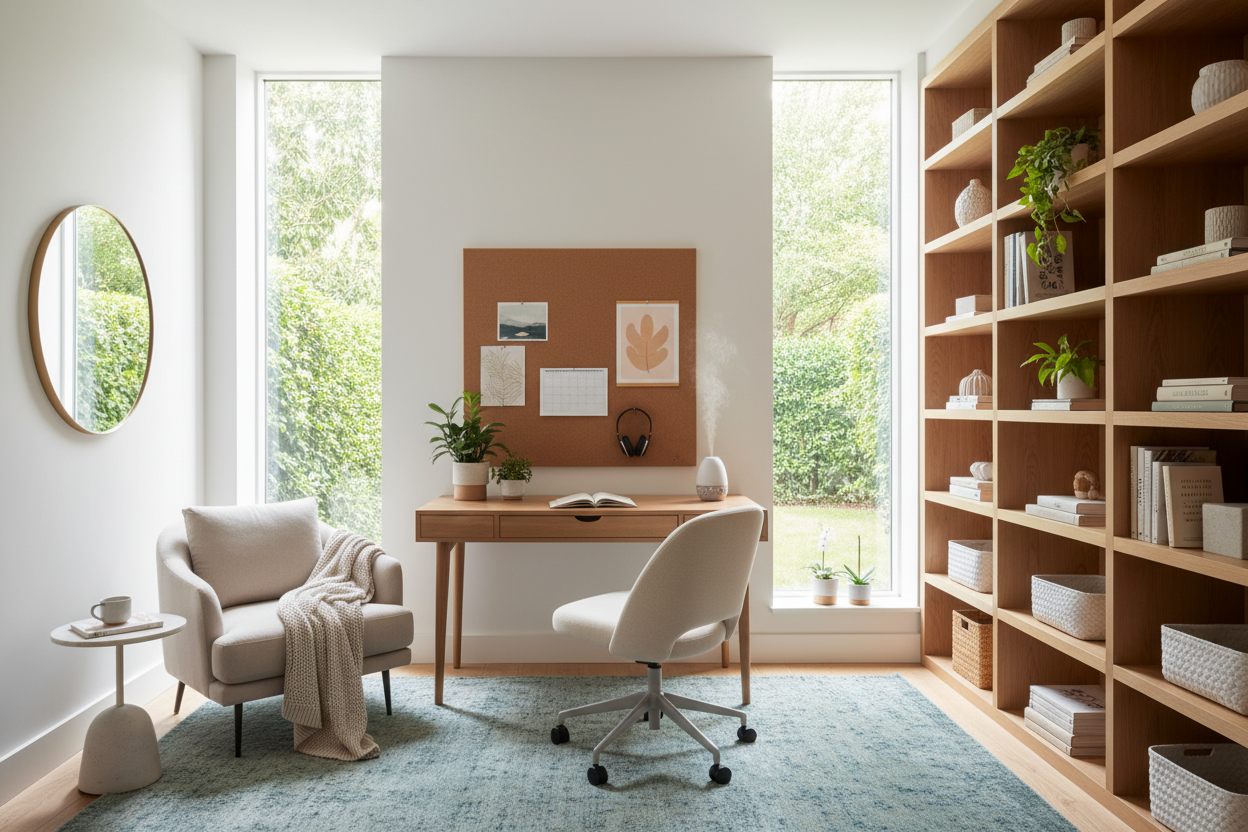
Many clients come to me exhausted, complaining that their living room suddenly feels like a corporate cubicle. When your laptop sits on the dining table, staring at you during dinner, the lines between rest and productivity vanish. I have learned that supporting your mental health while working from home is not just about taking scheduled breaks; it is deeply tied to how we arrange our physical spaces.
By tweaking your layout, lighting, and furniture choices, you can reclaim your home's relaxing energy and build a workspace that actually serves you. Here is how to rethink your floor plan for better focus and peace of mind.
Quick Decision Guide
- Create deliberate zones: Use rugs or room dividers to physically separate work areas from rest areas.
- Prioritize natural light: Position your desk perpendicular to a window to reduce eye strain and boost mood.
- Invest in ergonomics: Skip the rigid aesthetic dining chairs for a highly adjustable, commercial-grade office chair.
- Hide the work: Use closed storage to literally put your job out of sight at the end of the day.
Space Planning: Establishing Visual Boundaries
The Power of Negative Space
When a room lacks boundaries, our brains struggle to switch off. The relationship between working from home and wellbeing heavily relies on visual cues. If you are in a multi-use room, leave a buffer of negative space around your desk. Floating the desk in the room—rather than shoving it into a dark corner—gives you a commanding view of the space and prevents that claustrophobic, 'staring-at-a-wall' feeling.
Using Rugs as Room Dividers
In open-concept North American homes, you rarely have the luxury of a dedicated office door to close. Instead, anchor your workspace with a specific area rug. A low-pile wool rug under the desk creates a distinct 'office zone' that visually separates it from the plush, high-pile rug in your adjacent living area. This subtle shift in texture signals to your brain that you have entered a different environment.
Comfort & Ergonomics: The Foundation of Focus
Seat Depth and Posture
There is a direct link between working from home and health, and it usually starts at your spine. A chair that looks stunning in an architectural digest might have a seat depth that cuts off circulation to your legs. Look for a seat depth of 15 to 18 inches, allowing you to sit with your back fully supported while leaving a two-inch gap between the back of your knees and the chair edge. Proper ergonomics prevent the physical fatigue that rapidly drains your mental energy.
Material & Style: Reducing Visual Noise
Closed Storage vs. Open Shelving
Visual clutter translates directly to mental clutter. While open metal shelving looks great in styled photos, it exposes every binder, cable, and sticky note to the room. I always steer clients toward closed storage for home offices. A solid wood credenza or a desk with deep, soft-close drawers allows you to sweep away the day's tasks. The ritual of closing the drawer becomes a psychological trigger that the workday is officially over.
Designer's Honest Take
A few years ago, I designed a minimalist home office for myself using a sleek acrylic 'ghost' chair and a glass desk to save visual space in a tight condo. It looked incredible in my portfolio. The reality? The chair offered zero lumbar support, and the glass desk felt cold to the touch every morning. Worse, because the desk was entirely transparent, I could see every tangled cord and power strip underneath. The visual noise drove me crazy.
I eventually swapped it all for a solid walnut desk with built-in cable management and a bulky, commercial-grade ergonomic chair. It completely ruined the ultra-minimalist aesthetic I was going for, but my daily focus skyrocketed, and my back pain disappeared. Sometimes, you have to sacrifice a magazine-perfect look for pieces that actually support your daily life.
Frequently Asked Questions
How do I separate my workspace in a small apartment?
Use a folding screen, a tall bookcase, or even a strategically placed large houseplant to block the line of sight between your bed or sofa and your desk. If floor space is too tight for dividers, rely on lighting: use a bright task lamp during the day, and turn it off completely when work is done, switching to warm ambient room lighting.
What colors are best for a home office?
Cooler tones like sage green, soft blues, and muted grays are excellent for focus and reducing anxiety. Avoid high-energy colors like bright red or yellow in your direct line of sight, as they can cause visual fatigue over long periods.
Is a standing desk worth the investment?
Yes, but only if you actually use the movement feature. The physical benefit comes from alternating between sitting and standing, not just standing all day. Pair it with an anti-fatigue mat to protect your joints, especially if you have hardwood floors.

Dejar un comentario
Este sitio está protegido por hCaptcha y se aplican la Política de privacidad de hCaptcha y los Términos del servicio.