










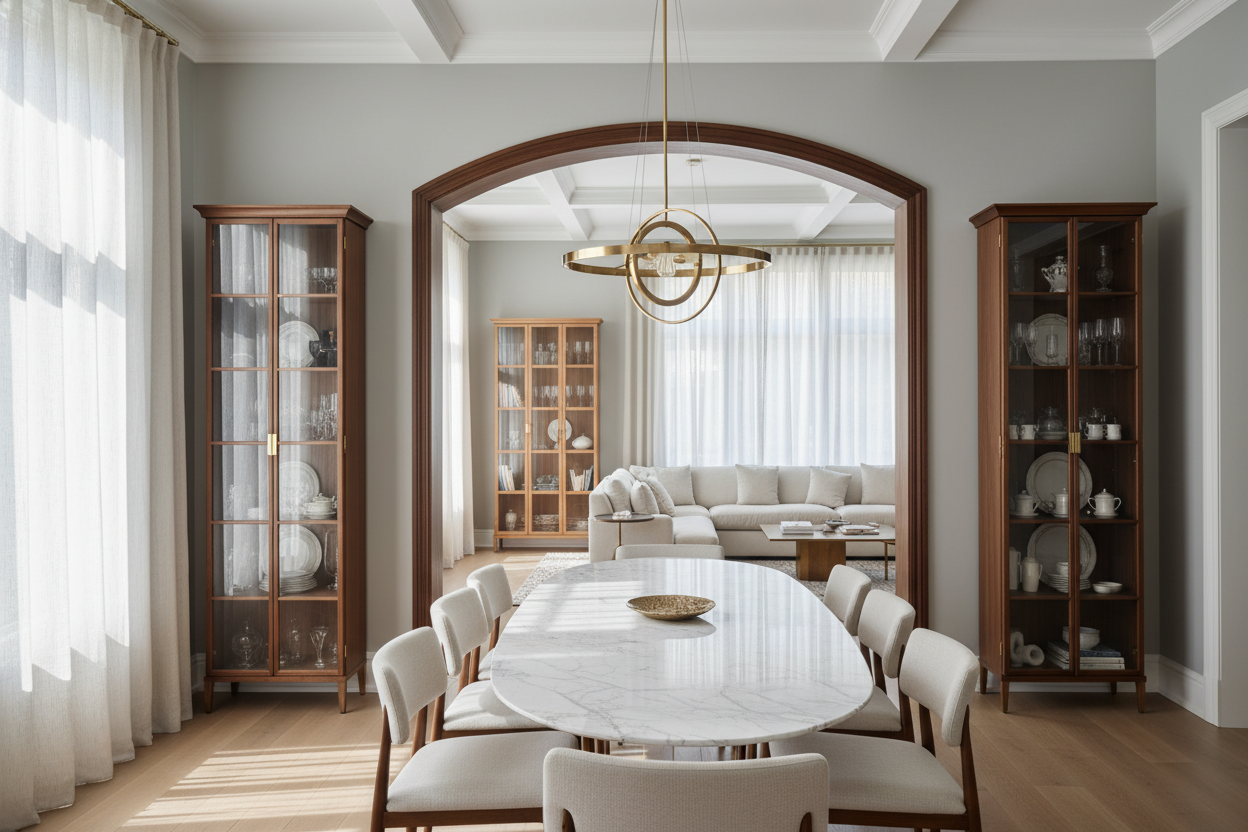
Dining rooms are notoriously tricky to furnish. Once the table and chairs are in, the walls often feel bare, leaving homeowners searching for vertical storage. But bringing tall china cabinets into a modern space can feel intimidating. Will it look like a relic from a bygone era? Will it completely swallow the room? It absolutely doesn't have to. When chosen carefully, these pieces anchor a room, draw the eye upward, and provide incredible architectural interest.
Whether you are working with an open-concept suburban layout or a more defined, traditional dining room, I will walk you through exactly how to choose, place, and style these vertical powerhouses so they look intentional, fresh, and perfectly scaled for your home.
Quick Decision Guide
- Leave at least 12 to 18 inches of negative space between the top of the cabinet and the ceiling to prevent the room from feeling cramped.
- Balance the heavy visual weight of a tall cabinet by placing visually lighter, low-profile furniture (like a sleek buffet or bench) on the opposite wall.
- A tall china cabinet with drawers offers the most practicality, giving you open display space for curated items and hidden storage for seasonal linens and flatware.
- Don't overstuff the shelves. Treat the glass-front upper section like an art gallery, not a storage closet.
Mastering Scale and Proportion
Navigating Ceiling Clearances
In standard North American homes with 8-foot or 9-foot ceilings, a massive piece of furniture can easily overwhelm the architecture. When measuring for a tall china cabinet, the height isn't the only number that matters—you need to consider the breathing room. If a piece brushes the crown molding, it makes the ceiling feel lower. Aim for a silhouette that stops at least a foot below the ceiling line. If you have vaulted ceilings, you have more flexibility, but you should still ensure the piece doesn't look like a lone skyscraper on an empty wall.
Balancing Visual Weight
A tall piece of solid wood carries immense visual weight. If you place it right next to a heavy, solid wood dining table and chunky upholstered chairs, the room will feel bottom-heavy and dense. To counter this, introduce contrasting textures. Pair a dark walnut cabinet with a glass-topped dining table or light linen slipcovered chairs. The goal is to let the cabinet be the focal point without letting it dictate the entire material palette of the room.
Modernizing the Traditional Display
Curating Your Shelves
The fastest way to make a dining space look dated is to pack a cabinet full of matching, unused fine china. Instead, embrace negative space. Mix stacks of everyday ceramic plates with leaning artwork, trailing plants, and sculptural wooden bowls. If you are styling a tall china hutch that has open shelving on top, use the depth of the shelves to layer items. Place taller items in the back and smaller, textured pieces in the front.
Storage Solutions for Real Life
The Hidden Clutter Zone
While glass doors are beautiful for display, no one wants to look at a chaotic stack of mismatched napkins or extra extension cords. This is why I almost exclusively recommend a tall china cabinet with drawers for my residential clients. The lower half acts as a functional workhorse. You get the aesthetic benefit of the towering display above, while the drawers below quietly handle the mundane realities of household storage—from placemats and candles to the good silverware.
Lessons from My Own Projects
A few years ago, I had a client fall in love with a stunning, antique mahogany cabinet. It was nearly 90 inches tall and deeply stained. Against my gentle warnings about scale, we moved it into her standard 8-foot-ceiling dining room. The moment it was in place, it felt like an eclipse; it absorbed all the natural light and made the room feel incredibly tight.
We had to pivot. We ended up painting the interior back panel of the cabinet a soft, warm cream color and installed discrete, battery-operated LED puck lights hidden behind the upper trim. It completely changed the piece, reflecting light back into the room rather than absorbing it. The honest downside to these giant pieces? Dusting the very top is a nightmare, and if you ever want to move it to another room, you better hope it breaks down into two pieces. Always check if the upper hutch detaches from the lower base before you buy.
Frequently Asked Questions
How do I measure my room for a tall cabinet?
Measure your ceiling height first, subtracting 12 to 18 inches for your maximum cabinet height. Then, measure the depth. Ensure you have a minimum of 36 inches of walkway clearance between the front of the cabinet and your dining chairs when they are pulled out.
Can I use a tall china cabinet in a living room?
Absolutely. In living rooms, they function beautifully as statement bookcases or display cases for collections. Just swap out the dinnerware for books, framed photos, and decorative objects to make it feel appropriate for the space.
How do I modernize an outdated cabinet?
Paint is the easiest fix, but changing the hardware goes a long way. Swapping ornate, brass pulls for sleek, matte black or brushed nickel hardware can instantly update the silhouette. You can also remove the glass panels entirely for an open-shelving look.


Dejar un comentario
Este sitio está protegido por hCaptcha y se aplican la Política de privacidad de hCaptcha y los Términos del servicio.