










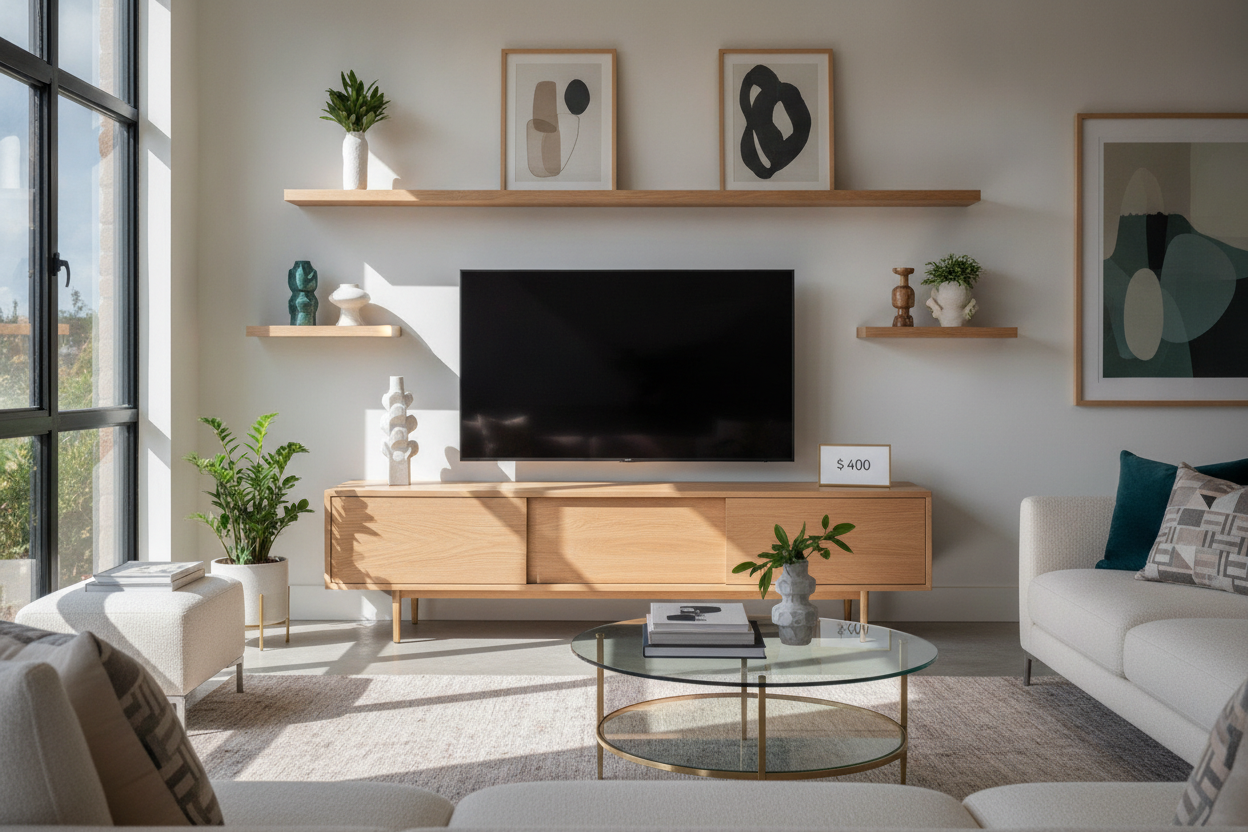
I’ve spent way too many nights staring at 40 browser tabs, trying to figure out why one media console costs $140 while another that looks identical is $1,400. It’s enough to make you want to just stack some milk crates and call it a day. If you’re asking how much is t.v stand furniture actually going to cost you, the answer depends entirely on how many times you want to replace it in the next five years.
- The $400-$600 range is the 'Goldilocks' zone for durability and value.
- Anything under $200 is likely temporary furniture with a short lifespan.
- Solid wood legs and metal hardware are the biggest indicators of a fair price.
- Check the center support; without a fifth leg, long units will always sag.
Why Your Media Console Budget Feels So Confusing
The furniture industry is notorious for price obfuscation. You can find a 'Mid-Century Modern' stand at a big-box store for $150 and a seemingly identical one at a boutique for $1,200. This disparity happens because the price is often inflated by major furniture retailers who use high-low pricing strategies. They mark a piece up 300% just so they can 'discount' it by 50% during a holiday sale.
It’s frustrating because price doesn't always equal quality. I've seen $800 units made of the same hollow-core particle board as the $100 versions. To shop smart, you have to look past the staged lifestyle photos and read the 'Materials' list like a hawk. If it says 'engineered wood' or 'wood-like finish,' you're looking at compressed sawdust and contact paper.
The Under-$200 Zone: Expect Sagging in a Year
In this price bracket, you are paying for convenience and aesthetic, not longevity. These pieces are almost exclusively made of low-density MDF (Medium Density Fiberboard) covered in a paper veneer. This veneer is so thin that if you accidentally scrape it while setting up your PlayStation, the 'wood' underneath is revealed forever. There is no sanding or staining your way out of a scratch here.
The biggest issue with budget stands is structural integrity. They rely on cam-lock fasteners—those little metal circles you turn with a screwdriver. They are notoriously bad at handling shear force. If you have a heavy 65-inch television, the top shelf will likely begin to bow within 12 months. I’ve seen budget stands literally 'smile' in the middle because the weight capacity was exaggerated by the manufacturer.
The $400-$800 Sweet Spot (Where I Tell My Clients to Look)
This is where the math starts to favor the consumer. In this range, you stop paying for just the 'look' and start paying for actual materials. You’ll find high-quality veneers over solid plywood, or better yet, actual solid wood elements. I usually point people toward a solid wood mid-century modern console because it offers the structural rigidity needed for modern tech without the $2,000 designer price tag.
In this tier, you also get better hardware. Think soft-close hinges that don't slam and drawer glides that actually glide instead of grinding. You’re also more likely to see 'kiln-dried' wood, which means the piece won't warp or crack when your heater kicks on in the winter. If you spend $500 on a well-built stand, it can easily last a decade. That’s a much better ROI than spending $150 every two years on a unit that ends up in a landfill.
The $1,000+ Club: Are Luxury Consoles Actually Better?
Once you cross the four-figure mark, you are paying for three things: brand name, artisanal craftsmanship, or exotic materials. If you’re buying a solid walnut piece from a high-end designer, you’re paying for the beauty of the grain and the fact that it was likely made in a small-batch factory. These are 'forever' pieces that you can pass down to your kids.
However, be careful. Some luxury brands sell the exact same MDF construction as the mid-tier brands but wrap it in a fancy brand story. Unless the piece features dovetail joinery, solid hardwood throughout (not just the legs), and a hand-applied finish, you might just be subsidizing their expensive showroom rent. For most people, the jump from $600 to $1,600 doesn't offer a proportional jump in how well the stand holds your TV.
Three Red Flags That Mean You Are Overpaying
Regardless of the price tag, watch out for these deal-breakers. First: plastic legs. If a stand costs more than $300 and has plastic legs painted to look like metal or wood, walk away. It’s a sign the manufacturer cut every possible corner. Second: exposed MDF edges on the back. If the back panel is just a piece of flimsy cardboard held on by tiny nails, it shouldn't cost a premium.
Third: a lack of cable management. A high-quality stand is designed for the reality of 2024. That means it should have pre-drilled holes with grommets and enough depth (at least 16-18 inches) to fit a modern receiver or gaming console without the wires forcing the front doors open. If it's shallow and has no ventilation, it's a glorified bookshelf, not a media stand.
My Personal Lesson in Cheap Furniture
I once bought a $110 'Scandinavian-style' stand for my first apartment. It looked great for exactly three weeks. Then I spilled a small glass of water near the edge. Because the veneer wasn't sealed properly, the MDF underneath soaked up the liquid like a sponge and bubbled up an inch high. It looked like a topographical map of the Andes. I had to cover it with a coaster for two years until I could afford something real. Don't be like me; get something with a real wood top if you plan on ever having a drink in your living room.
FAQ
How wide should my TV stand be?
Your stand should be at least 3 to 6 inches wider than the TV on both sides. This isn't just for looks; it prevents the 'top-heavy' look and protects the TV from being bumped by people walking past.
Is assembly service worth the extra money?
If the unit uses cam-locks and has 40+ steps, yes. If you miss one structural screw in a cheap unit, the whole thing becomes a wobbly mess. For high-end, pre-assembled units, you’re usually just paying for 'white glove' delivery to get it into the room.
Can I use a dresser as a TV stand?
You can, but dressers are usually taller (30-35 inches) than dedicated media stands (18-24 inches). This might put your TV at an awkward viewing angle, leading to 'TV-too-high' syndrome and a sore neck.

Dejar un comentario
Este sitio está protegido por hCaptcha y se aplican la Política de privacidad de hCaptcha y los Términos del servicio.