










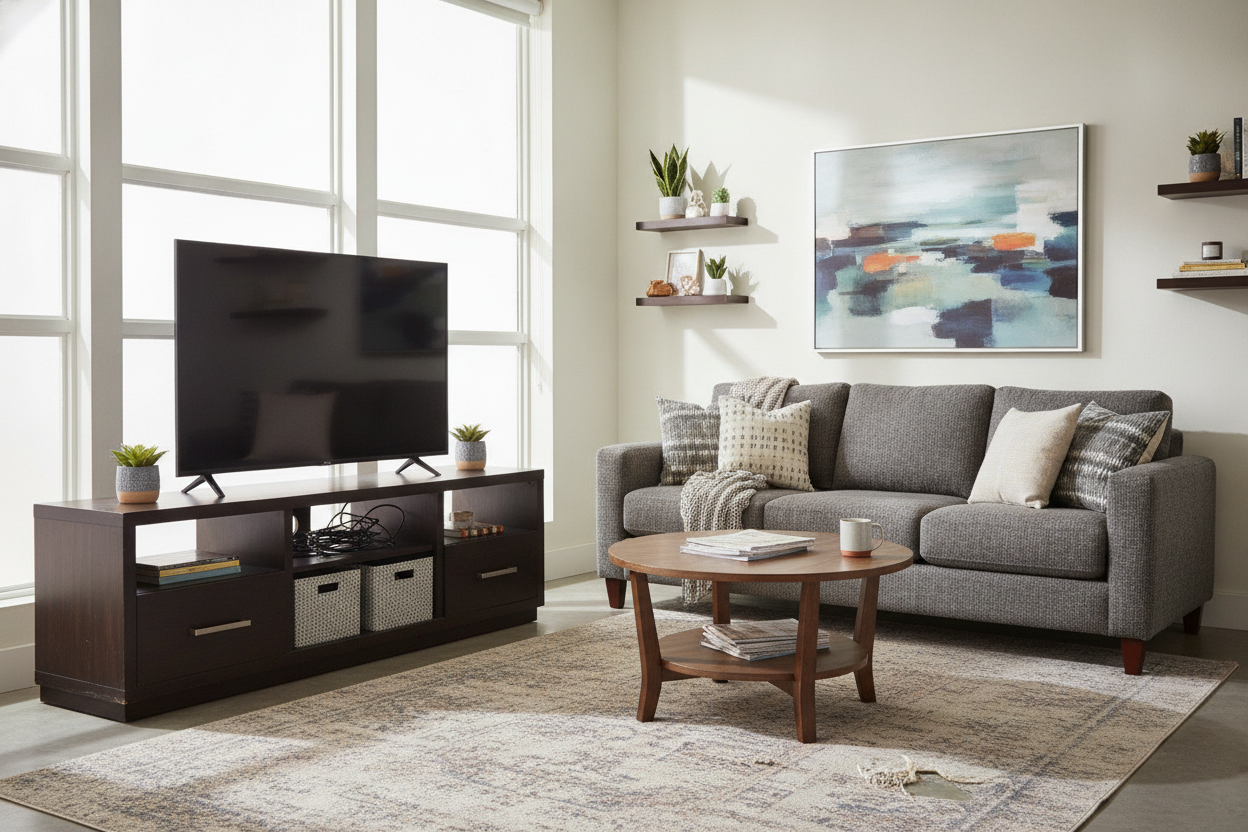
I have spent more hours of my life hunched over an Allen wrench than I care to admit. We’ve all been there: you finally upgraded to that 55-inch 4K display, but now it’s sitting on the floor because your old nightstand is too narrow and your coffee table is too low. You start scrolling, looking for a tv stand walmart 55 inch owners won't stop talking about, hoping for a bargain that doesn't look like a bargain.
But here is the thing about budget flat-pack furniture: it is a gamble. I have built units that felt like solid oak once the last screw was turned, and I have built others that felt like they were held together by nothing but hope and a thin layer of contact paper. Before you commit your Saturday to a pile of particle board, let's talk about what you are actually getting for your money.
Quick Takeaways
- Measure the actual width of your TV, not the diagonal screen size; a 55-inch TV is usually 48 inches wide.
- Look for a unit with a center support leg if you want to avoid the 'mid-life sag' in six months.
- If the hardware bag looks like it is filled with silver-painted plastic, proceed with caution.
- Throw away the included wood glue and use some Titebond for a much tighter bond.
The Sizing Lie We Keep Telling Ourselves
The biggest mistake people make when shopping for tv stands at walmart 55 inch models is forgetting how geometry works. When a TV is marketed as 55 inches, that is the diagonal measurement. The actual physical width of the frame is usually around 48 inches. If you buy a stand that is exactly 48 inches wide, your TV will sit flush with the edges. This looks, quite frankly, terrible. It makes your living room feel cramped and the TV look top-heavy.
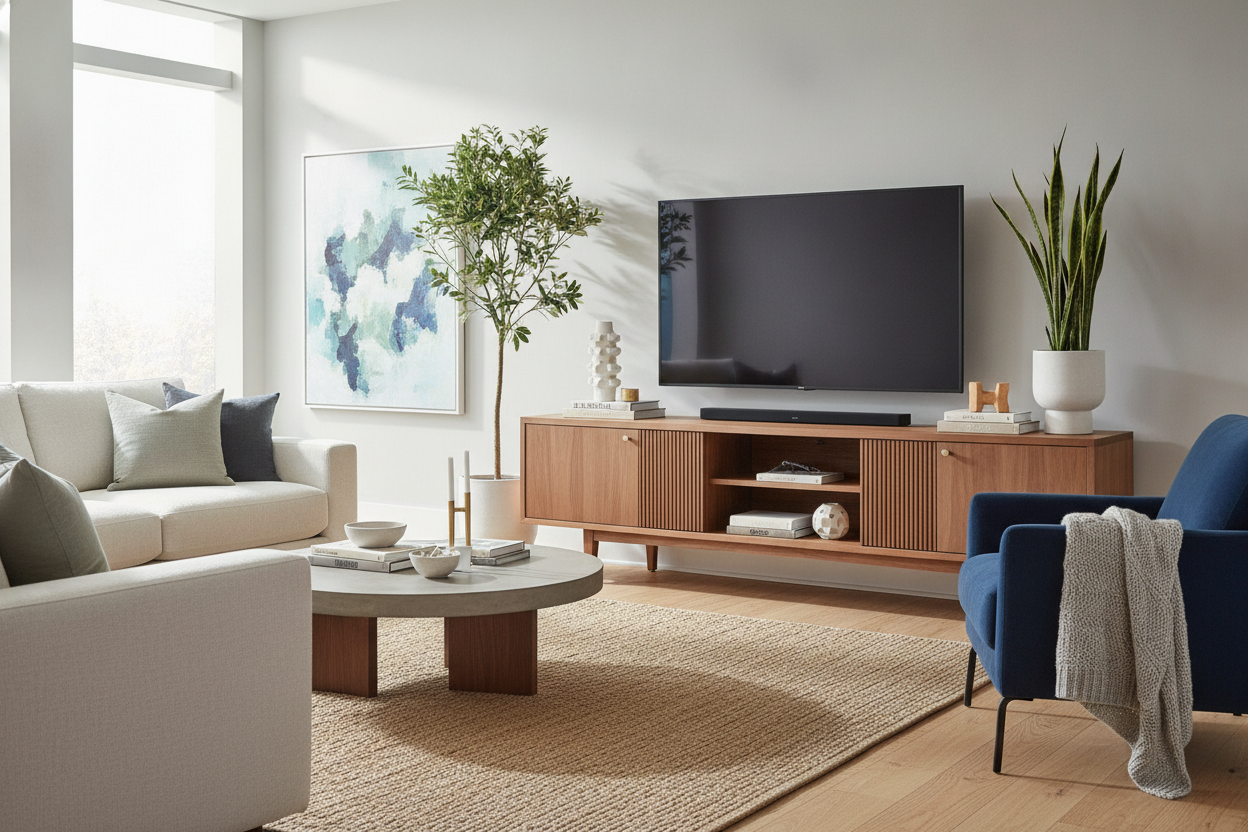
To get that high-end, balanced look, you want at least 3 to 6 inches of breathing room on either side of the screen. This means you should really be looking for a console that is 54 to 60 inches wide. I have seen so many people settle for a narrow base only to realize their soundbar now has nowhere to go. If you want to see what proper proportions look like, check out the oak tv stand 55 inch screens actually need to avoid looking like a tech-heavy mess. A bit of overhang on the furniture side makes the whole setup feel intentional rather than accidental.
Beyond aesthetics, there is the safety factor. If your stand is too narrow, a single bump to the corner of the TV can send the whole thing pivoting off the edge. I always tell my friends: if the TV is the star of the show, the stand shouldn't be the tiny, struggling stage it's trying to balance on.
Opening the Box (And Spotting the Cheap Stuff Fast)
The moment of truth happens the second you slice that tape. If a cloud of white styrofoam snow explodes into your living room, you are already in for a bad time. High-quality flat-pack uses high-density foam or cardboard buffers. The cheap stuff uses that crumbly styrofoam that sticks to your cat and your carpet for three weeks. But the real test is the weight. If you can lift the entire box by yourself without breaking a sweat, that 'wood' is mostly air and glue.
Check the hardware. If the cam locks feel like they are made of soda-can aluminum, they will snap the moment you apply actual torque. I have seen budget consoles where the veneer is so thin you can literally peel it back with a fingernail at the corners. If you see that, put it back in the box. It will not survive a move, and it definitely won't survive a spilled drink. If you are starting to get cold feet about the assembly process or the material quality, it might be worth it to browse other tv stands made from higher-grade MDF or solid pine.
I once assembled a unit where the pre-drilled holes were off by a full quarter-inch. I had to choose between a level top or a door that actually closed. That is the reality of the budget tier—sometimes you have to be part-carpenter, part-magician. Look for 'high-grade MDF' or 'engineered wood' over 'particle board' if you want any hope of the piece lasting more than a single lease term.
The Wobble Test: Can It Actually Hold the Weight?
Modern 55-inch TVs aren't as heavy as the plasma monsters of 2010, but 35 to 45 pounds is still enough to make a cheap shelf bow over time. The 'Walmart special' usually relies on four perimeter legs. For a mid-sized console, that is a recipe for disaster. Without a center support leg, the middle of the stand will slowly succumb to gravity, creating a 'U' shape that makes your doors stick and your drawers jam.
I always do the 'hip check' once the frame is together. Give it a firm nudge from the side. If it sways more than half an inch, it needs more structural integrity. Sometimes this is as simple as making sure the back panel is nailed on perfectly square—that flimsy piece of cardboard is actually what provides most of the lateral stability. If you are comparing this size to something larger, you might wonder if buying a 70 inch tv stand at walmart is any different. Usually, the larger stands have better internal bracing simply because they have to, whereas the 55-inch models often try to skate by with the bare minimum.
My personal rule? If the weight limit is 50 pounds and your TV is 48 pounds, don't do it. You want a buffer. You’re going to add a gaming console, a soundbar, and maybe a heavy stack of coffee table books. Don't redline your furniture's capacity on day one.
Cord Management on Budget Consoles is Usually a Joke
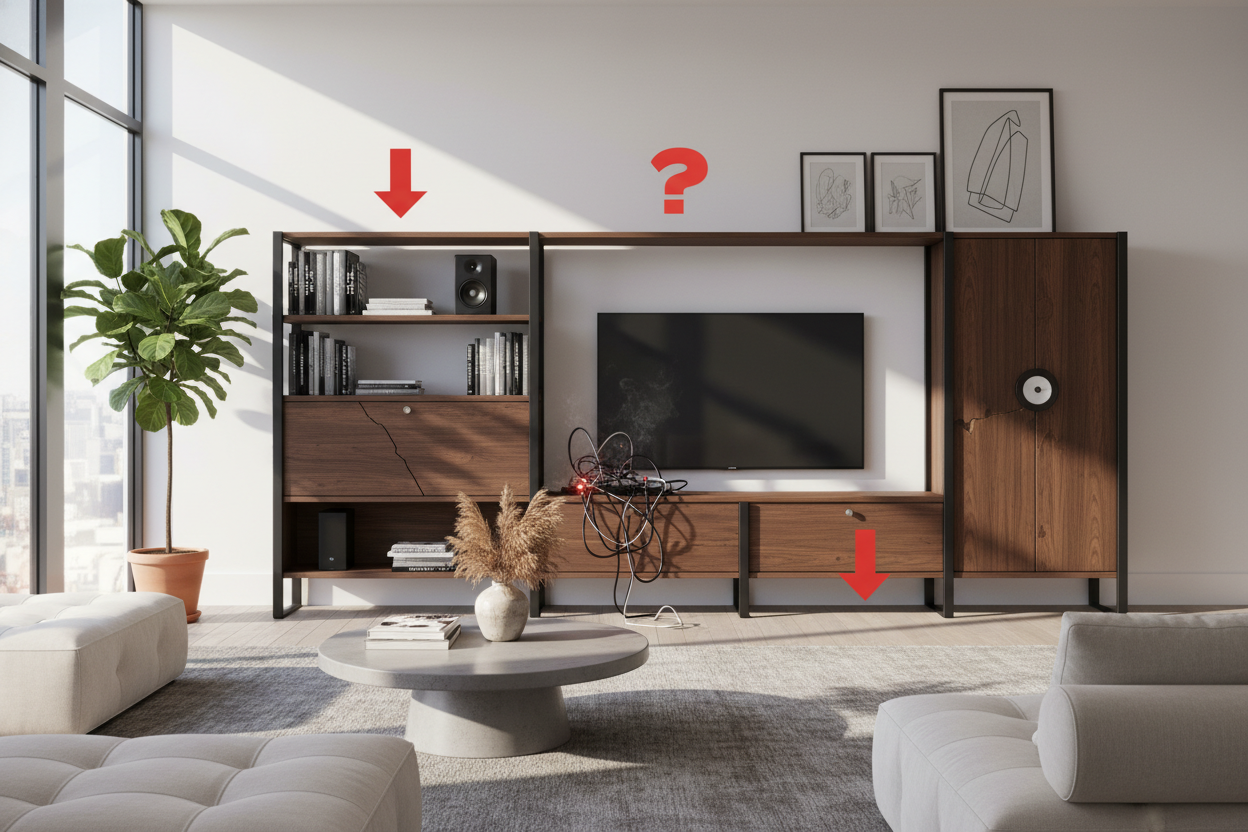
Manufacturers love to brag about 'integrated cable management,' which is usually code for 'we punched one hole in the cardboard back and called it a day.' If you have a PS5, a Nintendo Switch, and a cable box, that one hole becomes a crowded highway of heat and tangled plastic real fast. It’s the most frustrating part of these budget builds.
The fix is easy, though. Don't use their pre-cut holes if they don't work for your layout. I keep a 2-inch hole saw bit in my drill kit specifically for this. I'll cut my own holes directly behind where the components sit. This keeps the wires short and hidden. Also, those plastic 'cord organizers' they include? Trash them. Buy a pack of velcro ties. They don't lose their stickiness, and they don't rip the finish off the back of your new stand when you need to swap a cable.
How I Made Mine Look $200 More Expensive
You don't have to live with the 'out-of-the-box' look. The easiest way to spot a cheap tv stand walmart 55 inch model is by the hardware. The plastic or spray-painted silver handles are a dead giveaway. Go to a hardware store and buy real brushed brass or matte black steel pulls. It’s a $15 upgrade that makes the whole piece look like it came from a high-end boutique.
Another pro tip: change the legs. Most flat-pack stands use short, chunky plastic blocks. Swapping those out for tapered wooden mid-century legs or industrial metal hairpins completely changes the silhouette. It lifts the piece off the floor, making your room feel larger. If you’re not into the DIY life, you can find models that come with built-in flair, like a white tv stand and adjustable light, which handles the 'vibe' for you without needing a drill.
Lastly, pay attention to the seams. If you have gaps where the panels meet, use a matching wood filler or even a Sharpie in a similar shade to hide the raw particle board edges. It sounds hacky, but from six feet away on the sofa, those little details are the difference between 'college dorm' and 'adult apartment.'
FAQ
Will a 55-inch TV fit on a 50-inch stand?
Technically, yes, because the feet of most 55-inch TVs are spaced about 40-44 inches apart. However, it will look cramped. You generally want the stand to be wider than the TV for both visual balance and safety.
How long does it take to assemble a Walmart TV stand?
If you are working alone, budget about two hours. If you have a power drill (set to low torque!) and a clear workspace, you can probably knock it out in 90 minutes. Always double-check the orientation of the finished edges before hammering in any nails.
Can I leave the back panel off for better ventilation?
I wouldn't recommend it. On most budget furniture, that thin back panel provides the 'shear' strength that keeps the unit from collapsing sideways. If you’re worried about heat, use a hole saw to cut larger ventilation gaps instead of leaving the panel off entirely.

Dejar un comentario
Este sitio está protegido por hCaptcha y se aplican la Política de privacidad de hCaptcha y los Términos del servicio.