










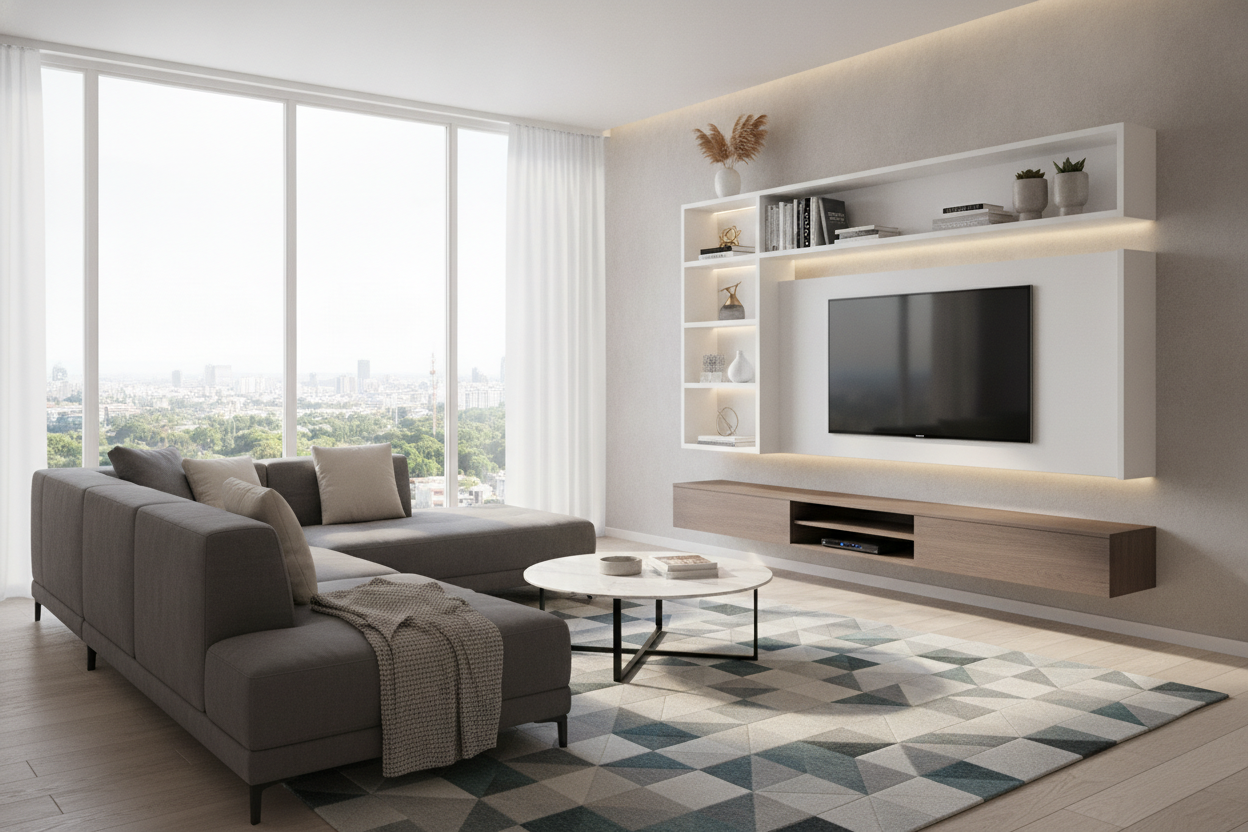
I spent three hours last Saturday staring at my living room wall with a level and a roll of blue painter's tape. My partner thought I had finally lost it, but I was trying to figure out why my new floating tv stands looked like they were trying to escape through the ceiling. Most people treat these units like artwork, hanging them at eye level while they are standing up, which is the first mistake of many.
The reality is that these units are meant to anchor the room, not float off into the ether. When you get the height wrong, the whole room feels top-heavy, and your neck starts to ache after a single episode of whatever you are binging. If you are tired of your living room looking like a doctor's waiting room, we need to talk about geometry.
- The Golden Height: Aim for the bottom of the unit to be 9 to 12 inches off the floor.
- The Width Ratio: Your stand should be at least 20% wider than your TV.
- Structural Integrity: If you aren't hitting at least two studs, do not walk away from that wall.
- Cable Ghosting: Plan your wire routing before you drill the first pilot hole.
Please Stop Hanging Them at Standing Eye Level
The biggest mistake I see DIYers make is mounting their console based on where it looks 'right' while they are standing in the middle of the room. Unless you plan on watching the game while pacing the floor, this is useless. You need to sit on your actual sofa, measure your seated eye level, and ensure the center of the TV screen—not the stand—is at that height.
Usually, this means the stand itself needs to be much lower than you think. If you browse standard height TV stands, you will notice they typically top out between 18 and 24 inches. When you are mounting a unit to the wall, you are trying to mimic that grounded feeling while clearing just enough floor space for a robot vacuum to do its job. Hanging a unit 30 inches off the ground makes it look like a shelf that lost its way.
The 'Two-Thirds Rule' for Floating TV Wall Units
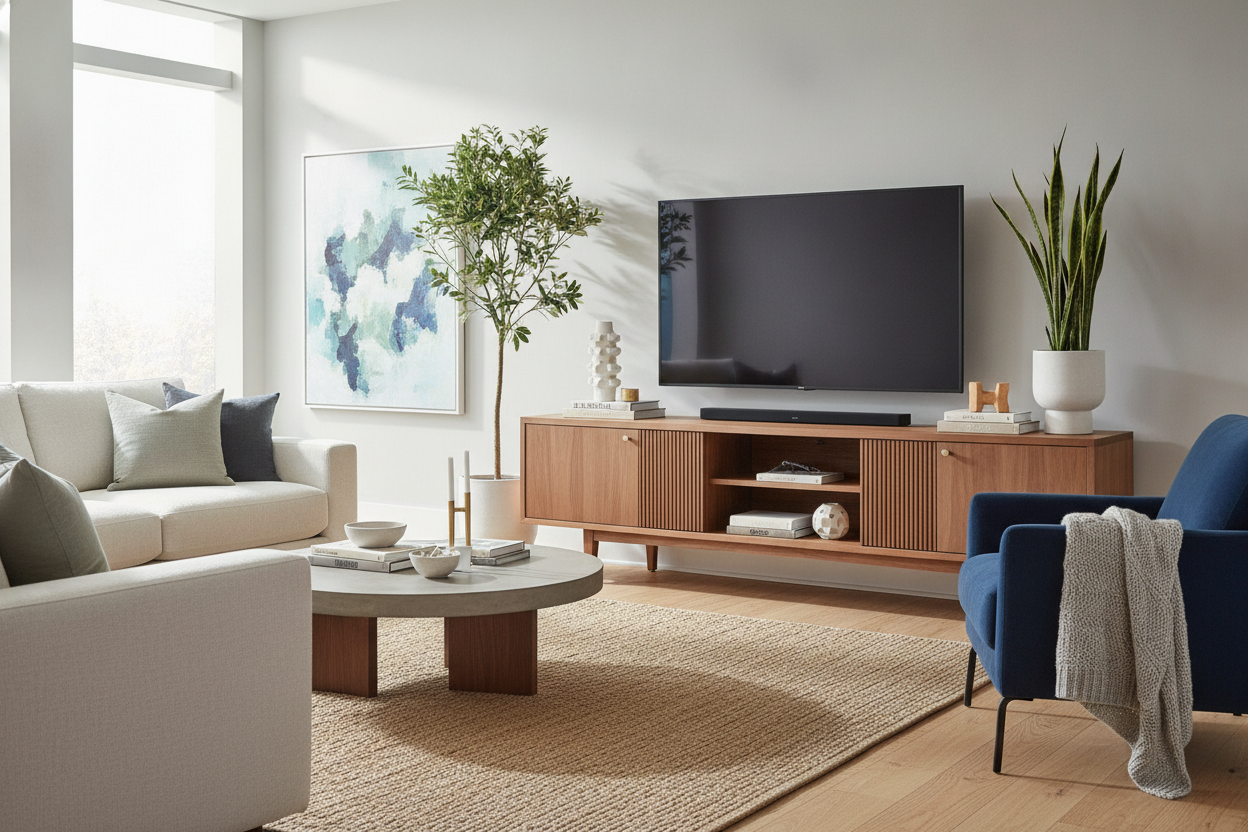
Visual scale is where most people fail. If your TV is 60 inches wide and your console is also 60 inches wide, you have created a vertical rectangle that looks incredibly awkward. You want the TV to take up about two-thirds of the width of the console below it. This creates a visual base that feels sturdy and intentional.
For a standard 65-inch screen, you should be looking for a floating TV stand wall mounted media console that stretches at least 72 to 80 inches. This extra width gives you room for a couple of curated objects—a ceramic vase or a stack of books—without making the area look cluttered. It turns the TV into part of a composition rather than just a black plastic box stuck to the drywall.
The Harsh Reality of Cord Management With TV Floating Stands
Let's be honest: nothing kills the 'architectural' vibe of tv floating stands faster than a mess of black power cords dangling down to the baseboard. You cannot just slap one of these on the wall and hope for the best. You have two real options: you either go behind the wall or you hide them in plain sight.
If you own your home, buy a recessed cable management kit. It allows you to run wires behind the drywall safely. If you are renting, grab some paintable cord tracks. They aren't invisible, but if you paint them the exact shade of your walls, they disappear 90% of the way. I have tried the 'tuck them behind a plant' method, and trust me, it only works from one specific angle. Do the work and hide the wires properly.
Will Floating Wall TV Stands Rip Out of My Drywall?
I have seen the aftermath of a 'toggle bolt only' installation, and it isn't pretty. These units are heavy, and once you add a soundbar and some decor, you are asking a lot of a piece of gypsum. You must find the studs. No exceptions. If your studs don't line up with the mounting holes on your floating wall tv stands, you need to mount a plywood cleat to the studs first, then mount the cabinet to the cleat.
If you have plaster and lath walls, God bless you. You will need specialized anchors and a lot of patience. But even with the installation headache, the payoff is worth it. When you see how much bigger your room looks without legs eating up floor space, you will understand why a cabinet for TV on wall wins every single time. It creates a sense of airiness that a traditional bulky console just can't touch.
How do I find the studs?
Use a magnetic stud finder to find the screws in the drywall, or the 'knock test' if you are feeling brave. I always use a tiny drill bit to verify the wood is actually there before I commit to a big hole.
Can I mount this alone?
Technically yes, but I wouldn't. You need one person to hold the level and the unit while the other marks the holes. Doing it alone is a fast track to a crooked console and a frustrated Saturday.
What if my wall is concrete?
You will need a hammer drill and masonry anchors. It is a dusty, loud job, but once it is in, that stand isn't going anywhere. It is actually the most secure mounting surface you can have.

Dejar un comentario
Este sitio está protegido por hCaptcha y se aplican la Política de privacidad de hCaptcha y los Términos del servicio.