










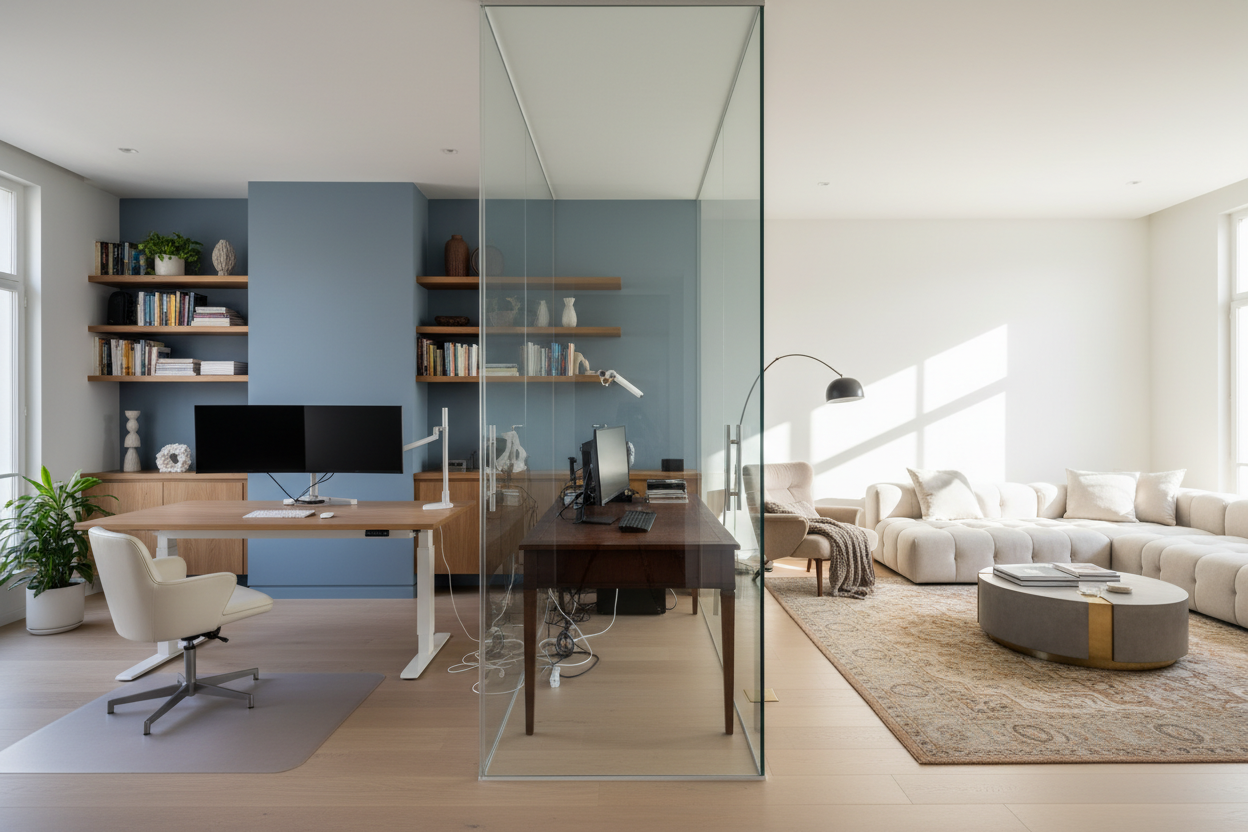
We have all experienced that lingering feeling of unease when the laptop closes, yet the living room still feels like a conference room. The challenge of shifting from work to home is no longer about a commute; it is about interior architecture and psychology. As a designer, I see clients struggle not with productivity, but with the inability to 'turn off' because their spatial cues are muddled. A well-designed space does the heavy lifting for you, creating a boundary that signals to your brain that the workday is done.
Quick Decision Guide: The Essentials of Hybrid Design
If you are rushing to furnish a home office, do not sacrifice your residential aesthetic for corporate utility. Here are the non-negotiables for a balanced space:
- Zoning Strategy: Never place a desk with your back to the room's entry; command position reduces subconscious anxiety.
- Material Warmth: Opt for wood veneers (walnut or oak) over cold laminates to blend with residential furniture.
- Lighting Temperature: Ensure you have adjustable lighting—cool (4000K) for focus, warm (2700K) for relaxation.
- Concealment: Prioritize storage that physically hides technology (monitors, cables) when not in use.
- Acoustics: Use rugs and soft drapery to dampen the 'echo' typical of office environments.
Mastering the Spatial Zoning
The most significant hurdle in transitioning to remote work is the lack of physical separation. When you cannot leave the building, you must create a 'commute' through layout. If you do not have a dedicated room, you must rely on visual zoning.
The Floating Desk Layout
Avoid pushing your desk against a blank wall. Instead, float the desk perpendicular to a wall or behind a sofa. This anchors the workspace without dominating the room. When you stand up and walk away, you are physically turning your back on work, which is a crucial psychological cue for how to transition from work to home effectively.
Selecting Furniture with Dual Identity
When adjusting to working from home, the furniture must serve two masters: ergonomics and aesthetics. The 'gaming chair' look rarely suits a sophisticated living area.
The Chair Dilemma: Structure vs. Style
High-end office chairs now come in performance fabrics like bouclé or high-grade leather rather than standard black mesh. Look for a mid-century modern silhouette that offers lumbar support without looking industrial. If the mechanism is visible, ensure it is polished aluminum or matte black to match your coffee table hardware.
Materiality and Texture
To soften the transition to working from home, tactile elements are key. A solid wood desk creates a sense of permanence and warmth. However, be wary of softwoods like pine; a ballpoint pen will leave indentations instantly. Stick to hardwoods like white oak or walnut which offer durability while maintaining a high-end residential feel.
Lighting: The Invisible Boundary
Lighting is the most underutilized tool when learning how to adjust to working from home. Corporate offices use uniform, high-kelvin lighting. Your home should rely on layers.
During work hours, use task lighting focused on the desk surface. As soon as the workday ends, turn that task light off and switch to ambient floor lamps with warmer bulbs. This shift in color temperature acts as a subconscious trigger, signaling the body to release the day's stress.
My Personal Take on from work to home
In my own design practice, and specifically in my own study, I learned a hard lesson about 'convertible' furniture. I purchased a beautiful, high-end secretary desk (the kind that folds down) thinking it would be the ultimate solution for hiding my work.
The reality? The hinges were stiff, and the desktop depth was about two inches too shallow for comfortable typing with a separate keyboard. I found myself leaving it open constantly because the friction of closing it every evening became a chore rather than a ritual. Furthermore, the finish on the drop-down leaf began to show wear patterns from my watch clasp within three months.
The lesson I now pass to clients: If you buy a 'hideaway' desk, test the hardware rigorously. If it isn't effortless to close, you will never close it, and you will lose that psychological separation we are striving for.
Conclusion
Successfully designing a space that moves from work to home requires intention. It is not just about fitting a desk into a corner; it is about curating an environment that respects both your professional ambition and your personal peace. Invest in pieces that hide the clutter and lighting that shifts the mood, and you will find the balance comes naturally.
Frequently Asked Questions
How do I transition to working from home in a small apartment?
Verticality is your friend. Use wall-mounted shelving with a drop-down desk mechanism. This clears floor space and allows you to physically 'shut' the office away. Also, use a rug to define the office 'zone'—step off the rug, and you are 'home.'
What is the best way to handle transitioning from working from home to office hybrid schedules?
For hybrid schedules, the 'landing strip' entry console is vital. Design a specific drawer or tray near your door for your laptop bag and badge. This prevents work items from migrating to the kitchen island on the days you commute.
Is a standing desk worth the aesthetic compromise?
It can be. Look for standing desks with solid wood tops and hidden motors. Avoid the generic T-leg laminate options. Alternatively, use a high-quality standing converter that can be stowed away in a closet when guests arrive.

Dejar un comentario
Este sitio está protegido por hCaptcha y se aplican la Política de privacidad de hCaptcha y los Términos del servicio.