










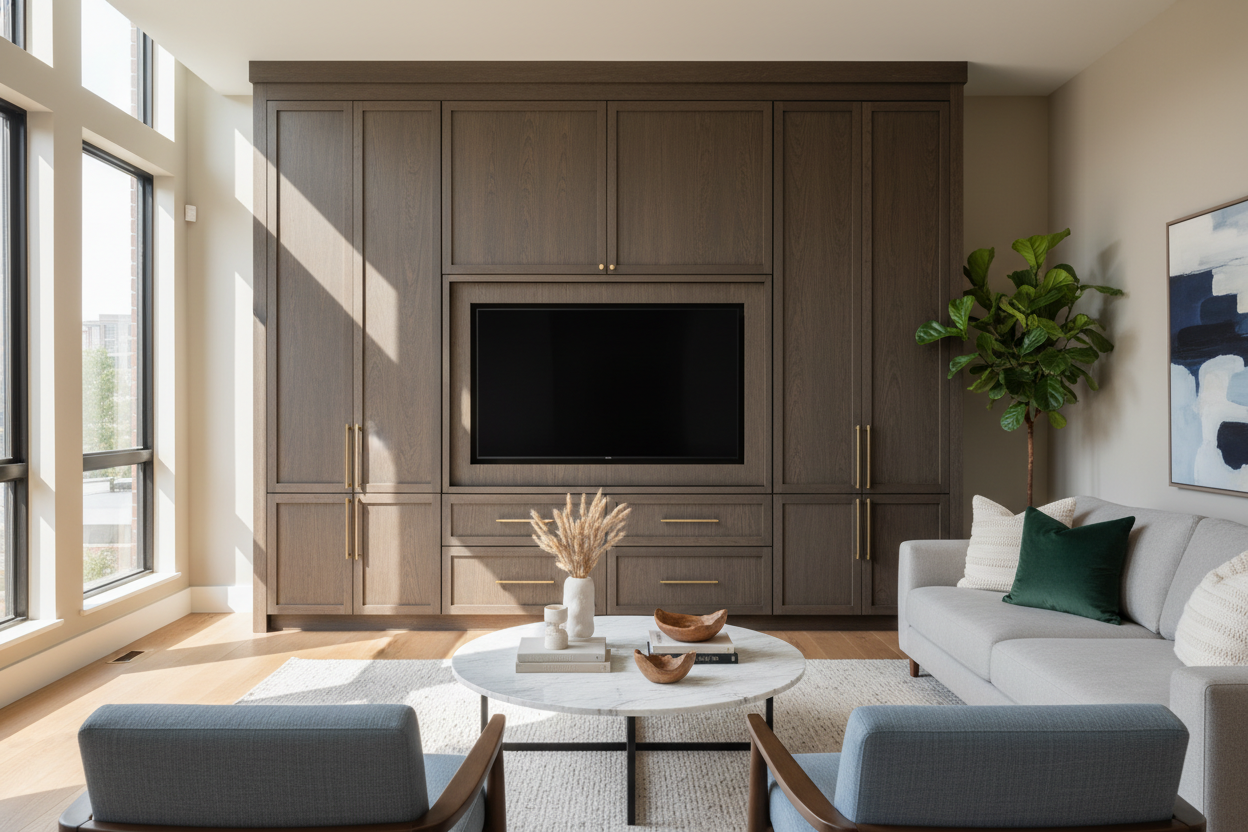
I remember staring at my mid-century open console at 2 AM, wondering how three simple devices had spawned forty feet of tangled black cables. It looked like a plastic octopus was dying behind my television. I had bought into the 'airy' aesthetic I saw on Pinterest, but in reality, my living room felt like the cable management section of a chaotic Best Buy backroom. Switching to tv cabinets enclosed was the only way to reclaim my sanity and my style.
- Open shelves are a magnet for dust and pet hair that sticks to static-charged wires.
- Visual clutter from routers and consoles creates mental noise in your relaxation space.
- Enclosed units protect expensive electronics from curious toddlers and bored cats.
- Modern designs include ventilation and cable ports, so tech stays cool and hidden.
The 'Airy' Open Console Lie We All Bought Into
We’ve all seen the catalog photos. A slim, oak console with nothing on it but a single ceramic vase and maybe one perfectly placed linen-bound book. It looks sophisticated, light, and effortless. But that photo is a lie because it’s not plugged into anything. In a real home, that 'airy' look is immediately ruined by the reality of power strips, bulky HDMI cables, and the glowing blue lights of a router that refuses to be aesthetically pleasing.
I lived with an open-shelf unit for two years, and I spent half that time trying to 'style' my way out of the mess. I bought decorative baskets to hide the wires, but the wires just spilled out the back anyway. I tried velcro ties, but you could still see the black plastic cords against my white walls. It never looked clean; it just looked like I was trying to hide a crime scene. Open tv stands enclosed by nothing but air are great for people who don't actually own a TV, but for the rest of us, they are a practical nightmare.
Beyond the visual mess, there’s the dust. Electronics are static magnets. In an open console, your PlayStation and cable box become furry within forty-eight hours. Cleaning it requires unhooking everything or awkwardly waving a duster through a web of wires. Life is too short to dust your router every Tuesday.
Why I Finally Swapped to TV Cabinets Enclosed
The day I finally hauled my open console to the curb was the day I realized I wanted my living room to look like an adult lived there, not a college gamer. I invested in a modern TV cabinet with storage and the relief was instantaneous. There is something deeply satisfying about physically shutting a door on the blinking lights and 'snake pit' of cables that used to define my focal wall.
Now, when I sit down to watch a movie, I see the wood grain and the clean lines of the furniture, not the glowing 'Update Required' light on my console. If you have high-end audio gear that you actually want to show off—maybe a vintage receiver or a beautiful turntable—I usually suggest a black cabinet with glass doors. It gives you that enclosed protection and dust-proofing while still letting you appreciate the hardware. But for the plastic stuff? Hide it. All of it.
My new setup finally allowed me to organize my media properly. I have a dedicated shelf for controllers, a spot for the remotes that always go missing, and enough room for a surge protector to sit flat instead of dangling off the back. It turned the TV area from a tech hub into a piece of actual furniture that complements the room.
The Overheating Myth (And How to Actually Vent Your Gear)
The biggest pushback I hear about a tv cabinet that closes is the fear of 'cooking' the electronics. People think if they put a PS5 or an Xbox behind a wooden door, it’s going to melt into a puddle of silicon. While it’s true that electronics need airflow, modern furniture designers aren't stupid. Most high-quality enclosed units are built with massive cutouts in the backboard or even slatted fronts that allow air to circulate freely.
I’ve run my gaming setup inside an enclosed unit for a year now, and I’ve never had a heat warning. The trick is to check the clearance. You want at least two or three inches of space around the vents of your devices. If you’re really worried, or if you live in a hot climate, you can buy a 'stealth' cooling fan for about $20. These are USB-powered, nearly silent, and can be mounted to the back of the cabinet to pull hot air out. It’s a small price to pay for a living room that doesn't look like an IT department.
How to Shop for an Enclosed Entertainment Center
Before you hit 'add to cart' on an enclosed entertainment center, you need to grab a tape measure. The biggest mistake people make is ignoring internal depth. A lot of modern consoles are surprisingly shallow—maybe 14 or 15 inches. That’s fine for a Nintendo Switch, but if you have a beefy A/V receiver, those things can be 17 inches deep once you factor in the knobs on the front and the plugs in the back. Always look for a unit with at least 18 inches of internal depth if you have serious gear.
Another tip: look for slatted or 'louvred' doors. These are the gold standard for an enclosed media cabinet because they allow infrared remote signals to pass through and let heat escape, all while keeping the messy tech 100% invisible. If you’re not sure how much gear you’ll have in two years, consider an adjustable length media console. These are great because they can expand or contract to fit your wall perfectly, often giving you a mix of enclosed drawers and open space that you can customize as your tech collection grows.
Reclaiming the Living Room Vibe
Your living room should be a place where you can actually relax, not a place that reminds you of your chores or your unfinished cable management projects. Hiding the black plastic boxes and the blinking LEDs makes the space feel intentional. It shifts the focus from the technology to the people in the room.
We spend a lot of money on our homes, and our furniture should do more than just hold a screen. Choosing modern entertainment units that prioritize hidden storage is about more than just being tidy—it’s about design discipline. It’s the difference between a room that feels like a home theater and a room that feels like a home. Trust me, once you shut those doors for the first time, you’ll never go back to open shelving again.
Will my remote work through the cabinet doors?
If the doors are solid wood, traditional IR remotes won't work. However, most modern remotes (like Apple TV, Fire Stick, or newer cable boxes) use Bluetooth or RF, which work through wood perfectly. If you have old gear, look for slatted doors or spend $20 on an IR repeater kit.
How do I stop wires from being a mess inside the cabinet?
Use adhesive cable clips on the interior walls of the cabinet. Run your power strip along the bottom back corner and zip-tie excess cord length. Since it's all behind closed doors, it doesn't have to be perfect—it just has to be out of the way.
Do I need to leave the doors open while gaming?
Usually, no. If the cabinet has a vented back or slatted front, the heat dissipation is sufficient for most sessions. If you're doing an 8-hour marathon on a high-spec PC or console, you might crack the door an inch just to be safe, but for casual use, keep them shut.


Dejar un comentario
Este sitio está protegido por hCaptcha y se aplican la Política de privacidad de hCaptcha y los Términos del servicio.