










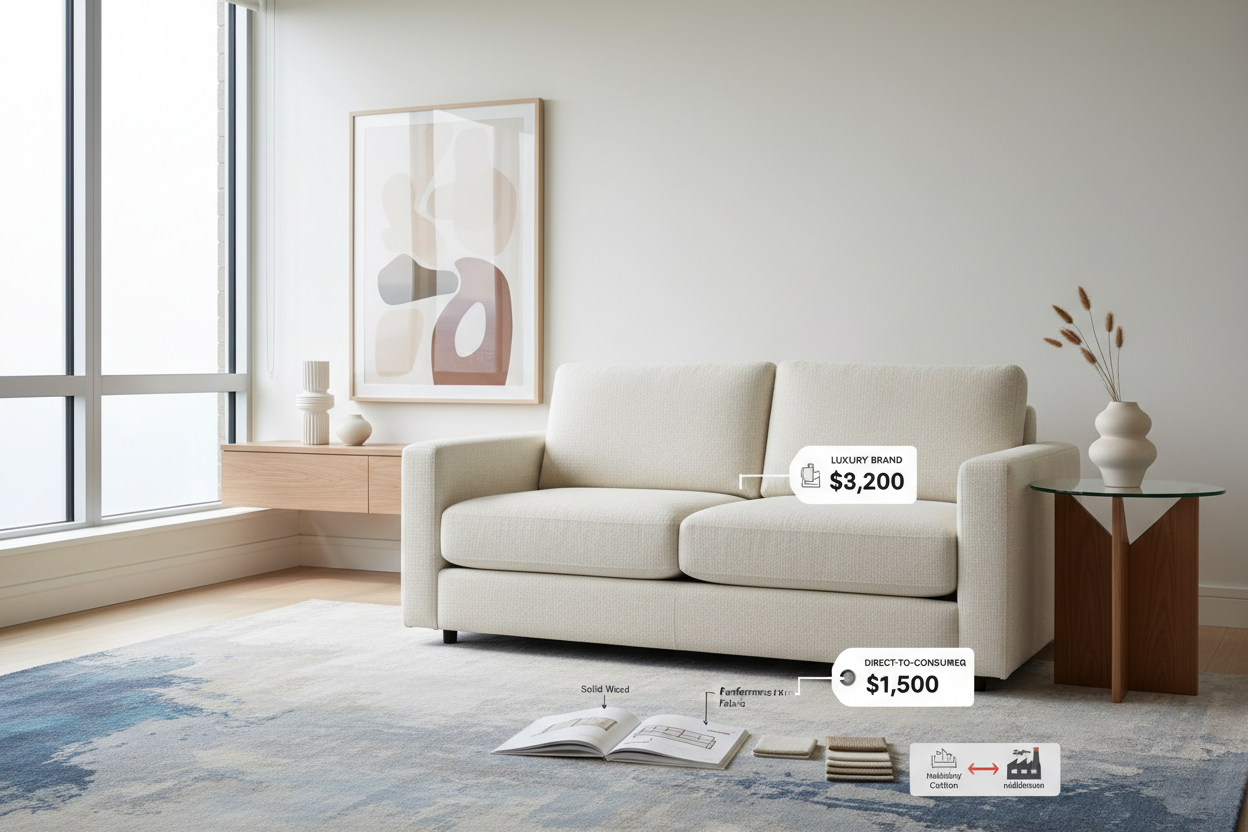
Walking into a showroom or browsing an online catalog can be disorienting. You see two pieces that look nearly identical in silhouette and color, yet one commands three times the cost of the other. As an interior designer, the most common question I field isn't about color theory, but about value: Is that higher loveseat price actually justified by longevity, or are you paying for a brand name?
When you are looking for a loveseat, the goal is to find the intersection of aesthetic appeal and structural integrity. A piece that looks beautiful but fails structurally within a year is the most expensive purchase you can make. This guide breaks down exactly where your money goes.
Quick Decision Guide: What Drives the Cost?
Before you commit to a purchase, use this checklist to determine if the price tag matches the quality. These are the hidden factors that dictate the true value of furniture:
- Frame Construction: Kiln-dried hardwood (maple, oak) resists warping and commands a higher price than plywood or particleboard.
- Suspension System: 8-way hand-tied springs are the gold standard for longevity; sinuous springs are common in mid-range options.
- Cushion Fill: High-density foam wrapped in down offers loft and resilience, whereas pure low-density foam flattens quickly.
- Joinery: Look for dowels, corner blocks, and glue. Avoid pieces held together primarily by staples.
- Upholstery Grade: Performance fabrics and top-grain leathers increase cost but significantly extend the visual lifespan.
Decoding the Price Tag: Construction Matters
The skeleton of your furniture is where the bulk of the love seat price should go. In my design practice, I often explain that a heavy sofa is usually a good sign. It indicates a solid wood frame rather than hollow plastic or soft pine.
When assessing value, ask about the joinery. A loveseat constructed with mortise-and-tenon joinery takes longer to build and requires skilled labor, naturally raising the price. However, this ensures the piece won't wobble or creak after a few years of daily use. If the manufacturer is vague about the frame materials, assume it is engineered wood, which typically reflects a lower price point but a shorter lifespan.
Fabric Grades and Visual Weight
The upholstery is the first thing you see, but it’s also the first point of failure. When you are looking for a loveseat, you will notice that fabric falls into "grades." A base grade might be a simple polyester blend. As you move up in price, you encounter natural linens, velvets, or performance cryptons that repel stains.
However, price doesn't always equal durability. A delicate silk velvet will have a high price tag due to the luxury of the material, but it is terrible for a high-traffic family room. Conversely, a heavy-duty canvas might be cheaper but last decades. Design is about context; ensure you are paying for the right characteristics for your specific lifestyle.
Ergonomics and Seat Mechanics
Cheap furniture forces your body to do the work of supporting itself. Quality furniture supports you. The disparity in price often comes down to seat pitch (the angle of the back) and seat depth. Engineering a piece that accommodates the human form comfortably requires R&D and higher quality foam densities.
In lower-end models, manufacturers use standard 1.8 density foam. It feels fine in the store, but within six months, you will notice "puddling"—where the fabric loosens because the foam has compressed permanently. Higher-end models use 2.5 density or spring-down cushions, maintaining the tight, tailored look of the piece for years.
My Personal Take on Loveseat Price
I learned the hard way early in my career why budget furniture is often a trap. I was furnishing my first apartment and found a mid-century modern style loveseat online for an incredibly low price. It looked fantastic in the photos—sleek lines, tufted back, exactly the vibe I wanted.
The reality check hit about four months in. It wasn't just that the cushions went flat; it was the noise. Every time I sat down, the frame groaned because it was held together with staples rather than corner blocks. Worse, the "linen-look" fabric started pilling aggressively from just standard friction. I ended up having to replace it within a year. Now, when I advise clients, I tell them to flip the cushion. If it's light as a feather, put it back. You want to feel weight and resistance. That density is what you are paying for, and it’s the only thing standing between you and a saggy, uncomfortable living room.
Conclusion
Ultimately, the loveseat price is a reflection of labor and materials. You don't always need to buy the most expensive item in the showroom, but you should avoid the cheapest unless it's for a purely decorative, low-traffic corner. Invest in the frame and the fill; fabric can always be changed, but a broken frame is a total loss.
Frequently Asked Questions
What is a reasonable price range for a quality loveseat?
For a piece intended for daily use with a solid wood frame and performance fabric, expect to pay between $1,200 and $2,500. Options below $800 typically utilize engineered wood and lower-density foam, suitable for first apartments or guest rooms.
Does custom upholstery significantly change the love seat price?
Yes. Moving from a "stock" fabric to a "custom" or "COM" (Customer's Own Material) option can increase the price by 20% to 50%. You are paying for the fabric yardage itself and the made-to-order labor required to cut and pattern match that specific textile.
How can I tell if a loveseat is good quality without seeing inside?
The "lift test" is your best tool. Lift one front corner of the loveseat about six inches off the ground. The other front leg should lift almost immediately. If the other leg stays on the floor while you lift, the frame is twisting, indicating weak joinery.


Dejar un comentario
Este sitio está protegido por hCaptcha y se aplican la Política de privacidad de hCaptcha y los Términos del servicio.