










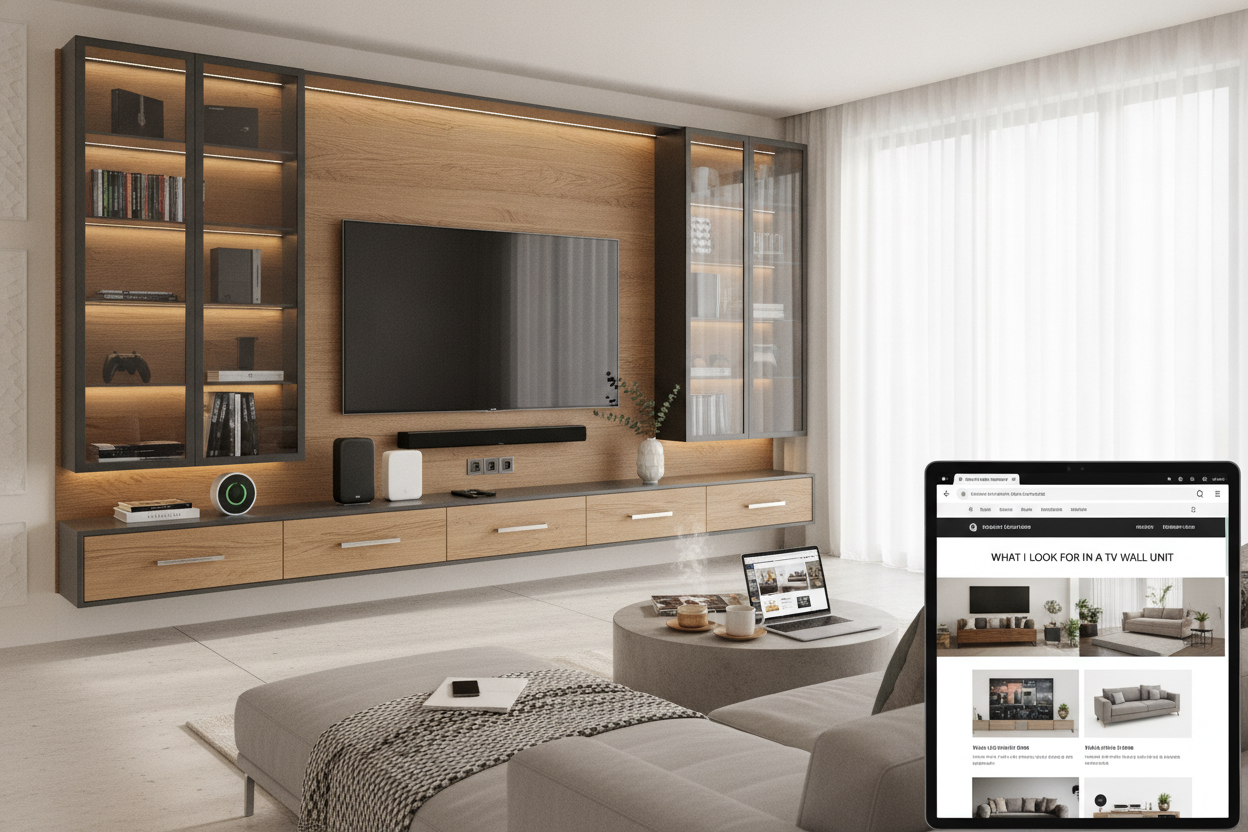
I have spent far too many late nights with 47 browser tabs open, comparing wood grains and trying to guess if a console will actually hold my 65-inch OLED or just buckle under the pressure. We have all been there—you see a tv wall unit for sale that looks like it belongs in a high-end loft, but the price feels suspiciously low. My living room has been a graveyard for 'good deals' that turned out to be made of glorified cardboard.
Before you hit 'add to cart' on that sleek-looking entertainment center, you need to look past the professional lighting. I have learned the hard way that the difference between a centerpiece and a structural disaster lies in the fine print of the assembly manual and the material specs. Here is my personal checklist for vetting any media unit before I hand over my credit card.
Quick Takeaways
- Measure your TV's actual width in inches, not the diagonal screen size.
- Verify if the weight limit accounts for your soundbar and gaming consoles.
- Search for 'French cleat' mounting systems for anything that hangs on the wall.
- Avoid 'paper foil' finishes; they peel at the first sign of humidity.
Don't Let the Clever Staged Photos Fool You
Furniture retailers are masters of scale deception. They will often stage a small unit with a tiny 32-inch TV and oversized coffee table books to make the console look like a massive architectural feature. If you are browsing a tv wall unit sale, the first thing you should do is grab a roll of painter's tape. Map out the actual dimensions on your wall to see if it actually fills the space or just looks like a lonely rectangle.
I have seen dozens of listings that use these tricks, and it is one of the 3 huge red flags I tell everyone to watch for. If the listing doesn't show the unit next to a standard-sized object like a 12-inch vinyl record or a person, assume it is smaller than it looks. Always buy for the room you have, not the room in the rendering.
The 'Floating' Myth: What You Actually Need to Check
There is nothing cooler than a floating media console, but gravity is a cruel mistress. Most cheap units rely on simple L-brackets that pull right out of the drywall if you aren't careful. When I am looking at a wall mounted media console, I look specifically for a metal cleat system that spans at least 16 to 24 inches so I can hit multiple studs.
If the product description doesn't mention a weight capacity of at least 50 to 75 pounds for a floating unit, keep scrolling. You have to account for the weight of the unit itself plus your tech. I once saw a gorgeous floating shelf rip a fist-sized hole in a friend's rental wall because they ignored the 'studs required' warning. Don't be that person.
Veneer vs. Laminate: Decoding the Product Specs
'Manufactured wood' is a term that does a lot of heavy lifting. It can mean high-density MDF that is actually quite sturdy, or it can mean low-grade particle board that flakes like a pastry. The real tell is the outer layer. Wood veneer is a thin slice of real wood—it looks and feels premium. Laminate is essentially a plastic sticker.
If you are on a budget, I actually make the case for a white media center or a lighter wood tone. Why? Because cheap dark espresso laminates show every single scratch and the seams at the edges look terrible after a month. White or light oak finishes hide those manufacturing shortcuts much better, making your 'sale' find look twice as expensive as it actually was.
Cable Management is the Ultimate Dealbreaker
A tv wall unit for sale is useless to me if it doesn't have a plan for the 'spaghetti' of wires behind the scenes. I look for pre-drilled grommet holes in every shelf compartment, not just one at the bottom. If you have to take a hole saw to your brand-new furniture just to plug in your PlayStation, you bought the wrong unit.
The best designs have a recessed back panel. This gives you about an inch of 'dead space' between the back of the unit and the wall where you can tuck power strips and excess cord length. If the back of the unit is flush against the wall with no routing holes, your 'clean look' will be ruined by a waterfall of black cables.
How to Tell if a TV Wall Unit Sale is Actually Good
Not every 'sale' is a bargain. Many big-box retailers inflate the 'original' price just to make a 20% discount look like a steal. I typically wait for the 'Big Three' furniture holidays: President's Day, Memorial Day, and Labor Day. That is when you see genuine clearance on last season's designs.
If the price seems too good to be true for a wall-mounted system, it probably is. If your budget is under $200, you are almost always better off looking at standard floor tv stands. They are easier to assemble, safer for your walls, and usually use thicker materials because they don't have to worry about the weight of mounting hardware. A solid floor unit beats a flimsy wall unit every single time.
Personal Experience: The 2 AM Assembly Disaster
I once bought a massive wall unit on clearance that arrived in three separate boxes weighing 90 pounds each. The instructions were just grainy pictures with no words. Halfway through, I realized the 'solid wood' legs were actually plastic with a wood-print wrap. I kept it because returning three 90-pound boxes is a nightmare, but I regretted it every time I looked at those plastic legs for three years. Now, I download the assembly PDF before I buy. If the parts list looks like a junk drawer, I pass.
FAQ
Can I mount a TV wall unit on metal studs?
You can, but you need toggle bolts, not the standard wood screws that come in the box. Metal studs are thin and won't grip a screw thread like a 2x4 will. If you aren't sure, call a pro.
How high should I mount my wall unit?
Your TV should be at eye level when you are sitting down. Most people mount their units way too high. Aim for the center of the screen to be about 42 inches from the floor.
Does 'engineered wood' mean it's waterproof?
Absolutely not. In fact, it's the opposite. If you spill a drink on cheap particle board and it gets under the laminate, the wood will swell and 'mushroom,' and there is no way to fix it. Always use coasters.


Dejar un comentario
Este sitio está protegido por hCaptcha y se aplican la Política de privacidad de hCaptcha y los Términos del servicio.