










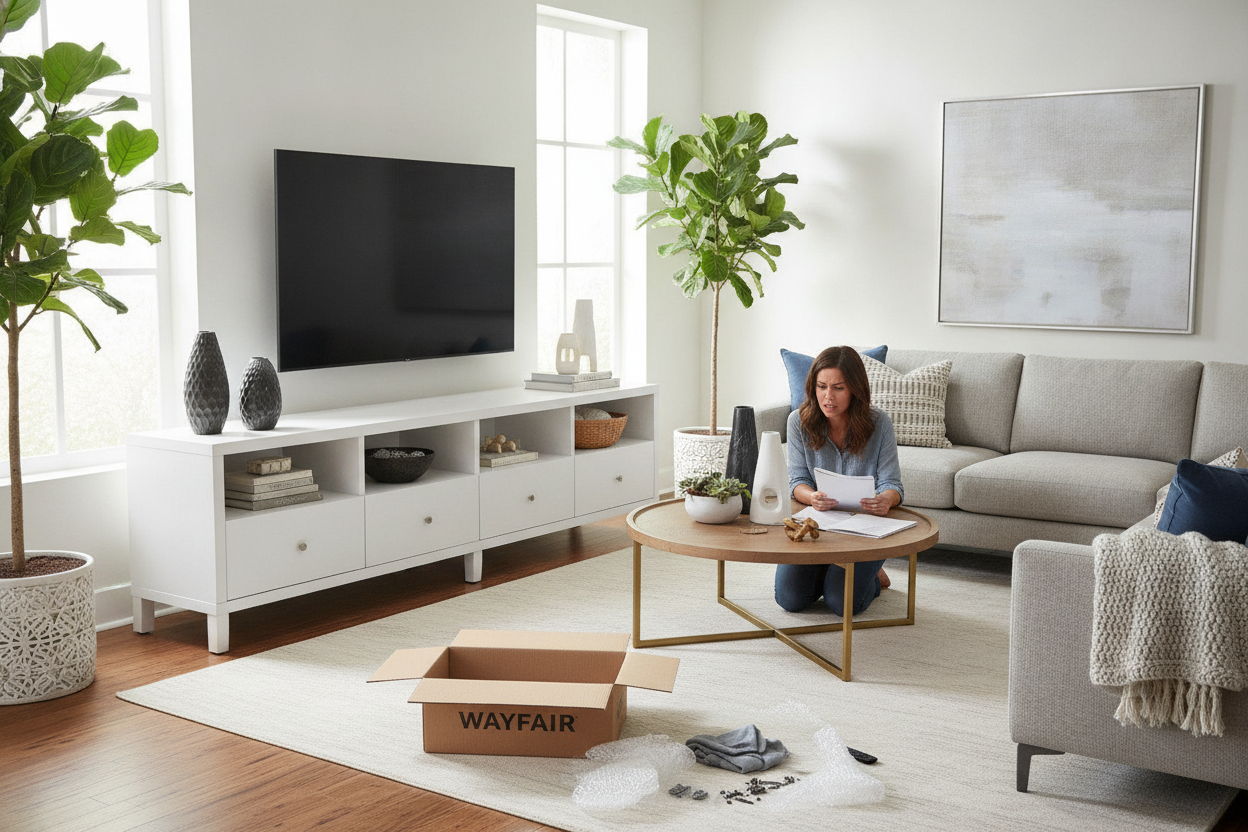
I spent three weeks staring at my new 75-inch TV sitting on a media console meant for a 50-inch screen. It looked ridiculous—like a giant mushroom or a bodybuilding champion who skipped every single leg day. It wasn't just an eyesore; it felt structurally precarious, like one accidental bump from the dog would send $900 of glass and pixels crashing to the floor.
That is how I found myself deep in the rabbit hole of searching for a wayfair 80 inch tv stand. After assembling three different units and returning two of them, I’ve learned exactly where these mass-produced pieces fail and where they actually punch above their weight class.
- Measure the base: Your TV's feet might be wider than you think.
- Center support is king: Never buy a long console without at least two middle legs.
- Weight capacity matters: Modern TVs are lighter, but a 100lb limit is the safety floor.
- Assembly is a two-person job: Handling an 80-inch top panel alone is a recipe for a snapped cam lock.
The 'Floating Mushroom' Problem
When your TV is almost as wide as the furniture it sits on, you create a visual 'top-heavy' nightmare. Designers call it the mushroom effect. It makes your living room feel cramped and the TV look like it’s just hovering there, waiting to tip. A massive screen needs visual 'grounding'—it needs a console that extends at least 5 to 8 inches past the edges of the frame.
If you can't find a stand wide enough to satisfy your eyes, you might want to pivot entirely. Some of my friends gave up on the wide-console look and went for a lifting TV cabinet instead. It hides the beast when it's not in use, which is a great move if you're trying to keep a formal living room feeling like a place for humans rather than a home theater.
Why I Settled on a Wayfair 80 Inch TV Stand
I looked at high-end showrooms where an 80-inch solid oak console costs more than my first car. Then I looked at the 'big box' stores where everything topped out at 60 inches. Wayfair occupies this weird, necessary middle ground. I spent hours hunting for TV stands that hit that magical 80-to-84-inch mark without requiring a second mortgage.
The filters are your best friend here. Don't just search for 'large.' Filter by '80 inches and wider' specifically. I found that once you cross the 75-inch threshold, the construction quality usually jumps up because manufacturers know they are supporting heavy, expensive tech. You start seeing more 'manufactured wood' (high-density MDF) rather than the flimsy hollow-core stuff found in cheaper, smaller units.
The Overhang Math You Can't Ignore
Here is the math that trips everyone up: A 75-inch TV is measured diagonally. Its actual physical width is usually around 65 or 66 inches. If you put that on a 70-inch stand, you only have two inches of clearance on either side. That looks crowded. An 80-inch stand gives you about 7 inches on each side, which is the 'sweet spot' for placing a small plant or a soundbar without it looking like a cluttered mess.
Two Specs to Check Before You Trust It With Your TV
The biggest mistake people make with flat-pack furniture is ignoring the 'legs' section of the specs. For an 80-inch span, you cannot rely on just four corner legs. Physics will win, and the center of your stand will bow within six months. Look for at least one, preferably two, adjustable center support legs. These are the unsung heroes that prevent the 'center sag' that ruins the look of your room.
You also need to check the top-shelf weight capacity. Even though a 75-inch LED might only weigh 65 lbs, you want a stand rated for at least 100 lbs. I always use the Grindle solid wood TV stand as my benchmark for structural integrity—if the stand you're looking at feels like it has half the bracing of a solid wood piece, keep looking. Sagging isn't just ugly; it makes doors and drawers stick.
Does Flat-Pack Actually Look Good in a Grown-Up Living Room?
Let's be real: it's not a custom heirloom. But modern veneers have come a long way. The textured 'wood-look' finishes on Wayfair's higher-end lines actually pass the 'touch test' from a distance. The key to making a massive 80-inch piece look 'grown-up' is cable management. If I see a tangle of black wires hanging behind an 80-inch console, the whole aesthetic is shot.
Look for units with pre-drilled holes and, ideally, 'clamshell' or 'flip-down' doors that hide the PlayStation and the router. Once it's assembled, take the time to master the layout by centering the stand on a rug that is wider than the console itself. If the rug is smaller than the stand, the whole thing looks like it's floating in space. My own setup had a 1-inch gap between the back and the wall for airflow, which I highly recommend if you’re running a hot receiver inside.
FAQ
How long does it take to assemble an 80-inch TV stand?
Budget at least two to three hours. These aren't just bookshelves; they have multiple support points, drawers, and heavy top panels. You will absolutely need a second person to help flip it over without snapping the legs.
Can I put an 85-inch TV on an 80-inch stand?
Technically, yes, if the feet fit. But it will look 'pinched.' The TV will overhang the edges of the furniture, which is the cardinal sin of living room design. Always try to have the stand be wider than the screen.
Is manufactured wood safe for a heavy TV?
Yes, provided it has center support legs. High-density MDF is actually very stable and won't warp like some cheap solid woods might, but it has zero structural integrity if it gets wet, so keep those coasters handy.


Dejar un comentario
Este sitio está protegido por hCaptcha y se aplican la Política de privacidad de hCaptcha y los Términos del servicio.