










I was sitting on my floor eating takeout when I noticed it: my 55-inch TV was literally bowing the top shelf of my media console. I had bought that stand for $45 back in college, and five years later, the particle board was tired. It was peeling at the corners, and the 'espresso' finish was basically just contact paper. I realized then that I couldn't keep living like a student. I needed something that didn't wobble when a heavy cat walked past it.
Quick Takeaways
- Avoid paper-thin laminate; look for real wood veneers or solid wood legs for longevity.
- Check the depth of your equipment—modern 'slim' consoles often won't fit a standard AV receiver.
- Cable management is the difference between a 'home' and a 'dorm.'
- Measure your eye level from the sofa before you buy; most people mount or place TVs too high.
The Day I Realized My Living Room Was Embarrassing
The moment of clarity usually happens when you actually look at your furniture instead of the screen. For me, it was seeing a visible dip in the center of my console. I spent three hours that night asking where can i find tv stands that actually have some soul? I wanted to find actually cool TV stands that didn't look like they came out of a flat-pack box with a hex key that strips after three turns.
My biggest mistake was thinking 'cheap' meant 'good value.' It doesn't. That $40 stand lasted two moves before the screws started falling out of the sawdust frame. If you're at the point where you're tired of seeing messy cords and sagging shelves, you're ready for the 'adult' tier of furniture. It’s that sweet spot where you spend enough to get quality, but not so much that you're shopping at high-end boutiques where everything is 'price upon request.'
Okay, So Where Can I Find TV Stands That Actually Last?
When you start asking where to get tv stands, you'll find a lot of noise. Big-box retailers are great for budget stuff, but if you want something that survives a move, you have to look at the materials list. Skip anything that says 'engineered wood with paper laminate.' You want 'solid wood' or 'high-grade MDF with real wood veneer.' The latter is actually better for some designs because it doesn't warp as easily with heat from your electronics.
I’ve found that the best places to look are mid-market online retailers who specialize in 'attainable' design. They focus on the details that matter—like soft-close hinges and cord cutouts—without the markup of a designer showroom. You want a piece that feels heavy. If the shipping weight is 30 pounds for a 60-inch stand, run away. A real piece of furniture should have some heft to it.
The 'Elevated Basics' Tier
If you just want something clean that hides your mess, this is your zone. I’m a huge fan of pieces that prioritize storage over 'open shelving' which just becomes a dust magnet. A modern TV stand with cabinets is the gold standard here. It lets you shove your remotes, controllers, and manuals into a drawer so your living room doesn't look like a Best Buy clearance aisle.
Look for hardware that isn't plastic. Metal pulls and sturdy legs make a massive difference in how the piece feels day-to-day. I once bought a stand with plastic handles that snapped off within a month. Never again. Go for pieces with adjustable interior shelves so you can actually fit that oversized PlayStation or Xbox without swearing at the instruction manual.
The 'Secretly High-End' Mid-Century Look
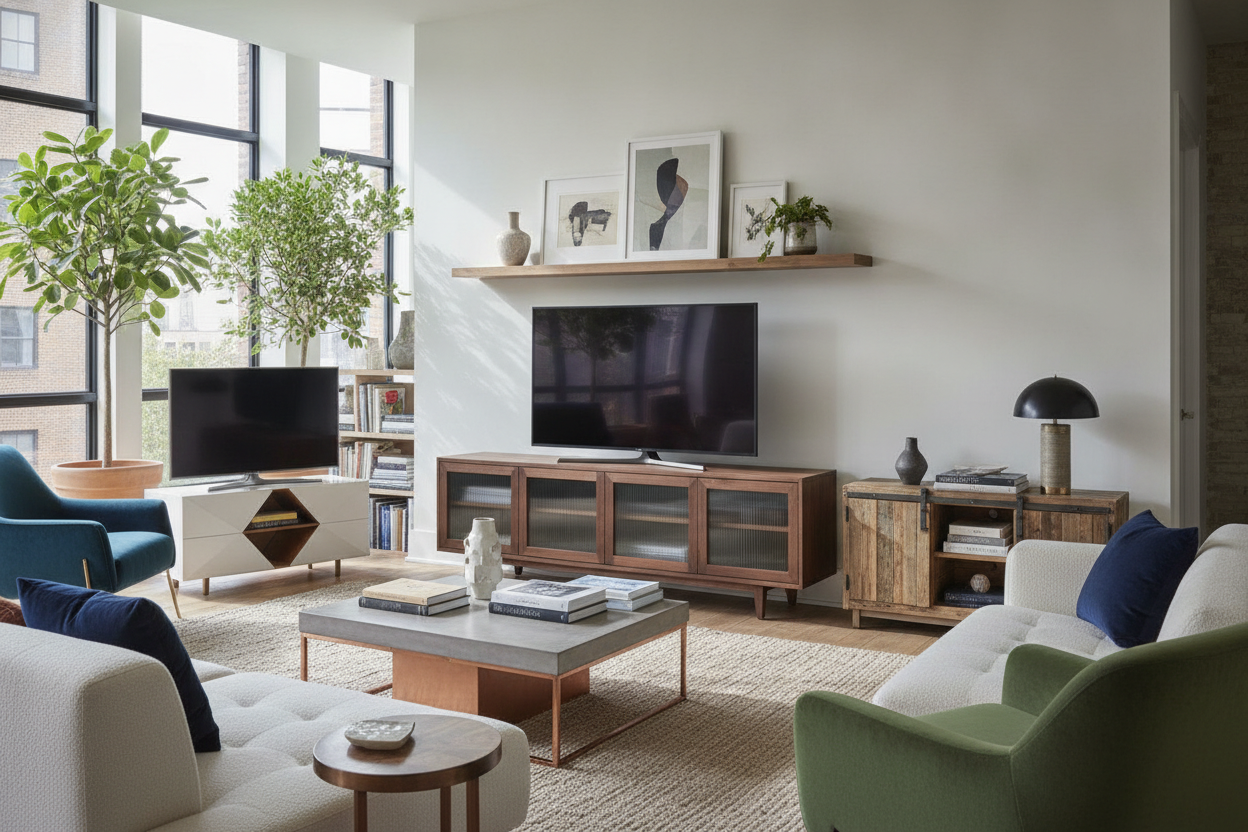
We all love the mid-century vibe, but you don't need to scour vintage shops for a 1960s sideboard that smells like old cigarettes. You can find mid-century designs with slatted doors that give you that architectural look while being built for modern tech. Slatted doors are a secret weapon—they allow your remote signals (IR) to pass through even when the doors are closed, and they keep your gear ventilated.
This style instantly makes a room feel more intentional. It's about the silhouette. Tapered legs lift the piece off the ground, which makes a small apartment feel bigger because you can see more of the floor. It’s a design trick that works every single time. Plus, real wood slats catch the light in a way that flat laminate never will.
Where to Get TV Stands If You Have Huge Equipment
If you're an audiophile or a serious gamer, the 'pretty' stands often fail you. I learned this the hard way when I tried to put a 40-pound receiver on a shelf that had a weight limit of 15 pounds. It didn't end well. You need to look for deep and sturdy TV stands specifically designed for heavy-duty use. Most standard consoles are 15 to 16 inches deep; if you have a high-end receiver, you might need 18 to 20 inches once you factor in the cables sticking out the back.
Ventilation is the other big one. Electronics die in small, unventilated boxes. If you have a console or a receiver, you need airflow. Look for stands with open backs or specifically drilled ventilation holes. I’ve seen people fry $500 receivers because they tucked them into a beautiful, airtight cabinet. Don't be that person. Real equipment needs room to breathe, and quality stands will account for that.
Stop Googling 'Where to Find TV Stands' and Do This First
Before you hit 'add to cart' on that 70-inch beauty, get your measuring tape out. The biggest mistake people make is buying a stand that is the exact same width as their TV. It looks terrible. You want at least 3-5 inches of breathing room on either side of the screen. It balances the visual weight of the room. Also, check your eye level. If you're sitting on your sofa, your eyes should hit the middle of the screen. If you're looking up, you're going to have neck pain by next Tuesday.
Set a realistic budget. If you want something that isn't dorm furniture, you're looking at the $300 to $800 range. Anything less is usually the same particle board you're trying to escape. Once you have your measurements, look for options that don't look cheap by checking the close-up photos of the grain and the joints. Real furniture is an investment in your sanity and your space. Stop settling for stuff that sags.
FAQ
How wide should my TV stand be?
Ideally, your stand should be at least 20% wider than your TV. This prevents the 'top-heavy' look and gives you space for a small lamp or a plant without crowding the screen.
Can I put a TV on a stand that is smaller than the base?
Absolutely not. It’s a major safety hazard, and it looks like you’re still living in your first dorm room. Always ensure the feet of the TV sit fully and securely on the surface of the stand.
What is the best material for a TV stand?
Solid wood is the most durable, but high-quality MDF with a thick wood veneer is actually excellent for media consoles because it handles the heat from electronics without warping or cracking like solid wood sometimes can.

Dejar un comentario
Este sitio está protegido por hCaptcha y se aplican la Política de privacidad de hCaptcha y los Términos del servicio.